C’mon… we’re better than this
Advertisement
Read this article for free:
or
Already have an account? Log in here »
To continue reading, please subscribe:

Digital Subscription
One year of digital access for only $205*
- Enjoy unlimited reading on winnipegfreepress.com
- Read the E-Edition, our digital replica newspaper
- Access News Break, our award-winning app
- Play interactive puzzles
*First annual payment billed as $205.00 + GST for one year. This annual subscription will automatically renew at $233.00 + GST every 52 weeks (10% off the regular annual price of $259.35). Offer available to new and qualified returning subscribers only. Cancel any time.
To continue reading, please subscribe:
Add Free Press access to your Brandon Sun subscription for only an additional
$1 for the first 4 weeks*
- Enjoy unlimited reading on winnipegfreepress.com
- Read the E-Edition, our digital replica newspaper
- Access News Break, our award-winning app
- Play interactive puzzles
*Your next Brandon Sun subscription payment will increase by $1.00 and you will be charged $17.95 plus GST for four weeks. After four weeks, your payment will increase to $24.95 plus GST every four weeks.
Read unlimited articles for free today:
or
Already have an account? Log in here »
Hey there, time traveller!
This article was published 12/05/2017 (3405 days ago), so information in it may no longer be current.
A pull quote on a poster announces that The Belko Experiment is “Office Space meets Battle Royale.” That’s not praise so much as a declaration of fact. Since the 2000 Japanese film about teens forced to kill each other in a government-sanctioned murder game, there has been many a riff on that cult classic — The Condemned, The Tournament and, most notably and similarly, The Hunger Games. It’s a story format with which we’ve become familiar: Unwitting civilians are placed in a controlled environment where they are compelled by a Big Brother type to kill each other or be killed themselves. The variable is always the “why.”
In The Belko Experiment, the “why” turns out to be social science, much like the 1961 Stanley Milgram experiment on obedience to authority figures, which explored individual willingness to go against personal moral conscience in obeying commands. The Belko Experiment, written by Guardians of the Galaxy helmer James Gunn, is an extreme, gory and extremely violent take on research of that kind.
Director Greg McLean, best known for Aussie horror flick Wolf Creek, is a member of the unofficial group the “Splat Pack,” so named by Alan Jones in Total Film Magazine: It’s a group of horror directors who, in the early 2000s, gained notoriety for their brutal, torturously violent horror films. While a few of those directors have branched out to other genres (Saw director James Wan is directing Aquaman), McLean stays close to his roots with the dark and bloody The Belko Experiment.
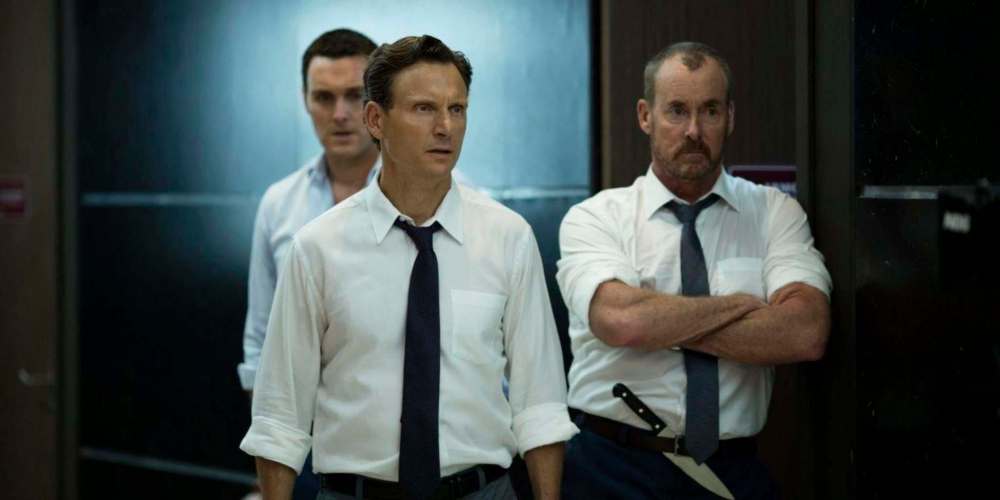
The film finds a group of 80 employees, mostly American, working at a Colombian recruiting firm. There are the standard office friendships, tensions and romances, all of which are thrown into stark relief when impenetrable metal shutters come down and an ominous voice comes over a loudspeaker, instructing the group to kill each other or be killed themselves. The “game,” if you will, involves impossible ethical questions about whether or not to kill a certain number of innocent people in order to save a larger group of innocent people.
No one here is getting saved, though. Mike (John Gallagher Jr.) is the first to pick up on that. His boss, Barry (Tony Goldwyn), insists on following the instructions, out of some deference to authority or hope that the ominous voice might actually let them survive. His actions unleash a torrent of violent chaos in the building, as the employees descend into savage barbarism.
Despite cutesy Spanish-language covers of American songs playing on the radio, the proceedings are relentlessly grim and violent. The sadism enacted on screen is directed at the audience, battering us with horrific, deadening images. McLean takes splat to a whole new level, and soon every surface is slick with blood.

Most of these Battle Royale tributes aren’t contained to a single location — they take place outside, so there are opportunities for suspense and individual confrontations that truly draw out the essential, intimate nature of this terrible exercise. Confined to this sterile office space, The Belko Experiment descends into a meaningless orgy of murder. By the end of the film, you’re left with the unshakable feeling that everyone involved, from actors to filmmakers to audience, is, and should have been, better than material like this.
— Tribune News Service
Movie review

The Belko Experiment
Starring John Gallagher Jr. and Tony Goldwyn
Towne
18A
96 minutes
2 stars out of five
Other voices
It could have used a few more weeks on the drafting table, to sharpen its ideas and give it priorities other than gore.
— Tasha Robinson, The Verge
The unsatisfying result of all the berserk paranoia is predictable.Talk about a take-no-prisoners plot.
— Rex Reed, New York Observer
You may think of Dilbert one minute, the Nuremberg defence the next. No, really.
— A.A. Dowd, AV Club
While it’s hardly a work of groundbreaking originality, it’s a heck of a lot more fun than the majority of horror films churned out at the moment.
— Benjamin Lee, Guardian
Advertisement Advertise With Us
Advertisement Advertise With Us