

The Civil War goes gothic
Director Coppola's feel for women's stories shines in adaptation
Advertisement
Read this article for free:
or
Already have an account? Log in here »
To continue reading, please subscribe:
Monthly Digital Subscription
$0 for the first 4 weeks*
- Enjoy unlimited reading on winnipegfreepress.com
- Read the E-Edition, our digital replica newspaper
- Access News Break, our award-winning app
- Play interactive puzzles
*No charge for 4 weeks then price increases to the regular rate of $19.95 plus GST every four weeks. Offer available to new and qualified returning subscribers only. Cancel any time.
Monthly Digital Subscription
$4.99/week*
- Enjoy unlimited reading on winnipegfreepress.com
- Read the E-Edition, our digital replica newspaper
- Access News Break, our award-winning app
- Play interactive puzzles
*Billed as $19.95 plus GST every four weeks. Cancel any time.
To continue reading, please subscribe:
Add Free Press access to your Brandon Sun subscription for only an additional
$1 for the first 4 weeks*
*Your next subscription payment will increase by $1.00 and you will be charged $16.99 plus GST for four weeks. After four weeks, your payment will increase to $23.99 plus GST every four weeks.
Read unlimited articles for free today:
or
Already have an account? Log in here »
Hey there, time traveller!
This article was published 30/06/2017 (3117 days ago), so information in it may no longer be current.
Although it unfolds in and around a Virginia boarding school in 1864, a year before the end of the Civil War, Sofia Coppola’s The Beguiled has some of the spooky, suggestive magic of a fairy tale.
The opening shot could be of an ancient grove at the witching hour, the chatter of cicadas merging with the sound of a young girl humming as she strolls past trees draped in mist and moss. Kneeling to pick a few mushrooms for supper, young Amy (Oona Laurence) is startled to find a man at the base of an oak, as if he had materialized out of thin air.
The man is John McBurney (Colin Farrell), an Irish mercenary who has deserted his Union army post after a severe leg injury. Frightened but intrigued, Amy guides McBurney to the Miss Martha Farnsworth Seminary for Young Ladies, where she and four other students are waiting out the war with French lessons and needlepoint under the eye of their headmistress, Miss Martha (Nicole Kidman), and teacher, Edwina (Kirsten Dunst).
Miss Martha is initially scandalized by the Yankee’s presence. But rather than turn him over to Confederate troops, she is moved by some impulse — call it Southern hospitality, Christian compassion or something less pure of heart — to nurse the handsome stranger back to health. The other women meekly but excitedly concur, by which point it’s clear the eerie supernatural portents seeded at the outset have already taken root.
Adapted by Coppola from Thomas Cullinan’s 1966 Southern gothic novel, The Beguiled soon weaves its own hushed, intoxicating spell. The precision of her technique is plain to see in the shadowy spareness of the plantation setting, the delicate cut of the women’s lacy dresses and, above all, the flickering candlelight in the movie’s ravishing nighttime images, shot on richly muted 35-millimetre film by Philippe Le Sourd.
But there is more to Coppola’s moody sorcery than an eye for fine embroidery and antebellum real estate. Lost in Translation, Marie Antoinette and Somewhere established the director as a quietly meticulous observer of individuals in enclosed environments. Here she again displays patience and intuition, letting the story rise and fall on the subtlest shifts in emotional temperature.
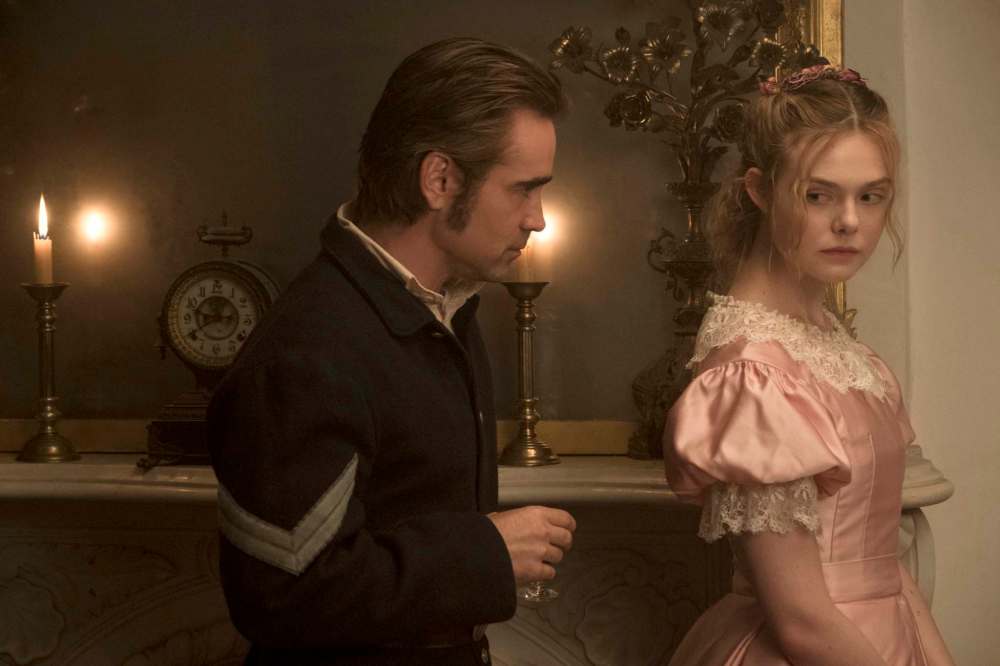
McBurney, laid up with a bad leg but otherwise functioning lower-body appendages, is properly beguiled by the lovely ladies. What soldier in his position would not be? But Coppola is more interested in the women’s own beguilement, and how McBurney, with more instinct than calculation, manipulates their sympathies and repressed desires.
There is the childish curiosity of Amy and Marie (adorable Addison Riecke), as well as the teenage lust of Alicia (Elle Fanning). Alicia’s single-minded pursuit of McBurney stands in stark contrast to the sadness and diffidence that clings to Edwina, whom Dunst, Coppola’s most reliable muse, plays with piercing vulnerability. Not to be counted out is Miss Martha, whose sense of propriety is undergirded with glimmers of warmth and mischief in Kidman’s delicious performance. The movie’s most memorable scene finds her bathing McBurney as he sleeps, her scrubbing motions becoming more hesitant the farther south she goes.
The duelling impulses at play in that moment — the way Coppola teasingly acknowledges the humour of the situation, even as she treats female desire with complete seriousness — are a testament to her control in a story that might have gone the way of The Bacchae or a Monty Python sketch. No virgins get spanked, but Coppola and her actors aren’t afraid to nudge their story gently and occasionally in the direction of camp, particularly in a dinner scene in which each girl, trying to impress McBurney, boasts about her contribution to that evening’s dessert. “Hope you like apple pie!” winks Alicia. (He does.)
On the surface, The Beguiled roughly follows the narrative trajectory of Don Siegel’s enjoyably pulpy 1971 adaptation, which starred Clint Eastwood and Geraldine Page. It’s another violent parable about the dark side of desire, in which a man fancies himself a fox but soon learns he’s landed in the wrong henhouse.
Coppola’s film — less a remake of Siegel’s than a repositioning of the original text — makes McBurney more sympathetic (the tender-eyed Farrell has little of Eastwood’s macho snarl) even as it grants the women the moral high ground. The fascination and at times the frustration of her achievement is that she’s drained away some of the story’s juiciest elements: a spot of incest, a violent ambush and a grisly surgical operation.
There is compromise in all this narrative subtraction, but there is also purpose. Her most troubling decision, to judge by the criticisms that have arisen in recent days, is the excision of a character: Hallie, a slave girl who figures significantly in both Cullinan’s novel and Siegel’s movie.
Coppola’s film might well have been more compelling had she left that thread of Cullinan’s story intact. (Mae Mercer’s superb performance as Hallie in the 1971 film suggests as much.) But what others will decry as a failure of sensitivity on her part is better understood, I think, as an assertion of humility, rooted in a deeper knowledge of her own limitations than her critics realize.
After seeing The Beguiled, you may well claim that Coppola misses the bigger picture, though it might be fairer to say that she sees the beauty in the smaller one.
— Los Angeles Times
Movie review

The Beguiled
Starring Colin Farrell, Nicole Kidman and Kirsten Dunst
Grant Park
14A
93 minutes
★★★ 1/2 stars out of five
Other voices
Each frame of The Beguiled is a wonder to look at, from the candle-lit dinner-time conferences to the angelic portraits of John, who’s frequently bathed in heavenly light.
— David Sims, The Atlantic
Strip away the dread and much of the menace from this tale of sexual betrayal and revenge, and it’s an Austen-with-a-drawl comedy-of-manners, utterly missing the point.
— Roger Moore, Movie Nation
Coppola gets at thorny and complex ideas about how expectations of female gentility poison female sexuality and cause these women to experience desire as sickness.
— Charles Taylor, Newsweek
Beguiled is less a hothouse flower than a bonsai garden, a work of cool, exquisite artifice that evokes wildness on a small, controlled scale.
— A.O. Scott, New York Times
The performances are engrossing, particularly Kidman’s: she disappears into the distant primness of Ms. Farnsworth. The costumes are exquisite and the Southern setting atmospheric and beautiful.
— Sandy Cohen, The Associated Press
Advertisement Advertise With Us
Advertisement Advertise With Us