A different kind of cowboy
Art-house western bucks genre norms in all of the right ways

Advertisement
Read this article for free:
or
Already have an account? Log in here »
To continue reading, please subscribe:

Digital Subscription
One year of digital access for only $205*
- Enjoy unlimited reading on winnipegfreepress.com
- Read the E-Edition, our digital replica newspaper
- Access News Break, our award-winning app
- Play interactive puzzles
*First annual payment billed as $205.00 + GST for one year. This annual subscription will automatically renew at $233.00 + GST every 52 weeks (10% off the regular annual price of $259.35). Offer available to new and qualified returning subscribers only. Cancel any time.
To continue reading, please subscribe:
Add Free Press access to your Brandon Sun subscription for only an additional
$1 for the first 4 weeks*
- Enjoy unlimited reading on winnipegfreepress.com
- Read the E-Edition, our digital replica newspaper
- Access News Break, our award-winning app
- Play interactive puzzles
*Your next Brandon Sun subscription payment will increase by $1.00 and you will be charged $17.95 plus GST for four weeks. After four weeks, your payment will increase to $24.95 plus GST every four weeks.
Read unlimited articles for free today:
or
Already have an account? Log in here »
Hey there, time traveller!
This article was published 01/08/2018 (2991 days ago), so information in it may no longer be current.
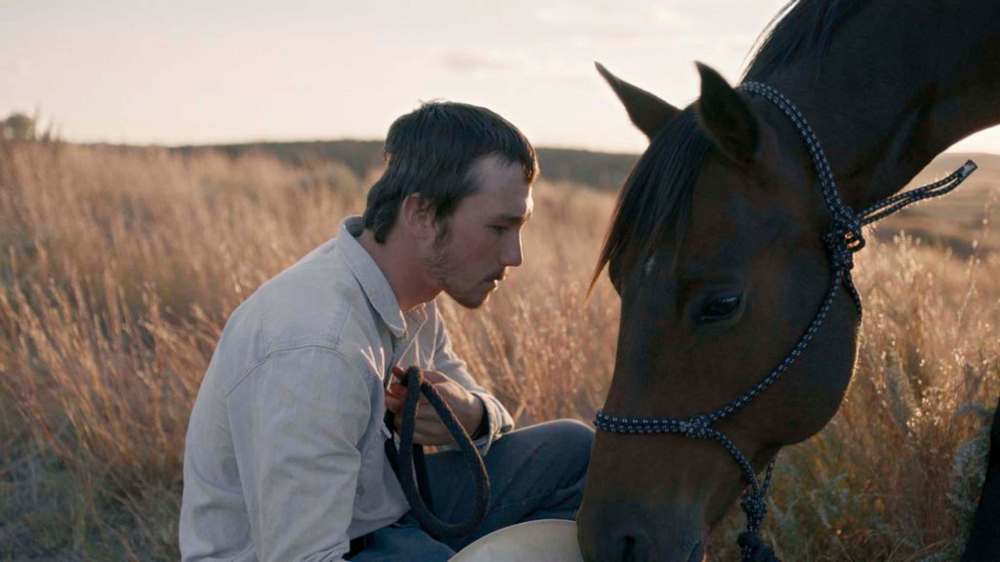
Reticent and rough-edged, this art-house neo-Western features Brady Jandreau, a real-life cowboy from the Oglala Lakota Pine Ridge First Nation in South Dakota, playing a version of himself.
A young rodeo star who has sustained a severe head injury in a bronc-riding accident, Brady must redefine his sense of identity after being told he can’t risk another bad fall.
Beijing-born filmmaker Chloé Zhao (Songs My Brother Taught Me), who financed this low-budget drama on her credit cards, favours a documentary-style approach, relying on the slow, patient observation of her non-professional cast.
This is a purposefully reticent film, its plain and functional dialogue not even reaching the usual laconic level of cinematic cowboy talk.
The poetry comes from a heightened apprehension of the wide-open South Dakota landscape — captured by cinematographer Joshua James Richards — and a deep understanding of the relationships between humans and animals.
Brady lives in a trailer with his father (played by the actor’s actual father, Tim Jandreau), who alternates between tough love and drunken meanness, and his 15-year-old sister (played by his real-life sister, Lilly Jandreau). Lilly, who is autistic, is the one chatty character in the film, sometimes singing lovely little songs she composes in the moment.
The film opens on a scene of Brady taking medical staples out of his head with a pocketknife. He lives in a community where the phrase “cowboy up” means swallowing the pain and getting on with things. But as he later tells a friend, “A brain is a little different from cracked ribs.”
Brady tries working at a grocery mart — just until he “heals up,” he tells people — but you can still see the imprint of his cowboy hat along the back of his hair.
Struggling with the side-effects of his fall and not sure whether he’ll ever be able to return to his old life, he’s left to figure out what it means to be a man if he can’t be a rodeo rider.
This is not the usual cowboy quest, which is exactly The Rider’s point.
Scenes of Brady working with horses are extraordinary, offering the pure cinematic pleasure of watching someone do something they are very good at. (And these are sequences that couldn’t possibly be replicated by a Hollywood star, no matter how good he might look in his Wranglers.) Brady possesses deep-down knowledge and skill, but also something else that goes beyond that — “the touch,” as one character calls it.
Zhao’s touch is sometimes less certain. She hasn’t quite developed the delicacy or precision of Kelly Reichardt, another indie director interested in deconstructing the myths of the American West.
But she has crafted something that feels unusual and urgent.
Scenes in which Brady visits his profoundly injured friend, Lane (played by Lane Scott, a bull rider who is now unable to walk or talk), have a heartrending realness to them. Working together, Scott, Jandreau and Zhao break down the iconic image of the cowboy and build it back up again.
These characters are reaching toward a different vision of manhood, realizing there are different ways to be strong, different ways to be brave.
For a story in which emotions are tamped down and shunted, The Rider finds a moving and difficult power.
alison.gillmor@freepress.mb.ca
Studying at the University of Winnipeg and later Toronto’s York University, Alison Gillmor planned to become an art historian. She ended up catching the journalism bug when she started as visual arts reviewer at the Winnipeg Free Press in 1992.
Our newsroom depends on a growing audience of readers to power our journalism. If you are not a paid reader, please consider becoming a subscriber.
Our newsroom depends on its audience of readers to power our journalism. Thank you for your support.
Movie review
The Rider
Starring Brady Jandreau
Cinematheque
14A
104 minutes
Four stars out of five
Other voices
Classic westerns may never go out of style, but sometimes it’s good to see a movie about a cowboy who’s a full-fledged human and not a type.you
— Colin Covert, Minneapolis Star Tribune
You can almost feel the wind and smell the dust of the South Dakota plains, so deeply is Chloé Zhao’s new film steeped in the reality of its environment.
— Peter Howell, Toronto Star
The Rider reinvigorates tropes from the western genre of men, horses, honour codes and vast expanses of nature with a refreshing lack of sentimentality, without sacrificing their inherent lyricism and poetry.
— Ann Hornaday, Washington Post
Beautifully captures the way a handful of people stoically deal with the meagre hands life has dealt them.
— Todd McCarthy, Hollywood Reporter
The Rider comes as close to a spiritual experience as anything I’ve encountered in a movie theatre this year.
— Justin Chang, Los Angeles Times
Studying at the University of Winnipeg and later Toronto’s York University, Alison Gillmor planned to become an art historian. She ended up catching the journalism bug when she started as visual arts reviewer at the Winnipeg Free Press in 1992.
Our newsroom depends on a growing audience of readers to power our journalism. If you are not a paid reader, please consider becoming a subscriber.
Our newsroom depends on its audience of readers to power our journalism. Thank you for your support.
Advertisement Advertise With Us
Advertisement Advertise With Us
History
Updated on Wednesday, August 1, 2018 6:54 AM CDT: Photo added.