Intimate look at violin virtuoso’s life
Documentary follows Perlman around New York
Advertisement
Read this article for free:
or
Already have an account? Log in here »
To continue reading, please subscribe:

Digital Subscription
One year of digital access for only $205*
- Enjoy unlimited reading on winnipegfreepress.com
- Read the E-Edition, our digital replica newspaper
- Access News Break, our award-winning app
- Play interactive puzzles
*First annual payment billed as $205.00 + GST for one year. This annual subscription will automatically renew at $233.00 + GST every 52 weeks (10% off the regular annual price of $259.35). Offer available to new and qualified returning subscribers only. Cancel any time.
To continue reading, please subscribe:
Add Free Press access to your Brandon Sun subscription for only an additional
$1 for the first 4 weeks*
- Enjoy unlimited reading on winnipegfreepress.com
- Read the E-Edition, our digital replica newspaper
- Access News Break, our award-winning app
- Play interactive puzzles
*Your next Brandon Sun subscription payment will increase by $1.00 and you will be charged $17.95 plus GST for four weeks. After four weeks, your payment will increase to $24.95 plus GST every four weeks.
Read unlimited articles for free today:
or
Already have an account? Log in here »
Hey there, time traveller!
This article was published 03/08/2018 (2989 days ago), so information in it may no longer be current.
Itzhak is a warm, engaging documentary about the life of the violinist Itzhak Perlman, presenting both his daily life and his origins.
It’s an interesting story of a consummate talent, but the biggest advantage the documentary has, just as a piece of entertainment, is Perlman, who is unaffected and likable. So the movie is a chance to hang out with a great guy, who is also a great musician.
The movie begins with Perlman at Citi Field in New York, preparing to play the national anthem at a Mets game.
Right away that tells you the kind of New Yorker he is — not an obnoxious, superior Yankees fan, but a friendly, down-to-earth Mets fan. We see him playing with Billy Joel and later with pianist Martha Argerich. We are present when he brings his Stradivarius violin in for a checkup. (He bought it many years ago and claims he is still paying for it.) And we see him navigating icy New York streets in his motorized wheelchair.
The Israeli-born Perlman contracted polio when he was 4 years old. He wears leg braces and can walk with the aid of crutches.
Most people who know anything about him know this, but what they don’t know — though, in retrospect, it probably shouldn’t come as a surprise — is that his rise as a violinist was somewhat hampered by his disability.
He was clearly a prodigy from an early age, but it took a while for him to be accepted at Juilliard and for people in the musical establishment to realize that he could have a great career.
An appearance on The Ed Sullivan Show, when he was 13, helped advance his case.
Director Alison Chernick uses a fly-on-the-wall technique to show Perlman’s daily life, and although he never seems completely to forget the presence of the camera, we come away with a sense of Perlman’s loving and mutually supportive marriage to fellow musician Toby Perlman, and their domestic life in New York.
We see him cooking and discussing art with a friend, the actor Alan Alda. And we see him teaching, something that he says has contributed to his own growth as an artist.
It seems like a satisfying life. Over the course of the film he meets two heads of state, Benjamin Netanyahu of Israel and then-U.S.-president Barack Obama.
And he seems to enjoy the experience of being Itzhak Perlman, which is only fair, since everyone else is enjoying him, too.
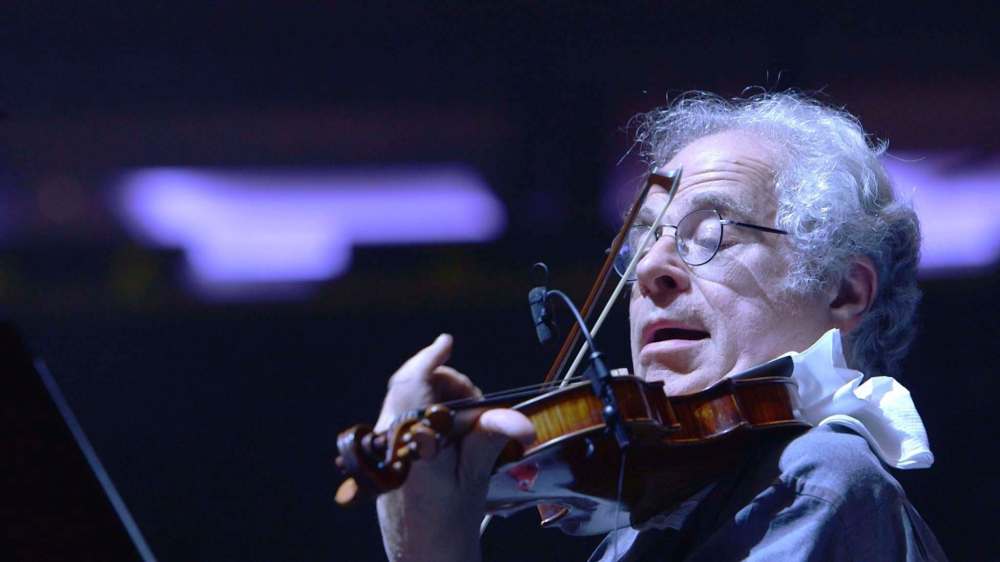
Over the course of the film, there is lots of opportunity for viewers to hear him play, both in recent performances and archival footage.
Itzhak is ideal for Perlman fans, but it’s also persuasive enough to create new fans.
It’s just impossible not to like this guy.
— San Francisco Chronicle