Movie pushes environmental message
Kayak to Klemtu a protest against supertankers, pipelines in First Nations territories

Advertisement
Read this article for free:
or
Already have an account? Log in here »
To continue reading, please subscribe:

Digital Subscription
One year of digital access for only $205*
- Enjoy unlimited reading on winnipegfreepress.com
- Read the E-Edition, our digital replica newspaper
- Access News Break, our award-winning app
- Play interactive puzzles
*First annual payment billed as $205.00 + GST for one year. This annual subscription will automatically renew at $233.00 + GST every 52 weeks (10% off the regular annual price of $259.35). Offer available to new and qualified returning subscribers only. Cancel any time.
To continue reading, please subscribe:
Add Free Press access to your Brandon Sun subscription for only an additional
$1 for the first 4 weeks*
- Enjoy unlimited reading on winnipegfreepress.com
- Read the E-Edition, our digital replica newspaper
- Access News Break, our award-winning app
- Play interactive puzzles
*Your next Brandon Sun subscription payment will increase by $1.00 and you will be charged $17.95 plus GST for four weeks. After four weeks, your payment will increase to $24.95 plus GST every four weeks.
Read unlimited articles for free today:
or
Already have an account? Log in here »
Hey there, time traveller!
This article was published 11/08/2018 (2970 days ago), so information in it may no longer be current.
This British Columbia-set dramedy, from Heiltsuk/Mohawk filmmaker Zoe Hopkins (Mohawk Midnight Runners), functions better as a straight-up message movie than as cinematic storytelling.
Kayak to Klemtu’s purpose is urgent and important. Hopkins is protesting the presence of oil supertankers and pipelines in the irreplaceable ecosystems and traditional First Nations territories along the B.C. coastline.
Unfortunately, this heartfelt cinematic activism is expressed through a stiff storyline and formulaic characters. When 14-year-old Ella (played by promising newcomer Ta’Kaiya Blaney) undertakes a 520-kilometre kayak trip from Vancouver, where she lives with her mother, to Klemtu, her family’s home community, the journey is breathtakingly beautiful but narratively flat.
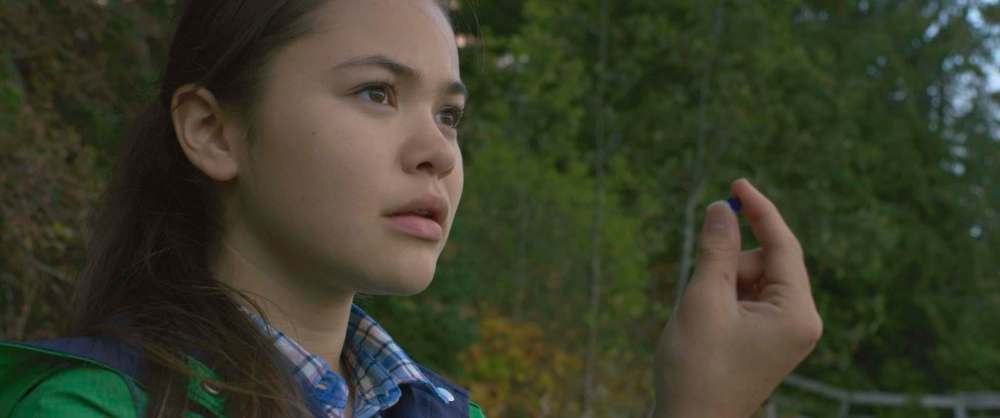
Ella wants to honour her late Uncle Bear (Evan Adams) by travelling through the waters that meant so much to him and testifying, in his place, at environmental hearings being held in Klemtu. But she can’t do it alone.
Ella’s mother (Sarah Kelley) insists she take her cranky Uncle Don (Lorne Cardinal), who hopes to reconnect with his Klemtu-based teenaged son, as well as her Aunt Cory (Sonja Bennett), who still hasn’t fully grieved for her dead husband. “We don’t cry,” she tells her son Alex (Jared Ager-Foster), which seems like a bad family motto.
Alex just wants to leave the big city and return to Klemtu, where he spent half his life and feels most at home.
This is the kind of basic plot summary that’s common in movie reviews, but the film itself doesn’t go much beyond this bare-bones outline.
The script sets out one emotional issue for each character, along with a little light comedy.
Cory is hopeless at kayaking and camping, for example, and makes the greenhorn mistake of eating red-tide oysters, resulting in some intestinal-trouble jokes.
Don and Cory also do a comedy double-act in the tandem kayak. (Evidently, tandems are often called “divorce boats,” for good reason.)
Much of the dialogue is clunky, but the cast is solid, and when everyone is complaining, joshing, bickering and making up, as family members do, they find some moments of realness.
Cardinal, in particular, works that Corner Gas comic timing, going on rants about environmentalists — “drinking their bean juice at $7 a glass and breastfeeding their kids until they’re nine,” he rails.
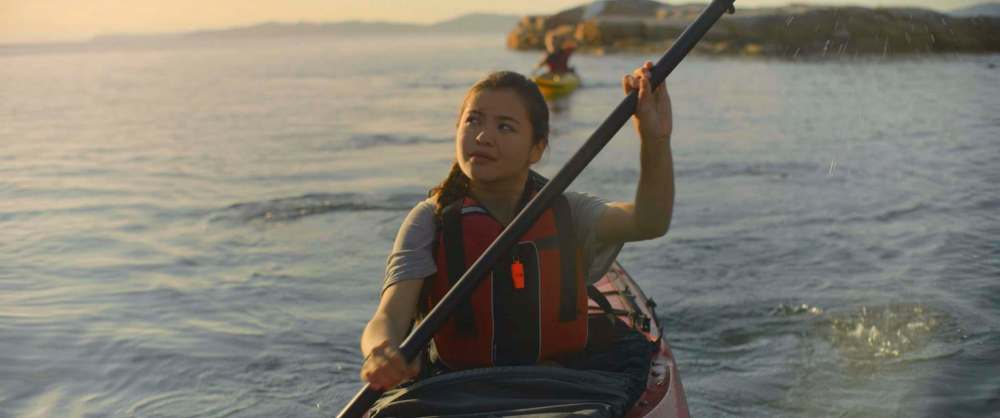

He is initially reluctant to go on the trip but feels compelled by his late brother’s final request. “Dying wishes and all that,” he sighs in mock complaint. “Geez.”
As played by the very able Blaney, Ella is determined and composed and one wishes she had more to do. The conflicts and obstacles along the way feel contrived and although Ella frets about making her speech, the film’s conclusion is never in doubt.
Still, predictable as the ending might be, there is a touching sweetness to the final scenes.
And the film’s depressing real-world postscript — news of a disastrous diesel spill near Bella Bella, B.C., in 2017, just after filming wrapped up — proves Kayak to Klemtu’s message is, unfortunately, very topical.
alison.gillmor@freepress.mb.ca
Studying at the University of Winnipeg and later Toronto’s York University, Alison Gillmor planned to become an art historian. She ended up catching the journalism bug when she started as visual arts reviewer at the Winnipeg Free Press in 1992.
Our newsroom depends on a growing audience of readers to power our journalism. If you are not a paid reader, please consider becoming a subscriber.
Our newsroom depends on its audience of readers to power our journalism. Thank you for your support.
Movie review
Kayak to Klemtu
Starring Ta’Kaiya Blaney and Lorne Cardinal
● Cinematheque
● PG ● 91 minutes
★★★ out of five
It is a journey from A to B, storytelling 101 — a soulful gesture free of artifice and grandiosity. That it comes with activism attached is not a bonus, but its very point.
— Brad Wheeler, Globe and Mail
(Ta’Kaiya) Blaney brings genuine conviction to her role, and visits from whales and seals add to the adventure — and is that a spirit bear we see?
— Peter Howell, Toronto Star
It moves along well enough and younger viewers should respond to Ella’s arc, but grown-ups will quickly realize the movie they’re watching should be a lot better than it is.
— Norman Wilner, NOW Toronto
Studying at the University of Winnipeg and later Toronto’s York University, Alison Gillmor planned to become an art historian. She ended up catching the journalism bug when she started as visual arts reviewer at the Winnipeg Free Press in 1992.
Our newsroom depends on a growing audience of readers to power our journalism. If you are not a paid reader, please consider becoming a subscriber.
Our newsroom depends on its audience of readers to power our journalism. Thank you for your support.
Advertisement Advertise With Us
Advertisement Advertise With Us