Scenes from a literary marriage
Glenn Close delivers captivating performance as devoted spouse

Advertisement
Read this article for free:
or
Already have an account? Log in here »
To continue reading, please subscribe:
Digital Subscription
One year of digital access for only $1.44 a week*
- Enjoy unlimited reading on winnipegfreepress.com
- Read the E-Edition, our digital replica newspaper
- Access News Break, our award-winning app
- Play interactive puzzles
*Billed as $5.77 plus GST every four weeks. After 52 weeks, price increases to the regular rate of $19.95 plus GST every four weeks. Offer available to new and qualified returning subscribers only. Cancel any time.
To continue reading, please subscribe:
Add Free Press access to your Brandon Sun subscription for only an additional
$1 for the first 4 weeks*
- Enjoy unlimited reading on winnipegfreepress.com
- Read the E-Edition, our digital replica newspaper
- Access News Break, our award-winning app
- Play interactive puzzles
*Your next Brandon Sun subscription payment will increase by $1.00 and you will be charged $17.95 plus GST for four weeks. After four weeks, your payment will increase to $24.95 plus GST every four weeks.
Read unlimited articles for free today:
or
Already have an account? Log in here »
Hey there, time traveller!
This article was published 28/09/2018 (2943 days ago), so information in it may no longer be current.
Perhaps no one does patrician elegance that morphs into rage as well as Glenn Close.
In The Wife, however, that rage is a different animal than the bunny-boiling vitriol of Fatal Attraction’s Alex Forrest or the icy anger of Damages’ Patty Hewes. As Joan Castleman, Close’s rage is a long-simmering thing that bubbles almost imperceptibly below the surface, tamped down by a lifetime of devotion to a famous husband.
Swedish director Bjorn Runge’s adaptation of Meg Wolitzer’s novel, from a script by Jane Anderson (Olive Kitteridge), is engaging largely as a showcase for Close — not just for her rage, but for her range.
As the patient, supportive wife of a celebrated novelist, whether she’s elated or anguished, Close’s face is riveting; you’ll almost want to watch the film again once it’s over to reassess her emotions.
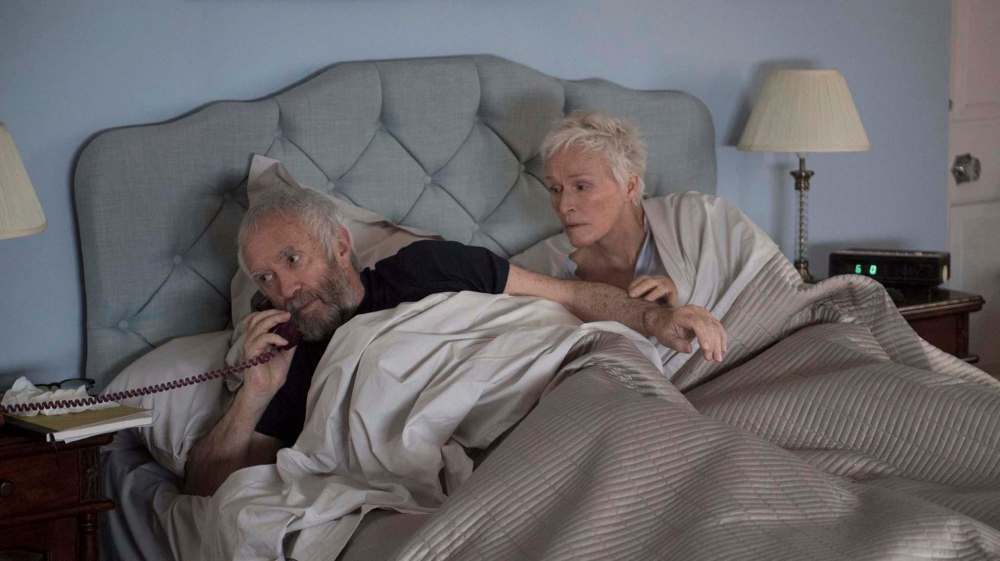
As The Wife opens, it’s 1992, and Joan is trying to sleep as her husband Joe (Jonathan Pryce) is climbing the walls, waiting for a phone call. When the call finally comes, it’s good, if expected, news: Joe has won the Nobel Prize for Literature.
The couple and their grown son, aspiring novelist David (Max Irons, son of Jeremy), head off for the ceremony in Stockholm, Sweden, where the wintry landscape seems to inject a chill into their relationship.
As Joe is fêted and fussed over, Joan, holding his coat like an assistant, is told “the wives” — and they are all wives, of course — will be taken shopping and offered spa treatments. It does not escape her gimlet eye that the beautiful official Nobel photographer, Linnea (Karin Franz Korlof), has not escaped her husband’s roving eye.
Another unwelcome presence is freelance writer Nathaniel Bone (Christian Slater), who has been angling to write Joe’s biography; he’s transparent in his attempts to win Joan’s favour so she’ll confirm some juicy details for him.
His probing into their life inspires some well-placed flashbacks, to when young Joan — played in a beautiful bit of casting by Close’s own daughter, Annie Starke — was a promising young writer at Smith College in the ’50s. She revels in praise for her stories from her passionate but married professor, one Joe Castleman (Harry Lloyd), and we see the roots of their symbiotic relationship take hold.
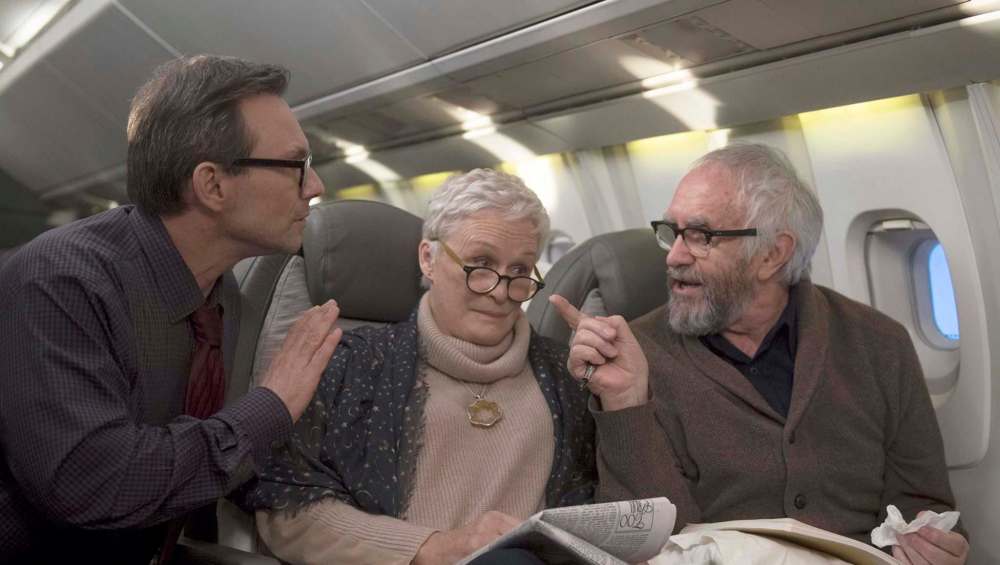
Pryce does a lot with a role that’s written as a bit of a stereotype. A Philip Roth figure, Joe is a philanderer and a blowhard, but his false humility masks an insecurity we sense is real.
It’s a tricky line to walk, but in Pryce’s hands, Joe’s calculated charm — the tweedy, beardy Great American Novelist — isn’t entirely insufferable. Adopting a faint Brooklyn accent that gets stronger when he’s playing up his working-class Jewish background, the Welsh-born actor captures a man convinced of his greatness who nonetheless needs constant reminders of it.
But it’s Close who’s the unmitigated star here. “Don’t paint me as the long-suffering wife,” she tells Nathaniel. “I’m more interesting than that.”

She is, of course, but the mechanics of her marriage are equally interesting. Suffer she might, but no one can accuse Joe of being ungrateful. At every turn, he’s at pains to laud her, not as his better half, but an equal partner, but his deference just seems to stoke her anger.
He’s the cliché of a genius author, needy and distracted; she’s the cliché of the devoted wife, keeping track of his glasses and his pills and his appointments. But as the film unfolds, it seems those are clichés of necessity, roles the couple have perfected — until their masks begin slip.
The Wife doesn’t deliver the shocking blow it ought to — Runge doesn’t build suspense as effectively as he could — but when Joan erupts, it’s a sight to behold.
jill.wilson@freepress.mb.ca Twitter: @dedaumier
Jill Wilson is the editor of the Arts & Life section. A born and bred Winnipegger, she graduated from the University of Winnipeg and worked at Stylus magazine, the Winnipeg Sun and Uptown before joining the Free Press in 2003. Read more about Jill.
Jill oversees the team that publishes news and analysis about art, entertainment and culture in Manitoba. It’s part of the Free Press‘s tradition, since 1872, of producing reliable independent journalism. Read more about Free Press’s history and mandate, and learn how our newsroom operates.
Our newsroom depends on a growing audience of readers to power our journalism. If you are not a paid reader, please consider becoming a subscriber.
Our newsroom depends on its audience of readers to power our journalism. Thank you for your support.
Movie review
The Wife
Starring Glenn Close and Jonathan Pryce
Grant Park
14A
101 minutes
HHHH out of five
Other voices
The Wife is that increasingly rare offering, a commercially viable film that also makes you rethink your assumptions about talent and who gets to wield it.
— Daphne Merkin, The New Republic
Other than the performances, there is nothing here audiences haven’t seen more times than they have their own feet.
— Scott Marks, San Diego Reader
What unites the film’s two halves — what makes it worth watching, period — is the road Close’s Joan travels as she decides whether to reclaim authorship of her own life.
— Ty Burr, Boston Globe
Runge is very good with actors. It’s a pleasure simply to watch Close and Pryce establish such minute and careful gradations of happiness, desolation and exasperation in their scenes together.
— Michael Phillips, Chicago Tribune
It’s Close’s wonderfully subtle characterization of Joan that lifts The Wife above its cliché setups and neat role reversals, which is really rather ironic. Once again, it’s the wife doing all the hard work. At least this time, she gets top billing.
— Katie Rife, AV Club
Jill Wilson is the editor of the Arts & Life section. A born and bred Winnipegger, she graduated from the University of Winnipeg and worked at Stylus magazine, the Winnipeg Sun and Uptown before joining the Free Press in 2003. Read more about Jill.
Jill oversees the team that publishes news and analysis about art, entertainment and culture in Manitoba. It’s part of the Free Press‘s tradition, since 1872, of producing reliable independent journalism. Read more about Free Press’s history and mandate, and learn how our newsroom operates.
Our newsroom depends on a growing audience of readers to power our journalism. If you are not a paid reader, please consider becoming a subscriber.
Our newsroom depends on its audience of readers to power our journalism. Thank you for your support.
Advertisement Advertise With Us
Advertisement Advertise With Us