Boy Erased only scratches the surface
Story of young man's gay conversion therapy lacks spiritual depth
Advertisement
Read this article for free:
or
Already have an account? Log in here »
To continue reading, please subscribe:

Digital Subscription
One year of digital access for only $205*
- Enjoy unlimited reading on winnipegfreepress.com
- Read the E-Edition, our digital replica newspaper
- Access News Break, our award-winning app
- Play interactive puzzles
*First annual payment billed as $205.00 + GST for one year. This annual subscription will automatically renew at $233.00 + GST every 52 weeks (10% off the regular annual price of $259.35). Offer available to new and qualified returning subscribers only. Cancel any time.
To continue reading, please subscribe:
Add Free Press access to your Brandon Sun subscription for only an additional
$1 for the first 4 weeks*
- Enjoy unlimited reading on winnipegfreepress.com
- Read the E-Edition, our digital replica newspaper
- Access News Break, our award-winning app
- Play interactive puzzles
*Your next Brandon Sun subscription payment will increase by $1.00 and you will be charged $17.95 plus GST for four weeks. After four weeks, your payment will increase to $24.95 plus GST every four weeks.
Read unlimited articles for free today:
or
Already have an account? Log in here »
Hey there, time traveller!
This article was published 07/12/2018 (2855 days ago), so information in it may no longer be current.
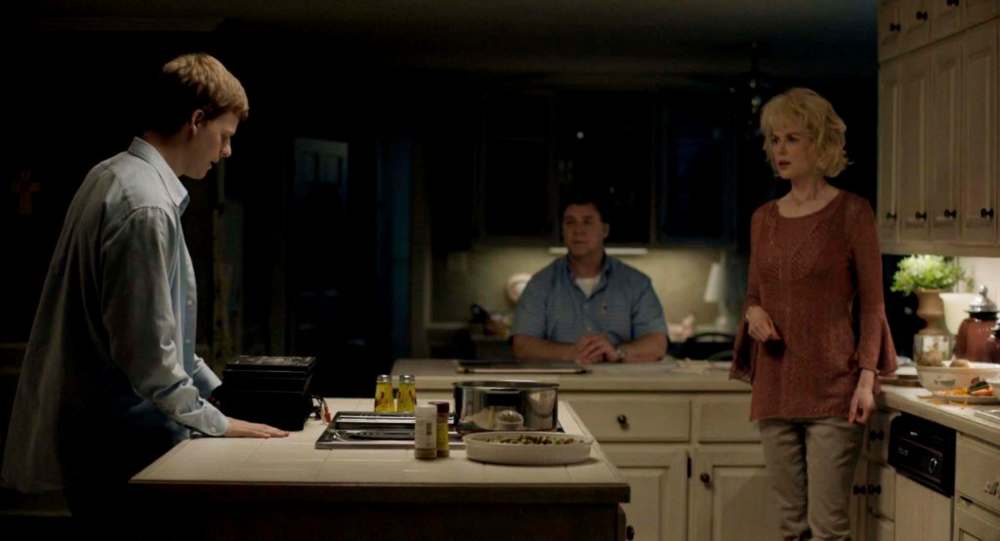
For much of Boy Erased, we are watching the face of 19-year-old Jared Eamons as he takes in his surroundings. It’s a handsome, intelligent face — it belongs to the actor Lucas Hedges — and its range of expressions subtly distils the drama of this sombre, coolly appalled and appalling movie. You note Jared’s dutiful attentiveness as his father preaches a sermon, his furtive downward glance in the company of a boy he likes and his quiet anguish when he finally approaches his parents and disgorges the long-held secret of his homosexuality.
Some time later — or perhaps earlier, given writer-director Joel Edgerton’s deft shuffling of time frames — Jared will find himself with a group of people, mostly young men, dressed in white button-up shirts that suggest a declaration of collective purity. At times he scans the room to see if anyone else shares his skepticism, despair and growing alarm, but those who enter the Christian ex-gay program known as Love in Action are generally advised to keep their eyes off each other and on the program’s strict director, Victor Sykes (Edgerton).
Hedges’ silent scream of a performance, more internalized than his excellent work in Manchester by the Sea and the recent Mid90s, both complements and counters the soul-smothering heaviness of Sykes’ agenda. Boy Erased is based on Garrard Conley’s 2016 memoir about his experience as an Arkansas teenager, when his Baptist parents sent him to Memphis for gay conversion therapy. The movie’s moral position on Love in Action is clear enough, but to its credit, it seeks to articulate that position without cheap histrionics or easy condemnations, to summon restraint in depicting an ideological campaign that has no particular use for nuance.
Edgerton, always a superb actor, is also a shrewd and attentive filmmaker, as he showed in his underappreciated 2015 psychological thriller, The Gift. His knack for evoking domestic tension especially animates the tense, difficult scenes of Jared’s home life after he is outed as gay to his parents by someone he thought was a friend.
Jared’s parents, Marshall and Nancy, are played by Russell Crowe and Nicole Kidman, and like Edgerton the two actors have closeted their native Australianness in service of a well-textured and reasonably convincing snapshot of southern suburbia. Kidman’s steely grace illuminates the plight of the doting, sympathetic Nancy, who responds to her son’s admission by sadly closing her eyes but not, crucially, her mind or heart. Crowe, meanwhile, conveys Marshall’s natural affection for his son but also his instinctive willingness to suppress it, to bark orders and demand answers in lieu of listening.
That difficult dynamic is replicated, with a much more toxic level of obtuseness, at Love in Action, where Jared is sent after surprisingly little family discussion. From there, Boy Erased, shot in dim, muted colours and accompanied by agitated orchestral strings, proceeds with the coolly restrained tension of an art-house horror movie. Or perhaps a prison movie, the kind that might bring back chilling memories of your company’s last employee retreat, only with more God talk and ritual self-humiliation.
Sykes, a drill sergeant in a necktie, runs the show with a few scowling deputies on hand. They confiscate their charges’ cellphones and other personal possessions, and warn them against drinking, viewing pornography or engaging in more than cursory physical touch. New enrollees are forced to diagram any deviant branches in their family trees (abuse, alcoholism, etc.), and also to excoriate themselves and especially their parents in extended group confessionals.
Boy Erased doesn’t seem particularly interested in the inner spiritual life of its characters. Not Jared’s parents, whose love for God permeates every aspect of their daily routine, and crucially not Jared himself, whose divine encounters are limited to a scene of him cursing the heavens in anger.

Given its focus on church and community, the movie seems curiously reluctant to broach the subject of God in more intimate, relational and compassionate terms.
I object to this omission partly on representational grounds — the teachings of groups like Love in Action should not, and do not, speak for all Christianity — but also, more important, on dramatic ones. In framing Jared’s conflict through the lens of a morally repressive and intellectually bankrupt program, rather than of his own much more valuable interior dialogue, the movie sacrifices a deeper, more intimate kind of insight. Boy Erased is a sobering, justly infuriating movie, but its own convenient elisions keep catharsis at bay.
— Los Angeles Times