Christie’s best driven by killer subtext, intricate inevitability

Advertisement
Read this article for free:
or
Already have an account? Log in here »
To continue reading, please subscribe:

Digital Subscription
One year of digital access for only $205*
- Enjoy unlimited reading on winnipegfreepress.com
- Read the E-Edition, our digital replica newspaper
- Access News Break, our award-winning app
- Play interactive puzzles
*First annual payment billed as $205.00 + GST for one year. This annual subscription will automatically renew at $233.00 + GST every 52 weeks (10% off the regular annual price of $259.35). Offer available to new and qualified returning subscribers only. Cancel any time.
To continue reading, please subscribe:
Add Free Press access to your Brandon Sun subscription for only an additional
$1 for the first 4 weeks*
- Enjoy unlimited reading on winnipegfreepress.com
- Read the E-Edition, our digital replica newspaper
- Access News Break, our award-winning app
- Play interactive puzzles
*Your next Brandon Sun subscription payment will increase by $1.00 and you will be charged $17.95 plus GST for four weeks. After four weeks, your payment will increase to $24.95 plus GST every four weeks.
Read unlimited articles for free today:
or
Already have an account? Log in here »
Hey there, time traveller!
This article was published 16/09/2023 (1120 days ago), so information in it may no longer be current.
This year, Agatha Christie’s Sept. 15 birthday was marked by the release of A Haunting in Venice, a glammed-up version of her 1969 murder mystery Hallowe’en Party.
As director and star Kenneth Branagh and his magnificent moustaches make clear, the Queen of Crime still reigns.
Christie’s book sales now number in the billions, and the movie versions, especially since Sidney Lumet’s 1974 Murder on the Orient Express, have often been sumptuous, star-packed productions. Christie had originally allowed for “film or nothing” when it came to adaptations, but since her death, it’s through television that her work has best reached mass audiences, with David Suchet becoming the definitive Hercule Poirot, the fastidious and brilliant Belgian detective, and the late Joan Hickson embodying the elderly spinster sleuth Miss Marple, who notices everything because she herself is unnoticed.
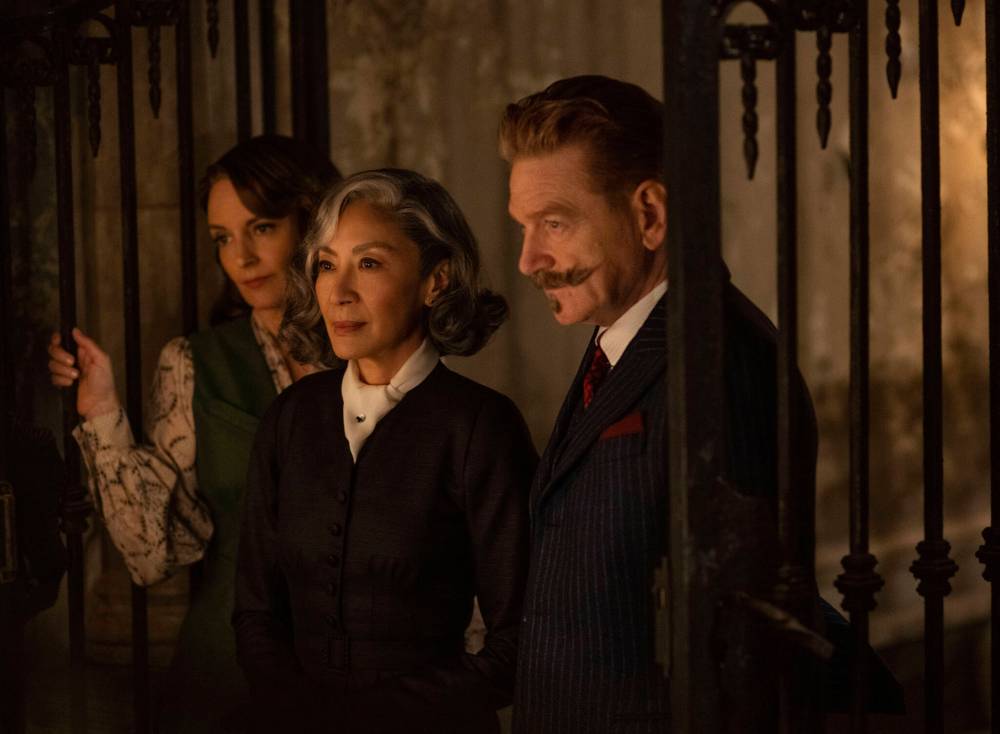
From left: Tina Fey as Ariadne Oliver, Michelle Yeoh as Mrs. Reynolds, and Kenneth Branagh as Hercule Poirot in ‘A Haunting in Venice.’ (20th Century Studios via The Associated Press)
The film and TV adaptations deliver reliable nostalgia. Christie’s later books may have awkwardly confronted long-haired, bell-bottomed youngsters smoking “hemp,” but adapters tend to stick to the interwar era, with lots of elegant Art Deco atmosphere, or the 1950s. They favour picture-perfect English villages, grand country houses and picturesque resort towns.
While keeping these good-looking period settings, the adaptations often update the books’ attitudes, losing the racial stereotypes and the outdated language that sometimes show up in the early novels. (One of Christie’s best books, And Then There Were None, possesses the unfortunate distinction of having one offensive title replaced by another offensive title before the publishers settled on the current iteration.)
Some adapters feel compelled to make the stories feel more edgy and relevant — like a recent BBC take on The ABC Murders — usually by bringing the submerged sex and violence to the surface. This feels a bit unnecessary. Miss Marple, for instance, has always been unshockable, believing that every variety of human behaviour can be found in an English village. She just doesn’t understand the modern need to talk about it all the time.
Christie viewed her books as entertainments, which is why she doesn’t delve too much into tragedy and trauma. Most of her novels feature a corpse (or two) that nobody much mourns. Emotions tend to run higher at the reading of the will than at the funeral. This briskly unsentimental approach means we can enjoy her mysteries as puzzles, and she is incredibly deft at constructing plots filled with locked rooms, impossible timelines and unshakeable alibis. Christie also has a gift for directing us to one obvious clue while sliding past a much more significant bit of info, but she (almost) always plays fair with her readers.
And while there is a lot of focus on means and opportunity — who was where when the dinner gong sounded — Christie’s mysteries aren’t merely practical problems. She is always interested in motive. Her view of human nature isn’t subtle, but it is shrewd, and the outlines of the crime are always filled in by satisfying amounts of avarice, lust, jealousy, conceit, resentment and self-delusion.
Of course, all this human folly gets wrapped up in the end. Christie is famous for perfecting the drawing-room summation, in which the detective offers several plausible accounts of the crime before finally coming to a solution that’s not just plausible but perfect. Her best works — and the prolific Christie could be uneven — leave you smacking your forehead in surprise, while simultaneously acknowledging that, of course, this resolution was the one, the only, the inevitable answer.

Christie has such a knack for making the complex seem, in the end, so beautifully simple that she is sometimes dismissed as a hack. But her lasting accomplishment is demonstrated by how hard it has been to replicate.
Sophie Hannah, for instance, who writes very good books of her own, has been authorized by the Christie estate to write four Poirot novels, with a fifth due this Christmas. While she sets up intricate problems and supplies clever solutions, her versions never deliver that satisfying Christie click. The estate also oversaw the recent release of Marple: Twelve New Mysteries, which features new-old stories from a dozen current crime writers.
Then there are the contemporary writers who get billed as “the Agatha Christie of our generation.” A common blurb on the covers of bestsellers, this seems like a label applied to any woman who writes about crime and shifts a lot of books. And Ruth Ware and Lucy Foley and Gillian Flynn do a lot of interesting things, using the crime genre for psychological exploration, social analysis and deep dives into the interior lives of women. But describing any of these writers as “the Agatha Christie of our generation” doesn’t tell us much about their specific skills — and almost always leads to disappointment for hardcore Christie fans.
As we mark 133 years since her birth, the Agatha Christie of our generation, it turns out, is still Agatha Christie.
alison.gillmor@freepress.mb.ca
Studying at the University of Winnipeg and later Toronto’s York University, Alison Gillmor planned to become an art historian. She ended up catching the journalism bug when she started as visual arts reviewer at the Winnipeg Free Press in 1992.
Our newsroom depends on a growing audience of readers to power our journalism. If you are not a paid reader, please consider becoming a subscriber.
Our newsroom depends on its audience of readers to power our journalism. Thank you for your support.
Studying at the University of Winnipeg and later Toronto’s York University, Alison Gillmor planned to become an art historian. She ended up catching the journalism bug when she started as visual arts reviewer at the Winnipeg Free Press in 1992.
Our newsroom depends on a growing audience of readers to power our journalism. If you are not a paid reader, please consider becoming a subscriber.
Our newsroom depends on its audience of readers to power our journalism. Thank you for your support.
Advertisement Advertise With Us
Advertisement Advertise With Us