Ontario’s public broadcaster under scrutiny for funding, then pulling Russian war doc
Advertisement
Read this article for free:
or
Already have an account? Log in here »
To continue reading, please subscribe:

Digital Subscription
One year of digital access for only $205*
- Enjoy unlimited reading on winnipegfreepress.com
- Read the E-Edition, our digital replica newspaper
- Access News Break, our award-winning app
- Play interactive puzzles
*First annual payment billed as $205.00 + GST for one year. This annual subscription will automatically renew at $233.00 + GST every 52 weeks (10% off the regular annual price of $259.35). Offer available to new and qualified returning subscribers only. Cancel any time.
To continue reading, please subscribe:
Add Free Press access to your Brandon Sun subscription for only an additional
$1 for the first 4 weeks*
- Enjoy unlimited reading on winnipegfreepress.com
- Read the E-Edition, our digital replica newspaper
- Access News Break, our award-winning app
- Play interactive puzzles
*Your next Brandon Sun subscription payment will increase by $1.00 and you will be charged $17.95 plus GST for four weeks. After four weeks, your payment will increase to $24.95 plus GST every four weeks.
Read unlimited articles for free today:
or
Already have an account? Log in here »
Hey there, time traveller!
This article was published 13/09/2024 (756 days ago), so information in it may no longer be current.
TORONTO – Ongoing controversy over the documentary “Russians at War” has brought scrutiny to Ontario’s public broadcaster, which has said it will not air the film it helped fund.
One media expert says TVO is getting “the worst of all worlds” by investing in a project that can no longer be shown or monetized.
“TVO created a thing which their audience doesn’t get to see, other audiences will get to see and they’ve footed the bill and gotten no reward for it,” Chris Arsenault, chair of Western University’s master of media in journalism and communication program, said in an interview.
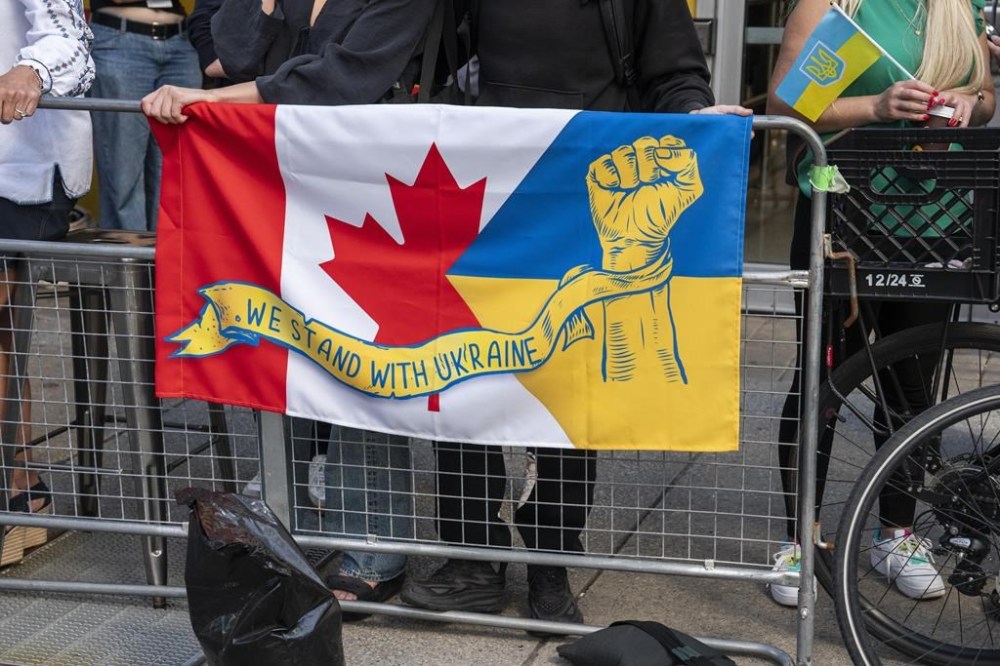
People protest outside of the Scotiabank Theatre about the documentary "Russians at War" at the Toronto International Film Festival, in Toronto, on Tuesday Sept. 10, 2024. THE CANADIAN PRESS/Paige Taylor White
“I can’t think of a worse outcome for a network than what’s happened.”
“Russians at War,” a film rebuked by the Ukrainian community and some Canadian politicians, was part of the Toronto International Film Festival’s lineup until organizers suspended all screenings this week due to “significant threats” to festival operations. The film, which recently screened at the Venice Film Festival and is headed to the Windsor International Film Festival next month, shows the disillusionment of some Russian soldiers on the front lines of the war in Ukraine.
TVO had planned to air the documentary in the coming months, but the network’s board of directors withdrew support for the film on Tuesday, citing feedback it received. The Ukrainian Canadian Congress, Ukraine’s consul-general in Toronto and others have called the film Russian propaganda and a “whitewashing” of Russian military war crimes in Ukraine – claims the film’s producers and TIFF have rejected.
The TVO board’s announcement came just days after the network defended the film as “antiwar” at its core. It was an about-face the Documentary Organization of Canada said “poses a serious threat” to media independence and raises questions about political interference.
TVO has not responded to requests for comment and board chair Chris Day declined to elaborate on the decision to pull the film.
“Suffice it to say, we heard significant concerns and we responded,” Day wrote to The Canadian Press in an emailed response to an interview request.
Arsenault, who has not seen the documentary and could not comment on its content, said he’s nevertheless worried about the spectre of board intervention in independent editorial decisions, which he said “opens the doors” to further meddling in the production of documentaries and journalism.
“Russians at War,” a Canada-France co-production, was funded in part by the Canada Media Fund, which provided $340,000 for the project through its broadcaster envelope program. A spokesperson for the fund said TVO independently chose to use that money to support the production of the documentary.
One of the film’s producers, Cornelia Principe, said that TVO also had to pay a licensing fee to air the documentary. Such fees can range from $50,000 to $100,000, she said.
Principe, who has defended the documentary and its Canadian-Russian director Anastasia Trofimova, said she was shocked by the TVO board’s decision.
“Anastasia and I have been working with TVO on this for two and a half years.… I was a little bit out of it for hours. I just couldn’t believe it.”
What happens next, she said, is “uncharted territory” for TVO.
“This has, as far as I know, never happened before,” said Principe, who has worked with the broadcaster on various documentaries over the years.
TVO’s board has said the network will be “reviewing the process by which this project was funded and our brand leveraged.”
Charlie Keil, a professor at the University of Toronto’s Cinema Studies Institute, said the TVO board needs to explain why it took “kind of a sledgehammer” to a film that seems to have been adequately vetted on the editorial side.
“It seems to me if they were being honest, what (the) TVO board would be saying is: “There’s a lot of pressure now. We don’t really like this … We’re just going to bail,” Keil said in an interview.
Ontario’s Minister of Education Jill Dunlop said in a statement that the decision made by TVO’s board of directors “was the right thing to do,” but did not elaborate.
As a non-profit government agency, TVO has a mandate to distribute educational materials and programs but the ministry is not involved with its broadcasting arm due to CRTC licensing rules.
Another public broadcaster, British Columbia’s Knowledge Network, has confirmed that it made a licence fee contribution of $15,000 for “Russians at War” so that it can be a “second window” broadcaster for the film.
Asked whether the documentary will still air at some point in British Columbia, a spokesperson for the network said it’s “working on a public response.”
Finance Minister and Deputy Prime Minister Chrystia Freeland has denounced the use of public funds for “Russians at War,” saying she shares the “grave concerns” Ukrainian officials and community members in Canada have raised about the film.

The Ukrainian Canadian Congress has said it will keep protesting “Russians at War” since TIFF has said it will still screen the doc at some point. A peaceful march and demonstration that wound its way to the TIFF Lightbox on Friday afternoon included people who laid sunflowers and photos of Ukrainians killed in the war on the sidewalk.
“Russians at War” is scheduled to screen at the Windsor International Film Festival, running from Oct. 24 to Nov. 3. The festival announced Friday that the documentary is among 10 nominees for its WIFF Prize in Canadian Film, worth $25,000.
“We hope that all our nominees – and all films at WIFF – generate meaningful, critical and intelligent discussion in an environment that is safe, respectful and civil,” festival organizers said in an emailed statement.
— With files from Queen’s Park correspondent Allison Jones in Toronto.
This report by The Canadian Press was first published Sept. 13, 2024.