Walking a fine line
‘Based on true story’ drama lacks crucial information

Advertisement
Read this article for free:
or
Already have an account? Log in here »
To continue reading, please subscribe:

Digital Subscription
One year of digital access for only $205*
- Enjoy unlimited reading on winnipegfreepress.com
- Read the E-Edition, our digital replica newspaper
- Access News Break, our award-winning app
- Play interactive puzzles
*First annual payment billed as $205.00 + GST for one year. This annual subscription will automatically renew at $233.00 + GST every 52 weeks (10% off the regular annual price of $259.35). Offer available to new and qualified returning subscribers only. Cancel any time.
To continue reading, please subscribe:
Add Free Press access to your Brandon Sun subscription for only an additional
$1 for the first 4 weeks*
- Enjoy unlimited reading on winnipegfreepress.com
- Read the E-Edition, our digital replica newspaper
- Access News Break, our award-winning app
- Play interactive puzzles
*Your next Brandon Sun subscription payment will increase by $1.00 and you will be charged $17.95 plus GST for four weeks. After four weeks, your payment will increase to $24.95 plus GST every four weeks.
Read unlimited articles for free today:
or
Already have an account? Log in here »
Hey there, time traveller!
This article was published 16/01/2026 (244 days ago), so information in it may no longer be current.
Loosely based on a real-life hostage taking in Indianapolis in 1977, this period crime drama from veteran director Gus Van Sant (Good Will Hunting, Milk) and screenwriter Austin Kolodney (making his feature-film debut) is packed with scruffy retro style and some cool callbacks.
The 1970s were a decade of paranoia, cynicism and division. (Maybe that’s why they’re resonating in pop culture right now.) Dead Man’s Wire channels some of the antihero energy of Dog Day Afternoon. It riffs on the mad-as-hell rants of Network. It gives us a turtlenecked, leather-jacketed cop like Serpico.
The hair is long, the cars are the size of barges and the colour palette suggests old Polaroid photos.
There’s dark humour and some sly, intriguing performances, but there’s also something missing. Dead Man’s Wire throws out heady ideas — looking at the era’s deepening distrust of institutions, the rise of vulture capitalism and the shifting role of media — but never really follows them up.
Bill Skarsgård (It) plays Tony Kiritsis, and when we first see him, he’s a man with a grievance and a suspiciously long cardboard box. Tony has an appointment at the Meridian mortgage company, run by father-and-son team M.L. Hall (Al Pacino, who starred in Dog Day Afternoon way back when) and Dick Hall (Stranger Things’ Dacre Montgomery).
Tony has taken out a loan to develop a plot of land into a shopping centre, and he believes the Halls have deliberately discouraged potential tenants in the hopes Tony will default on the loan, allowing them to swoop in and develop the property themselves.
The mysterious cardboard box turns out to contain a sawed-off shotgun, and it’s soon connected to Tony and to Dick’s neck via that titular “dead man’s wire.” Tony wants legal immunity, financial restitution and, more than anything else, an apology.
Any sudden moves and Dick will be dead.
Van Sant proceeds to track the 63-hour hostage ordeal, as the pair retreats to Tony’s apartment, followed closely by cops (including The Princess Bride’s Cary Elwes, hidden under a lot of hair) and a swarm of TV news trucks.
The bond that develops between Tony and Dick can be fascinating, but it’s also curiously tension-free.
Skarsgård plays Tony as an abrupt, awkward, off-putting guy who can be poignant at times, scary at others. He alternates between threatening to blow Dick’s head off and apologizing for being a bad host. (Did he remember to fill the ice cube trays, Tony wonders at one point.) Dick, handcuffed and facing a 12-gauge shotgun, is getting through on stoicism and sheer endurance.
We soon see that while Tony and Dick are two very different men, they have both suffered under the monstrous, malignant narcissism of Dick’s father, which is on display with some fabulous Pacino flair. (We’re first introduced to M.L. poolside in Florida, as he sends back a burrito because it’s been cut into halves rather than thirds. He just gets worse and worse.)
Row K
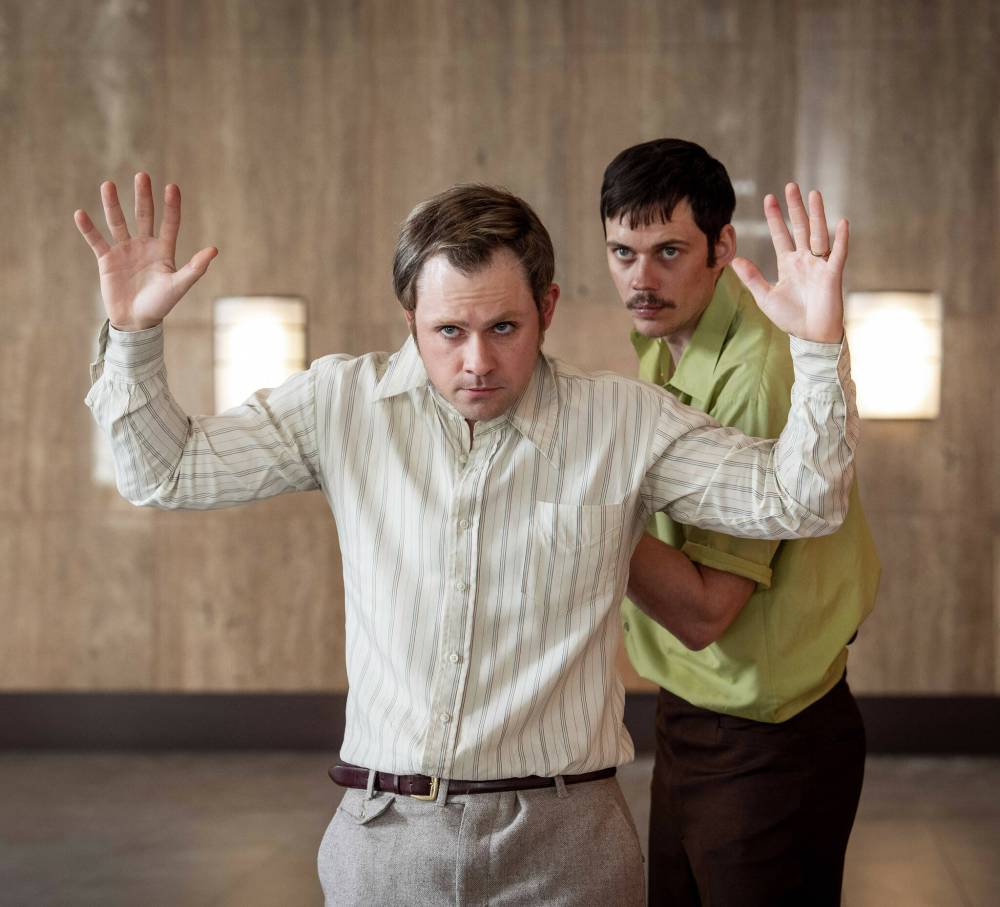
Dacre Montgomery (front) is taken hostage by Bill Skarsgård in Gus Van Sant’s latest feature, based on a real 1977 incident.
There are other characters circling around Tony and Dick. There’s cub reporter Linda Page (Industry’s Myha’la), who’s desperate to get closer to the scene, and smooth, suave radio DJ Fred Temple (Sing Sing’s Colman Domingo), considered “the voice of Indianapolis,” who is pulled into the situation against his will.
Van Sant sometimes freezes a scene into a black-and-white press photo or transforms it into grainy TV news footage, just to remind us how this event is being filtered through the media. And the Kiritsis story is still used at journalism schools as a case study in what happens when the media becomes part of the story they’re covering.
What are the ethical issues involved in platforming hostage-takers and their demands? And what about reporting in real time on law enforcement tactics, since hostage takers can watch TV, too? Kolodney raises these important questions but then kind of trails off. (You can see these ideas explored with much more depth in the 2024 film September 5 about the hostage situation at the 1972 Munich Olympics.)
Dead Man’s Wire is complicated with its sympathies, in a way that is both intriguing and frustrating. Is Tony a hard-done-by everyman with a righteous cause? “I’m a goddamn national hero,” he declares at one point. Or is he an aggrieved, angry, semi-delusional loner?
Maybe he’s a bit of both, but the film doesn’t give us enough hard information to fully understand the man or his motivations. This is the kind of “based on a true story” movie that will have viewers googling things in the lobby afterwards. They might sense that this version — for all its throwback style and interesting vibes — leaves some crucial stuff out.
winnipegfreepress.com/alisongillmor
Studying at the University of Winnipeg and later Toronto’s York University, Alison Gillmor planned to become an art historian. She ended up catching the journalism bug when she started as visual arts reviewer at the Winnipeg Free Press in 1992.
Our newsroom depends on a growing audience of readers to power our journalism. If you are not a paid reader, please consider becoming a subscriber.
Our newsroom depends on its audience of readers to power our journalism. Thank you for your support.
Movie Review
Dead Man’s Wire
Starring: Bill Skarsgård, Dacre Montgomery, Colman Domingo and Myha’la
● McGillivray
● 105 minutes, Not rated
★★★½ out of five
The intensity of the situation and Tony’s capacity to pull the trigger are unconvincing; Skarsgård’s looks are the only thing that can kill.
— Saffron Maeve, Globe and Mail
The movie’s tight focus on the sixty-three hours of Tony’s furious spree sacrifices any chance of a fuller view of his personality, his thoughts, his imaginings. Its treatment of the media-world subplot is both too little and too much.
— Richard Brody, The New Yorker
The film is designed as a timely reminder that when financiers sell the American dream, there’s often fine print that keeps it just out of reach — and a gripping, often hilarious, and briskly entertaining reminder it is.
— Bob Mondello, NPR
Skarsgård plays the role somewhere between a soapbox preacher and a Scooby-Doo episode that imagines Shaggy unmasking a money-grubbing bad guy and threatening to beat him to death.
— Amy Nicholson, Los Angeles Times
Studying at the University of Winnipeg and later Toronto’s York University, Alison Gillmor planned to become an art historian. She ended up catching the journalism bug when she started as visual arts reviewer at the Winnipeg Free Press in 1992.
Our newsroom depends on a growing audience of readers to power our journalism. If you are not a paid reader, please consider becoming a subscriber.
Our newsroom depends on its audience of readers to power our journalism. Thank you for your support.
Advertisement Advertise With Us
Advertisement Advertise With Us