Blood relation
Remake of George Romero's The Crazies keeps the horror, tones down the gore

Advertisement
Read this article for free:
or
Already have an account? Log in here »
To continue reading, please subscribe:

Digital Subscription
One year of digital access for only $205*
- Enjoy unlimited reading on winnipegfreepress.com
- Read the E-Edition, our digital replica newspaper
- Access News Break, our award-winning app
- Play interactive puzzles
*First annual payment billed as $205.00 + GST for one year. This annual subscription will automatically renew at $233.00 + GST every 52 weeks (10% off the regular annual price of $259.35). Offer available to new and qualified returning subscribers only. Cancel any time.
To continue reading, please subscribe:
Add Free Press access to your Brandon Sun subscription for only an additional
$1 for the first 4 weeks*
- Enjoy unlimited reading on winnipegfreepress.com
- Read the E-Edition, our digital replica newspaper
- Access News Break, our award-winning app
- Play interactive puzzles
*Your next Brandon Sun subscription payment will increase by $1.00 and you will be charged $17.95 plus GST for four weeks. After four weeks, your payment will increase to $24.95 plus GST every four weeks.
Read unlimited articles for free today:
or
Already have an account? Log in here »
Hey there, time traveller!
This article was published 25/02/2010 (5983 days ago), so information in it may no longer be current.
IN an era when the Support Our Troops sensibility resonates powerfully, it’s gutsy to cast the military as the heavy in your Hollywood movie.
Of course, director George Romero faced that challenge when, in 1973, he pitted the military against hapless townsfolk afflicted with a bio-weapon virus in the original version of The Crazies. Consider: A decade or two earlier, members of the military were generally the saviours against internal or extraterrestrial threats. Romero made them the threat.

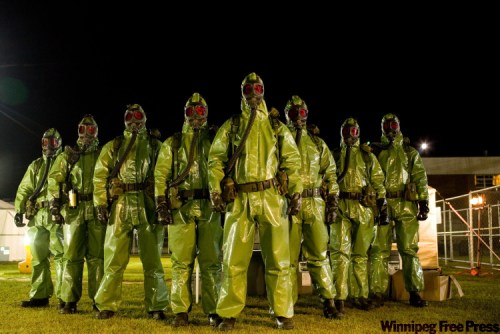
In director Breck Eisner’s remake, the production values are bigger, the actors are prettier and better, the sick people are ickier and the apocalypse is… apocalypsier. But if anything, the haz-mat clad military are even more scary in the remake because, in contrast to the original, the audience is rarely privy to the soldiers’ point of view.
"People’s tastes, and the movies that reflect them, are often a response to what’s going on in the world," says Eisner in a phone interview.
"In the ’50s, the military saves us, and in the ’70s, the military is the enemy, and in the ’80s, it was back to the military saving us again in Top Gun and Aliens," he says.
The new version of The Crazies, Eisner says, does not so much reflect a distrust of the troops as much as a distrust of the larger military machine.
"In the post-9/11 world, the George Bush administration used the military to fight a war that most people, myself included, feel should never have been undertaken in Iraq," Eisner says. "People suddenly lost faith in the military and in the politicians that control the military.
"So the movie for me is not about the individuals in the military. In fact, I went out of my way to make sure there are very few military characters actually shown, and the ones that are shown actually quite sympathetic.
"It’s more about the use of the military as a machine by the politicians to do its bidding," says Eisner, whose last feature film was the adventure movie Sahara.
Eisner departs from Romero’s sensibilities, however, when it comes to the horror aspects. Romero was something of a film pioneer when it came to presenting graphic violence on the screen. But the violence in the remake, while occasionally shocking, is not as graphic as it might appear.
"My tastes in horror movies are more akin to Rosemary’s Baby, The Omen, The Exorcist and The Shining … movies that are scary because of the context, the characters, the journey, the tone, the mood, and less about gore and pure violence," Eisner says. "There are violent episodes — there’s violence in the movie, there’s horrific moments — but it’s not about the way someone dies or the gore that’s associated with it."
Eisner was nevertheless schoolboy-nervous when it came time for Romero to see the film at a special screening in Toronto recently.
"He watched it and I had to call him the next day in Toronto and it was nerve-racking because he hadn’t shared his opinions yet. It’s a hard thing to watch a movie that you made be remade.
"He was quite gracious," Eisner says.
For his part, Eisner felt easier about remaking a movie that is relatively unknown, even if it is part of the Romero canon.
"If you’re going to remake something, which is a big commitment of time in one’s life, you want to make sure there’s a reason to do it," he says. "I liked the fact it was obscure, but I also liked the movie. I liked what the movie could be."
Breck Eisner’s The Crazies opens in theatres tomorrow.
THE CRAZIES
Original film, new on Blu-ray
GEORGE Romero’s original version of The Crazies was released in 1973, right smack between his more celebrated zombie thrillers Night of the Living Dead (1968) and Dawn of the Dead (1978). Even released in a handsome new restored DVD version from Blue Underground, it’s easy to see why it is obscure compared to his Living Dead movies.
The premise is not dissimilar. The Crazies features mobs of homicidal people threatening non-homicidal citizens.
The afflicted are victims of a biologically engineered virus, code-named "Trixie," let loose in the small town of Evan City, Penn., when an air force jet crashes.
The military arrives and the forced quarantine turns into a pitched battle. Attempting to evade the chaos are volunteer firefighter and former Green Beret David (W.G. McMillan), his pregnant nurse girlfriend Judy (Lane Carroll) and his best bud Clank (Harold Wayne Jones).
Vietnam vets, David and Clank are not intimidated by soldiers in haz-mat suits. Indeed, the two apparently don’t know a) the meaning of the word "fear," and b) the concept of "eyebrow trimming." (Early George Romero movies, like most early Canadian movies, stand as a demonstration of what Hollywood movies would look like if acting ability was prized more than good looks.)
In searching for a safe place to hide, the three go on the run with Artie (Richard Liberty) and his apparently sick daughter Kathie (Lynn Lowry), a couple that ultimately provides Romero with the film’s one significant taboo-busting outrage.
Running parallel to that plot, we actually see the point of view of the military as they attempt to keep the lid on this deadly outbreak. True to the Vietnam-era sensibilities of the film, the operation is botched time after time, with the likely result that the town will be incinerated in a nuclear "accident."
The reason the film was less successful was because it was more politically subversive than it was esthetically subversive. Here was a movie that dared to show Americans at war with their own military. But without the spectacle of gut-munching and exploding heads — the stuff that made Romero’s Living Dead movies stand apart within the genre — its major draw was the sight of people killing each other in the woods, a commodity handled with far more skill in early SSRq70s films such as, say, Deliverance (1972).
Put it this way: Lots of people, myself included, prefer George Romero’s original films to the slicker remakes of Night of the Living Dead and Dawn of the Dead. It’s doubtful anyone will feel that much loyalty to Romero’s The Crazies once they see the remake.
‘Ö’Ö’Ö out of five
Terror on
the prairies
"We almost shot the movie up in Winnipeg," says Breck Eisner of The Crazies.
It turns out the province’s flat landscapes (and its advantageous tax breaks) were perfect for a movie in which rural townsfolk afflicted with a genetically engineered disease have no place to hide on a wide open prairie.
"I was desperate to shoot there," says Eisner. The problem, he says, was that the movie kept changing hands, moving among three different studios over the course of its development.
"We started at Paramount and then went to Rogue and finally Overture, where it finally got made," Eisner says. "When I scouted up there, it was at Rogue and the time-frame was perfect and I found an awesome location that was perfect for the movie.

"But then Rogue changed ownership and the movie moved to Overture and we ended up shooting in March and April.
"And there was no way to shoot exterior in March and April in Winnipeg."
I can’t say I blame him, although, as I tell Eisner, losing the film was something of a heartbreaker. George Romero, the director of the original 1973 version of The Crazies, had scouted Winnipeg as a possible location for Land of the Dead, and opted to shoot in Toronto instead.
I tell him the impending March shoot of the Xavier Gens film The Fallout (which, like The Crazies, also features marauding soldiers in haz-mat suits) may finally give us a post-apocalyptic movie we can call our own.
"Well," Eisner says, "good luck with the coming apocalypse."
Our newsroom depends on a growing audience of readers to power our journalism. If you are not a paid reader, please consider becoming a subscriber.
Our newsroom depends on its audience of readers to power our journalism. Thank you for your support.
Our newsroom depends on a growing audience of readers to power our journalism. If you are not a paid reader, please consider becoming a subscriber.
Our newsroom depends on its audience of readers to power our journalism. Thank you for your support.
Advertisement Advertise With Us
Advertisement Advertise With Us