Film toes line between fact, fiction
Banderas plays director patterned after Almodóvar

Advertisement
Read this article for free:
or
Already have an account? Log in here »
To continue reading, please subscribe:

Digital Subscription
One year of digital access for only $205*
- Enjoy unlimited reading on winnipegfreepress.com
- Read the E-Edition, our digital replica newspaper
- Access News Break, our award-winning app
- Play interactive puzzles
*First annual payment billed as $205.00 + GST for one year. This annual subscription will automatically renew at $233.00 + GST every 52 weeks (10% off the regular annual price of $259.35). Offer available to new and qualified returning subscribers only. Cancel any time.
To continue reading, please subscribe:
Add Free Press access to your Brandon Sun subscription for only an additional
$1 for the first 4 weeks*
- Enjoy unlimited reading on winnipegfreepress.com
- Read the E-Edition, our digital replica newspaper
- Access News Break, our award-winning app
- Play interactive puzzles
*Your next Brandon Sun subscription payment will increase by $1.00 and you will be charged $17.95 plus GST for four weeks. After four weeks, your payment will increase to $24.95 plus GST every four weeks.
Read unlimited articles for free today:
or
Already have an account? Log in here »
Hey there, time traveller!
This article was published 06/12/2019 (2469 days ago), so information in it may no longer be current.
In this autumnal semi-autobiographical film, Pedro Almodóvar (known for such movies as Women on the Verge of a Nervous Breakdown, Tie Me Up! Tie Me Down! and The Skin I Live In) is working in that hyper-auteurist mode where a movie’s main character is a film director, usually male, usually older, usually facing some kind of creative and emotional crisis.
It’s a genre that is often self-indulgent — and occasionally angry and aggrieved — but in the hands of the 70-year-old Spanish master becomes a gentle and generous examination of time, age and the act of creation. Nuanced and elusive, Pain and Glory (in Spanish with subtitles) is highly personal without being self-absorbed.
The story starts with the Almodóvar-type character, Madrid-based filmmaker Salvador Mallo, finally patching things up with actor Alberto Crespo after a falling out more than 30 years ago. There are echoes here of Almodóvar’s up-and-down relationship with one-time muse Antonio Banderas: the two men made five films in the hedonist heyday of the post-Franco era, but Almodóvar felt betrayed by Banderas’s 1990s defection to Hollywood.
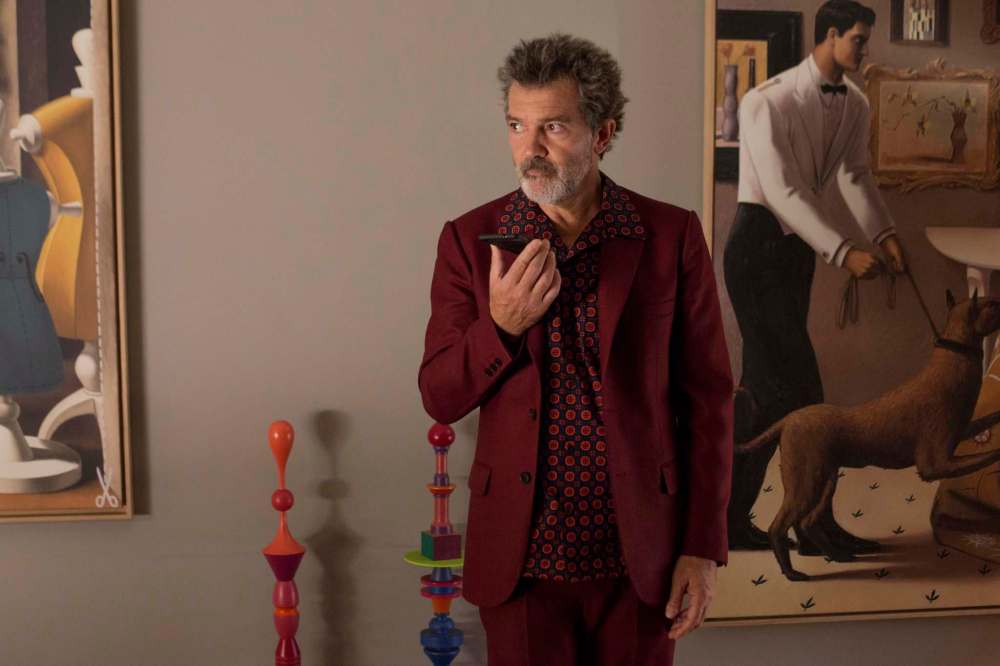
The self-referential trick is that Banderas plays not Alberto, the actor (who is portrayed by Asier Etxeandia), but Salvador, the director, complete with Almodóvar’s trademark hair, all wayward and sticking up. This is one sign that Almodóvar is fooling around with the line between autobiographical fact and artful fiction.
These boundaries are further complicated by the film’s look. Salvador’s apartment is a near replica of Almodóvar’s actual home — and wow, the mod chairs, the neo-surrealist paintings, the Hermes china — while Salvador’s wardrobe also borrows from Almodóvar’s closet.
Salvador suffers from chronic pain, multiple physical ailments and crushing anxiety, depression and agoraphobia. He has also recently developed a heroin habit (“Latecomers are the worst,” Alberto remarks). Mostly, he’s terrified he’ll never direct again.
We see Salvador gingerly getting out of cars, or putting down a pillow on the wooden floor when he has to pick something up. Banderas isn’t doing an impersonation, however. This is an understated but emotional performance, vulnerable and utterly without vanity, and Banderas brings in some of his own history. In the opening scene, we see a long scar running down his chest, a reminder of the actor’s heart attack in 2017.
There are moments of comedy, as when Salvador phones it in — literally — to a Madrid Cinematheque screening of one of his films, taking questions over the organizer’s iPhone while audibly snorting drugs.
More often, though, Almodóvar moves in a melancholy direction, with Salvador’s heroin reveries carrying him back to his rural boyhood and memories of his mother, Jacinta, played by Penelope Cruz with a complex combination of self-abnegation and fierce ambition.
The past also bleeds into the present. Along with Salvador’s reunion with Alberto, he also meets again with Federico (Leonardo Sbaraglia), his first love, their relationship in the 1980s having been undone not by lack of love or passion but by Federico’s own heroin addiction.
The story is moving but — unlike a lot of Almodóvar’s work — never tips over into outright melodrama. “Actors will take any opportunity to cry,” Salvador admonishes Alberto. The director thinks it’s better to be just on the verge of tears.
From the beguiling opening credits, it’s clear that Almodóvar still loves intense colour, and Pain and Glory is saturated with the greenest greens, the reddest reds, the bluest blues.
In other ways, however, the direction is subtle, subdued and layered with odd, seemingly offhand moments.
“I don’t like autofiction,” Jacinta says acerbically at one point. Despite these maternal misgivings, Pain and Glory, as the title suggests, is about transmuting experience into art.

With tremendous tenderness for himself, his characters and his audience, Almodóvar mixes memory and emotion, life and cinema, so that in the film’s evocative final image, they are impossible to pull apart.
alison.gillmor@freepress.mb.ca
Studying at the University of Winnipeg and later Toronto’s York University, Alison Gillmor planned to become an art historian. She ended up catching the journalism bug when she started as visual arts reviewer at the Winnipeg Free Press in 1992.
Our newsroom depends on a growing audience of readers to power our journalism. If you are not a paid reader, please consider becoming a subscriber.
Our newsroom depends on its audience of readers to power our journalism. Thank you for your support.
Movie review
Pain and Glory
Starring Antonio Banderas
● Cinematheque, to Dec. 15
● PG ● 114 minutes
★★★★ out of five
Studying at the University of Winnipeg and later Toronto’s York University, Alison Gillmor planned to become an art historian. She ended up catching the journalism bug when she started as visual arts reviewer at the Winnipeg Free Press in 1992.
Our newsroom depends on a growing audience of readers to power our journalism. If you are not a paid reader, please consider becoming a subscriber.
Our newsroom depends on its audience of readers to power our journalism. Thank you for your support.
Advertisement Advertise With Us
Advertisement Advertise With Us