Ink piece
Spielberg's newspaper drama a romanticized but entertaining look at journalism

Advertisement
Read this article for free:
or
Already have an account? Log in here »
To continue reading, please subscribe:

Digital Subscription
One year of digital access for only $205*
- Enjoy unlimited reading on winnipegfreepress.com
- Read the E-Edition, our digital replica newspaper
- Access News Break, our award-winning app
- Play interactive puzzles
*First annual payment billed as $205.00 + GST for one year. This annual subscription will automatically renew at $233.00 + GST every 52 weeks (10% off the regular annual price of $259.35). Offer available to new and qualified returning subscribers only. Cancel any time.
To continue reading, please subscribe:
Add Free Press access to your Brandon Sun subscription for only an additional
$1 for the first 4 weeks*
- Enjoy unlimited reading on winnipegfreepress.com
- Read the E-Edition, our digital replica newspaper
- Access News Break, our award-winning app
- Play interactive puzzles
*Your next Brandon Sun subscription payment will increase by $1.00 and you will be charged $17.95 plus GST for four weeks. After four weeks, your payment will increase to $24.95 plus GST every four weeks.
Read unlimited articles for free today:
or
Already have an account? Log in here »
Hey there, time traveller!
This article was published 12/01/2018 (3160 days ago), so information in it may no longer be current.
Newspaper readers who pine for the good ol’ days of journalism will get a kick out of The Post, an overly romanticized view of the industry and one of its standard bearers, the Washington Post.
The film, directed by Steven Spielberg and set in 1971, has the incessant clack-clack of typewriters pounded by hard-working reporters, ink-stained linotype operators setting the day’s news into hot lead and thousands of papers whizzing by on the press, all done to a heart-racing John Williams score that marches to the beat of stacks of papers hitting the pavement.
There’s even a famous story to chase: the Pentagon Papers, top-secret documents whisked out of government filing cabinets in 1971 by Daniel Ellsberg, a former war analyst who has had enough of American officials lying about the Vietnam War.
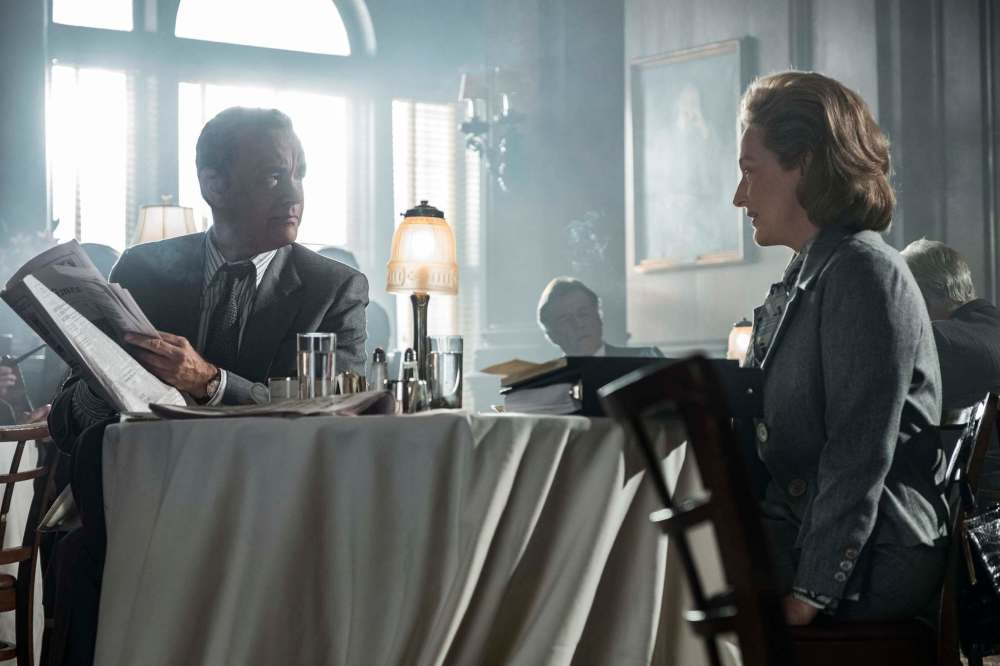
While the pursuit of a big story generates the excitement and nostalgia in The Post, it becomes the backdrop to the big decisions the newspaper’s publisher, Katharine (Kay) Graham (Meryl Streep), has to make on whether to run the story.
She also must decide on her role in life — continue being one of Washington’s key socialites or begin taking control of the corporate reins of her company, left to her after her husband’s suicide in 1963.
Pushing her on to make those decisions is intimidating executive editor Ben Bradlee (Tom Hanks), who rankles at the Postplaying second fiddle to the New York Times, especially when the Gray Lady scoops everyone by publishing details from the Pentagon Papers.
When a second copy of the Papers lands in the Washington Post’s lap, Bradlee urges his reporters, writers and editors on despite a court injunction that has halted the Times’ stories.
Whether to publish the stories in defiance of the injunction becomes Graham’s dilemma: Run them and lift the paper’s journalistic reputation or face contempt-of-court charges that threaten the future of her family’s business.
As much as Graham and Bradlee were newspaper superstars in the U.S., casting Hollywood legends Streep and Hanks proves to be a detriment. Hanks was able to do this in Spielberg’s previous historical drama, Bridge of Spies, and Streep has done it countless times during her storied career. In The Post, though, their presence often overwhelms the characters they play.
It makes you wonder what Spielberg could do without his access to the A-list of Hollywood’s A-list. It shows in the excellent supporting cast, especially Bob Odenkirk (Better Call Saul) as Post reporter Ben Bagdikian, who works the phones to hunt down a paranoid Ellsberg (Matthew Rhys of The Americans).

The result is such a nostalgic, romantic view of the newspaper business that it makes you wonder where the love for newspapers has gone all these years later.
So many of Spielberg’s films, be they thrillers such as the Raiders of the Lost Ark or the director’s masterpiece, Schindler’s List, focus on an individual’s battle against the government colossus. The Post follows suit, as the power brokers on the Washington Post’s board keep warning Graham that she is no match for a vindictive president Richard Nixon and his plumbers.
But like all those other Spielberg protagonists, Graham, egged on by Bradlee, decides to fight back against the White House and corporate sexism the best way she knows how.
Twitter: @AlanDSmall
Alan Small
Reporter
Alan Small was a journalist at the Free Press for more than 22 years in a variety of roles, the last being a reporter in the Arts and Life section.
Our newsroom depends on a growing audience of readers to power our journalism. If you are not a paid reader, please consider becoming a subscriber.
Our newsroom depends on its audience of readers to power our journalism. Thank you for your support.
Movie review
The Post
Starring Meryl Streep and Tom Hanks
Theatres
● PG
● 116 minutes
★★★1/2 stars out of five
Other voices
The standout is Bob Odenkirk as Ben Bagdikian, the kind of old-school reporter who wears out the soles of his shoes tracking down a scoop.
— Richard Roeper, Chicago Sun-Times
A blunt reminder that everything in this story concerning a craven, paranoid president’s loathing of an aggressive free press did not exactly vanish with the Nixon administration.
— Michael Phillips, Chicago Tribune
If the intention was to send audiences out feeling inspired about journalism and its function in a republic, consider that mission accomplished.
— Mick LaSalle, San Francisco Chronicle
The Post is so on the nose for the political moment that at times it almost seems it might have been produced not by Spielberg, but by some high-end marketing firm.
— Christopher Orr, The Atlantic
A pile of muck (old muck, too) with no rake, Steven Spielberg’s National Board of Review-approved Nixon-era newspaper drama The Post lacks the exact thing it glorifies: a reporter’s instinct for story.
— Ignatiy Vishnevetsky, AV Club
The beauty of Streep’s performance (and it’s one of her best in years) is how she lets you see her grow into the responsibility of her position. She elevates The Post from being a First Amendment story to a feminist one, too.
— Chris Nashawaty, Entertainment Weekly
Streep is revered for her great-lady acting, but she’s always freshest, and most alive, in comedy. Her performance here is terrific because it’s a whirlwind eddy of both.
— Stephanie Zacharek, Time magazine
Steven Spielberg’s drama about journalism under fire is so timely it’s practically a headline itself. Fine work from Streep and Hanks throughout.
— Rafer Guzman, Newsday
The Post works on many levels, from polemic and thinly veiled cautionary tale to fun period piece and rip-roaring newspaper yarn.
— Ann Hornaday, Washington Post
Alan Small
Reporter
Alan Small was a journalist at the Free Press for more than 22 years in a variety of roles, the last being a reporter in the Arts and Life section.
Our newsroom depends on a growing audience of readers to power our journalism. If you are not a paid reader, please consider becoming a subscriber.
Our newsroom depends on its audience of readers to power our journalism. Thank you for your support.
Advertisement Advertise With Us
Advertisement Advertise With Us