Laconic, sardonic look at Syrian refugee life

Advertisement
Read this article for free:
or
Already have an account? Log in here »
To continue reading, please subscribe:

Digital Subscription
One year of digital access for only $205*
- Enjoy unlimited reading on winnipegfreepress.com
- Read the E-Edition, our digital replica newspaper
- Access News Break, our award-winning app
- Play interactive puzzles
*First annual payment billed as $205.00 + GST for one year. This annual subscription will automatically renew at $233.00 + GST every 52 weeks (10% off the regular annual price of $259.35). Offer available to new and qualified returning subscribers only. Cancel any time.
To continue reading, please subscribe:
Add Free Press access to your Brandon Sun subscription for only an additional
$1 for the first 4 weeks*
- Enjoy unlimited reading on winnipegfreepress.com
- Read the E-Edition, our digital replica newspaper
- Access News Break, our award-winning app
- Play interactive puzzles
*Your next Brandon Sun subscription payment will increase by $1.00 and you will be charged $17.95 plus GST for four weeks. After four weeks, your payment will increase to $24.95 plus GST every four weeks.
Read unlimited articles for free today:
or
Already have an account? Log in here »
Hey there, time traveller!
This article was published 08/12/2017 (3227 days ago), so information in it may no longer be current.
Both melancholy and mordantly funny, if sometimes slightly slack, Aki Kaurismaki’s tale of the unexpected connection between a Syrian refugee and a Helsinki shirt salesman sees the sad-sack Finnish auteur (Leningrad Cowboys go America, The Man Without a Past) operating at peak deadpan.
Kaurismaki’s resolutely minimalist narrative runs in two parallel streams.
The Other Side of Hope (in Finnish, Swedish, Arabic and English, with subtitles) begins with Khaled (Sherwan Haji), a young Syrian man who barely got out of Aleppo alive, rising from a coal heap on a freighter that has just docked in Helsinki. Walking into the city centre, he tells a policeman he wants to apply for refugee status.
Meanwhile, Wikstrom (Kaurismaki regular Sakari Kuosmanen), a beige-looking middle-aged man, is ending his marriage. Placing his keys and his wedding ring on the kitchen table where his wife is drinking her morning vodka, he takes his wordless leave. A nearby cactus seems to comment on the arid state of things.
Selling up his vaguely 1970s stock of shirts, Wikstrom enters a high-stakes poker game and — Kaurismaki regulars being poker-faced by definition — manages to win a packet of money. He insists on investing the cash in a seedy, rundown restaurant, complete with an old-school jukebox, an incongruous Jimi Hendrix painting and several sad staff members. This very Kaurismakian collection of oddballs includes a lugubrious uniformed doorman, an undermotivated cook who can sleep standing up and a small dog.
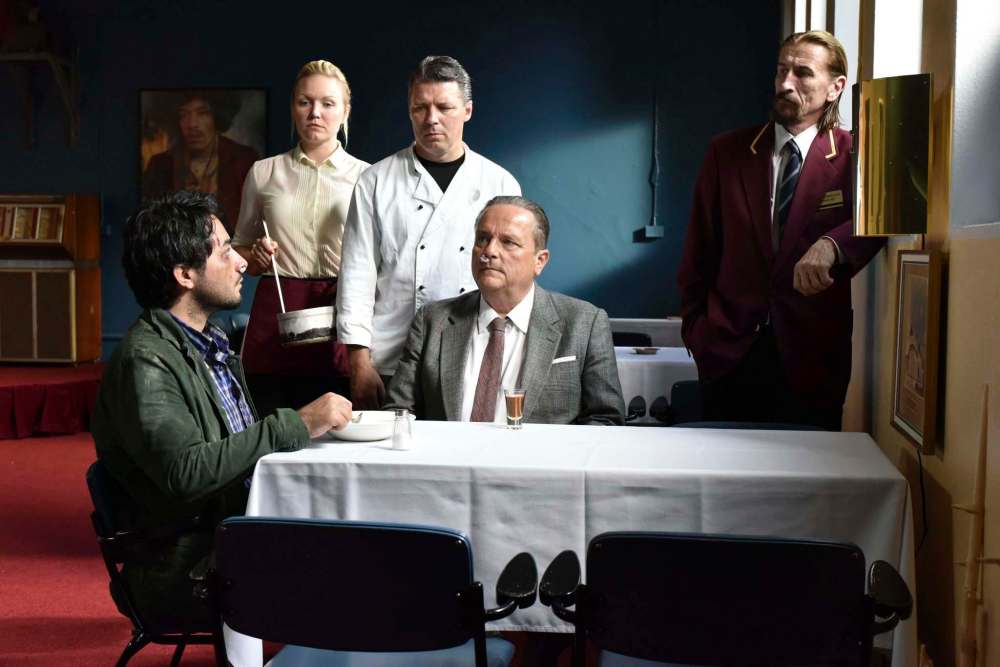
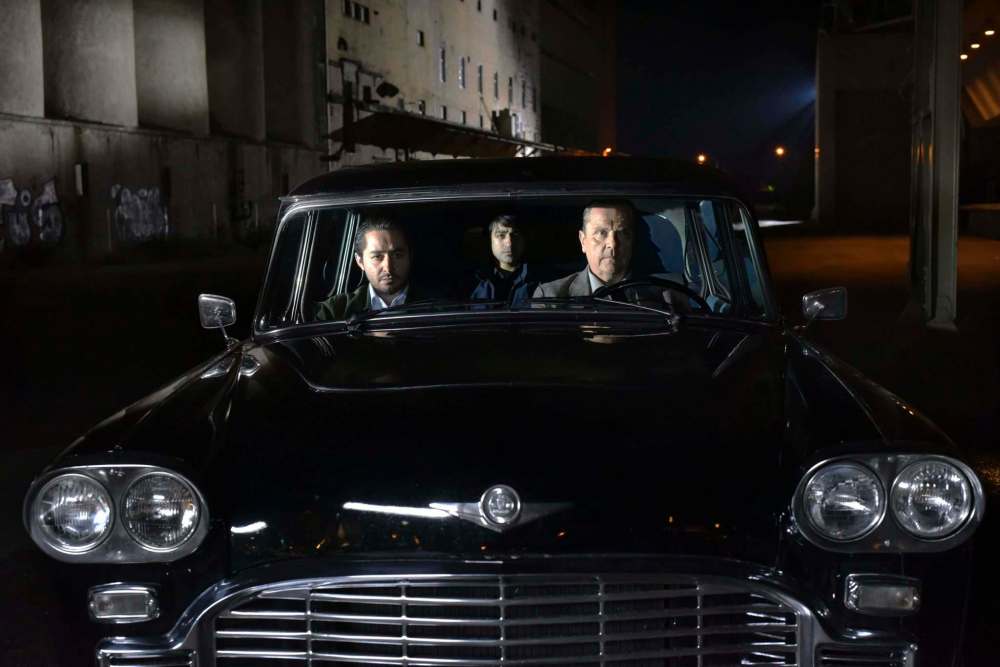
Somewhere near the middle of the film, the two narratives meet, when Khaled, denied asylum and forced underground, ends up working at the restaurant. Kaurismaki offers a typically understated vision of a Utopian society, in which mediocre cooking, good music and common humanity offer a temporary refuge from unfeeling officials and roving gangs of neo-Nazis.
The film’s distinctive style has a weird precision. The art direction is eccentric. The performances are low-energy. The dialogue is slow and sparse.
The setting is clearly contemporary, dealing with the Syrian war and the refugee crisis, but there are deliberately archaic touches.
Kaurismaki likes to construct his own little world, where people tap away at manual typewriters and smoke their heads off in public places. (One suspects this is a wry Kaurismakian joke: Finland actually enforces some of the toughest anti-smoking policies in Europe.)
Walking a tricky tonal tightrope between comedy and tragedy, Kaurismaki occasionally falls off. The characters’ ill-fated attempt to reinvent themselves as a sushi restaurant feels like a misfire.
On the other hand, the low-key approach to violence and horror, most of which occurs off-screen, can be very effective. When Khaled speaks of the rocket attack that killed most of his family and destroyed his home, he is reporting dispassionately to an immigration official. Somehow, this restraint makes his account even more devastating.

The Other Side of Hope is also a social-issue film that refuses to be didactic. (The only thing Kaurismaki is doctrinaire about is guitar music, which keeps popping up at the oddest times, in bursts of Nordic rockabilly and old-style country and western.)
Khaled and his friends and family members repeat several times that they have been helped on their way “by good people.”
Institutions, organizations and governments in this story are callous, if not outright cruel.
Instead, Kaurismaki places his hope in individuals, his sad but tender story making a modest and much-needed case for the value of simple human kindness.
alison.gillmor@freepress.mb.ca
Studying at the University of Winnipeg and later Toronto’s York University, Alison Gillmor planned to become an art historian. She ended up catching the journalism bug when she started as visual arts reviewer at the Winnipeg Free Press in 1992.
Our newsroom depends on a growing audience of readers to power our journalism. If you are not a paid reader, please consider becoming a subscriber.
Our newsroom depends on its audience of readers to power our journalism. Thank you for your support.
Movie review
The Other Side of Hope
Starring Sherwan Haji and Sakari Kuosmanen
Cinematheque
14A
104 minutes
★★★ 1/2 stars out of five
Other voices
Kaurismaki unashamedly believes in brotherhood, and among other things his film celebrates people who do the right thing without making a big deal about it.
— Kenneth Turan, Los Angeles Times
It’s at once honest and artful, a touching and clearsighted declaration of faith in people and in movies.
— A.O. Scott, New York Times
A movie about the important subject of Syrian refugees that subsumes every idea, theme and argument under Kaurismäki’s penchant for expressionless actors who smoke a lot and stare into camera while not saying much at all.
— Kevin Maher, The Times
The Other Side of Hope wants to take you back to a time when quirkiness in cinema felt not cute but bold. Apart from the songs, though, it just feels cute now. If that.
— Owen Gleiberman, Variety
Studying at the University of Winnipeg and later Toronto’s York University, Alison Gillmor planned to become an art historian. She ended up catching the journalism bug when she started as visual arts reviewer at the Winnipeg Free Press in 1992.
Our newsroom depends on a growing audience of readers to power our journalism. If you are not a paid reader, please consider becoming a subscriber.
Our newsroom depends on its audience of readers to power our journalism. Thank you for your support.
Advertisement Advertise With Us
Advertisement Advertise With Us