Mixed doubles match
Husband-and-wife directors work together to serve up social upheaval drama centred on women's lib-era tennis showdown between Billie Jean King and Bobby Riggs

Advertisement
Read this article for free:
or
Already have an account? Log in here »
To continue reading, please subscribe:

Digital Subscription
One year of digital access for only $205*
- Enjoy unlimited reading on winnipegfreepress.com
- Read the E-Edition, our digital replica newspaper
- Access News Break, our award-winning app
- Play interactive puzzles
*First annual payment billed as $205.00 + GST for one year. This annual subscription will automatically renew at $233.00 + GST every 52 weeks (10% off the regular annual price of $259.35). Offer available to new and qualified returning subscribers only. Cancel any time.
To continue reading, please subscribe:
Add Free Press access to your Brandon Sun subscription for only an additional
$1 for the first 4 weeks*
- Enjoy unlimited reading on winnipegfreepress.com
- Read the E-Edition, our digital replica newspaper
- Access News Break, our award-winning app
- Play interactive puzzles
*Your next Brandon Sun subscription payment will increase by $1.00 and you will be charged $17.95 plus GST for four weeks. After four weeks, your payment will increase to $24.95 plus GST every four weeks.
Read unlimited articles for free today:
or
Already have an account? Log in here »
Hey there, time traveller!
This article was published 23/09/2017 (3291 days ago), so information in it may no longer be current.
TORONTO — Battle of the Sexes is set in a reproduction of 1973, an epoch of long sideburns, garishly coloured interiors and an overall Playboy Mansion esthetic that feels uncomfortably accurate for those of us who lived through it.
It was also a benchmark period for feminism that saw the dawn of Ms. Magazine, the Equal Rights Amendment and the U.S. Supreme Court’s ruling in Roe v. Wade.
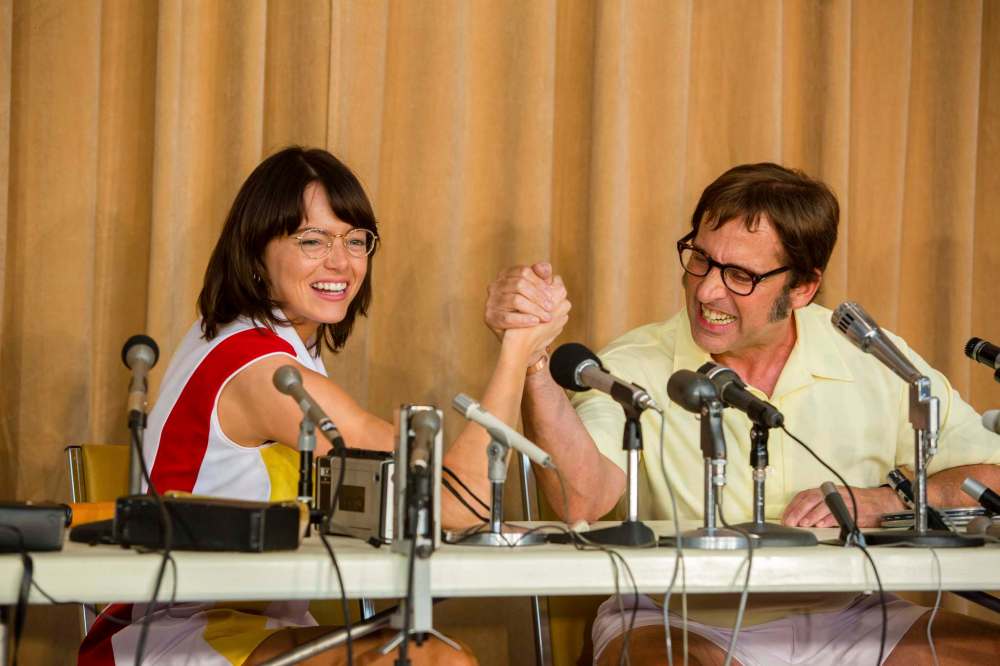
On the cultural front, the gender tension became exemplified by a tennis match between an over-the-hill former men’s player named Bobby Riggs and determined 29-year-old women’s champ Billie Jean King. An estimated 90 million people watched the match at home or, if they were lucky, live at a lavish event at the Houston Astrodome.
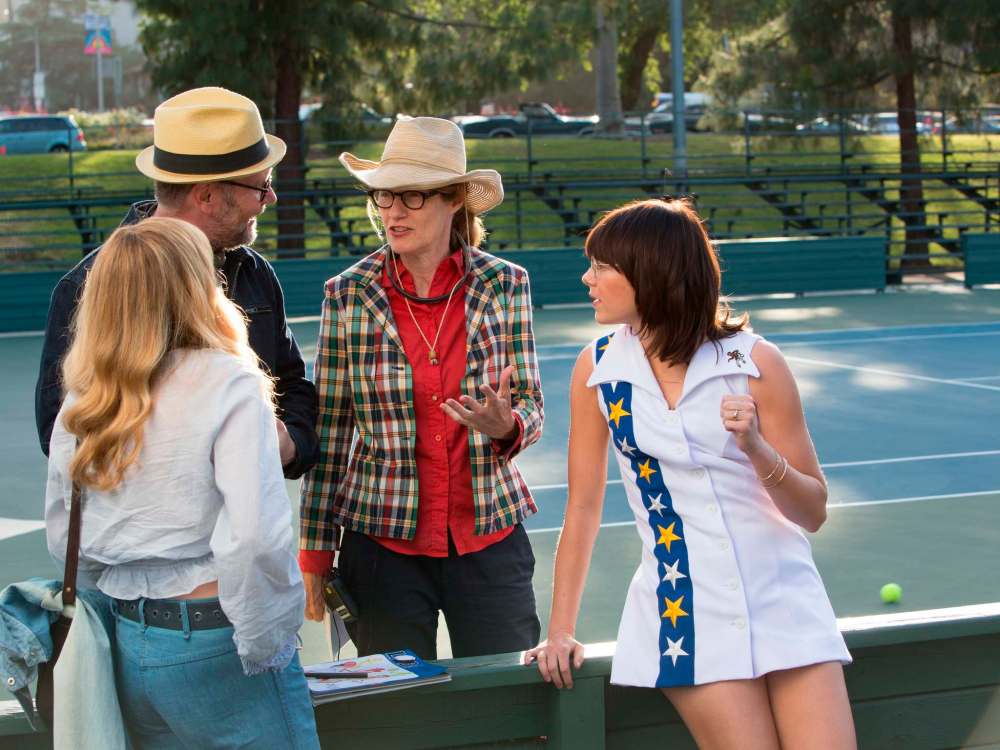
The game and the surprising events leading up to it are the subject of a drama directed by husband-and-wife filmmakers Valerie Faris and Jonathan Dayton, whose past films include Little Miss Sunshine and Ruby Sparks.

The film’s narrative, scripted by Simon Beaufoy (Slumdog Millionaire) volleys between the perspectives of both players. Riggs, played by Little Miss Sunshine vet Steve Carell, is seen as a compulsive hustler, even as he lives the lifestyle of a kept man, working a corporate job for the father of his well-off wife (Elizabeth Shue).
More surprising is the story of King (played by Emma Stone), seemingly happily married to a supportive husband, but exploring her sexuality via an illicit affair with a hairstylist (Andrea Riseborough), years before King would eventually come out as a lesbian.
At the Toronto International Film Festival the morning after the gala screening, co-directors Faris and Dayton clarified that while the movie alternates between male and female perspectives, that wasn’t reflected in a gender division of duties on the other side of the camera.
“We’ve done this for 20 years together and we really don’t divide things much at all,” Faris said. “We’re parents, too, and we don’t divide those duties. We do everything together.”
“But there’s no question that we bring our life experience as a man and a woman,” added Dayton. “That informs what we do, so I think that was a bonus on a film like this where those were in play.”
The issue comes up because the film includes a love scene between Stone and Riseborough that, while modest, possesses an undeniable erotic charge as King explores a hitherto unexamined aspect of her sexuality.
“It’s funny because Emma has never really done a full-on love scene,” Faris said. “She described this as her first sex scene.”
“She’s incredibly modest,” Dayton added. “We wanted to get it right and just find the right balance, something that had a charge but wasn’t… “
“… Too much from the male gaze,” Faris said, completing the thought. (Yep, they’re married all right.)
“In a potentially mainstream movie, to have a real love scene with two women was important to us,” Faris said. “That was a big issue.”
The film does not break down the “battle” as a fight between good and evil. In fact, Riggs is portrayed sympathetically, notwithstanding the sexist rhetoric he employed to hype the match, which included the assertion that women belonged exclusively in the bedroom and the kitchen.
“I think he was a chauvinist, but not the rabid chauvinist his public persona suggested,” said Dayton. “He was a chauvinist like 90 per cent of men were at the time.”

“I think he really loved women and he respected them,” Faris said, acknowledging that his oft-hateful words offer a timely reminder here in the Trump era: Words have consequences.
“That was not lost on us,” Dayton said. “We began this project long before the election and it was just unbelievable to see things in the news play out as if they were from our movie… or worse.”
“We had a screening of the movie before the election and one after,” Faris said. “And it was interesting to see — wow — after the election, people were so sensitized to the issues.
“Before, it was a story about a woman winning,” she said. “But the new reality coloured the film. We didn’t change anything. We made the same film. But I think it did shed a completely different light on the subject.”
randall.king@freepress.mb.caTwitter: @FreepKing
Our newsroom depends on a growing audience of readers to power our journalism. If you are not a paid reader, please consider becoming a subscriber.
Our newsroom depends on its audience of readers to power our journalism. Thank you for your support.
Movie preview
Battle of the Sexes
Starring Emma Stone and Steve Carell
Opens Sept. 29
PG
122 minutes
Our newsroom depends on a growing audience of readers to power our journalism. If you are not a paid reader, please consider becoming a subscriber.
Our newsroom depends on its audience of readers to power our journalism. Thank you for your support.
Advertisement Advertise With Us
Advertisement Advertise With Us