Quiet drama finds beauty in the North
Quebec-Nunavut co-production offers impressionistic view of the 1950s

Advertisement
Read this article for free:
or
Already have an account? Log in here »
To continue reading, please subscribe:
Digital Subscription
One year of digital access for only $1.44 a week*
- Enjoy unlimited reading on winnipegfreepress.com
- Read the E-Edition, our digital replica newspaper
- Access News Break, our award-winning app
- Play interactive puzzles
*Billed as $5.77 plus GST every four weeks. After 52 weeks, price increases to the regular rate of $19.95 plus GST every four weeks. Offer available to new and qualified returning subscribers only. Cancel any time.
To continue reading, please subscribe:
Add Free Press access to your Brandon Sun subscription for only an additional
$1 for the first 4 weeks*
- Enjoy unlimited reading on winnipegfreepress.com
- Read the E-Edition, our digital replica newspaper
- Access News Break, our award-winning app
- Play interactive puzzles
*Your next Brandon Sun subscription payment will increase by $1.00 and you will be charged $17.95 plus GST for four weeks. After four weeks, your payment will increase to $24.95 plus GST every four weeks.
Read unlimited articles for free today:
or
Already have an account? Log in here »
Hey there, time traveller!
This article was published 11/10/2019 (2566 days ago), so information in it may no longer be current.
This quiet film is based on Manitoba writer Gabrielle Roy’s novel La rivière sans repos (or Windflower in English) and set in northern Quebec’s Nunavik region.
The story opens in 1945, at the tail end of the Second World War. American GIs are stationed at Fort Chimo (now known as Kuujjuaq), a Hudson’s Bay Company outpost at the mouth of the Koksoak River.
Elsa (Malaya Qaunirq Chapman) is a smiley-faced young Inuk woman who loves attending movies in town with her friends. She catches the eye of a blue-eyed soldier, whose flirtation leads to violation.
The resulting pregnancy wipes the joy out of Elsa’s eyes, but when she gives birth to a blond, blue-eyed son she calls Jimmy, her family embraces him, and her sunny disposition returns.
However, she is torn about how to raise her between-two-worlds child. Influenced by Mme. Beaulieu (Magalie Lépine Blondeau), for whom she works cleaning house and babysitting, at first she adopts a white woman’s style of parenting, diapering Jimmy, putting him in a playpen and dressing him in store-bought clothes. Her mother Winnie (Taqraliq Partridge) disapproves, but she also doesn’t want Elsa raising him on the land.
With charming period detail, the film — in English and Inuktitut (with subtitles) — captures a pivotal time in Inuit history, when people were torn between the old ways and the new, and when white culture was beginning to dominate.
Elsa’s parents were born on a remote camp; they have since moved into a humble cabin that is still lit by a qulliq, or oil lamp, but they use it to read comic books or hymnals the kindly pastor brings them. Her father still hunts and fishes but they also buy groceries at the HBC store.
The Beaulieus treat her well, but they have little respect for her culture or her personal life.
When Elsa meets Isaki (Etua Snowball), her father’s cousin, she is tempted by his lifestyle. Isaki considers her father a slave, beholden to the idea of money and belongings, while he is free, providing for himself the way his people have done for centuries.
Co-writers/directors Marie-Hélène Cousineau and Madeline Ivalu (who also stars as Elsa’s grandmother) are better with silence than they are with dialogue. Roy is a poetic writer, but the characters’ exchanges here are mostly cursory and stilted; the acting could kindly be called naturalistic (Chapman is lovely to watch, and there are faces full of character), but it’s often just wooden.
The sense of place in this Quebec-Nunavut co-production is where the poetry comes in. The camera lingers on winter landscapes so bereft of colour they could be sketched in pen and ink, and finds beauty in the bright dresses of girls set against the brief greens of summer and the low-burning hues of fall that are so specific to the region.
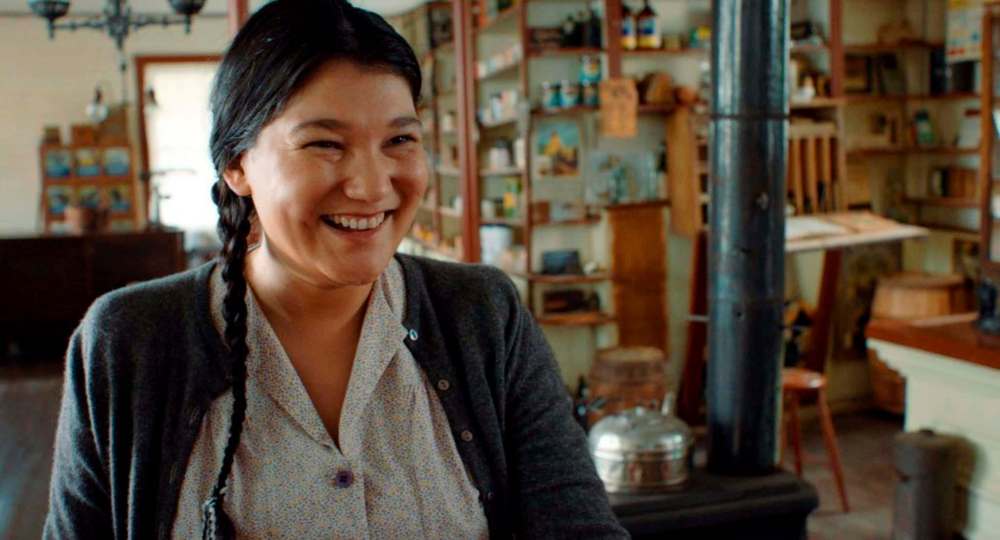

Elsa’s time with the taciturn but kind Isaki doesn’t romanticize the traditional way of life but shows us its appeal, allows us to wonder at the comforts that can be wrested from such a barren-seeming landscape (though her eventual romantic relationship with him is bound to make viewers uncomfortable).
As an impressionistic view of 1950s life in the North, Restless River is endlessly watchable, but when it comes to telling a story, the film is frustrating. There are too many pregnant pauses that reveal nothing, too many time-jumps that leave character development in the dirt, too many scenes that seem freighted with significance but go nowhere.
It’s not often you want more tell and less show, but more insight into Elsa’s mindset would be welcome. Though her path and that of her son are shaped inexorably by the forces of white influence, she’s far from passive. By the film’s end, however, we’re left wondering if she’s found contentment or is merely resigned to her fate.
jill.wilson@freepress.mb.ca
Twitter: @dedaumier
Jill Wilson is the editor of the Arts & Life section. A born and bred Winnipegger, she graduated from the University of Winnipeg and worked at Stylus magazine, the Winnipeg Sun and Uptown before joining the Free Press in 2003. Read more about Jill.
Jill oversees the team that publishes news and analysis about art, entertainment and culture in Manitoba. It’s part of the Free Press‘s tradition, since 1872, of producing reliable independent journalism. Read more about Free Press’s history and mandate, and learn how our newsroom operates.
Our newsroom depends on a growing audience of readers to power our journalism. If you are not a paid reader, please consider becoming a subscriber.
Our newsroom depends on its audience of readers to power our journalism. Thank you for your support.
Movie Review
Restless River
Starring Malaya Qaunirq Chapman
Cinematheque, to Oct. 19
★★★ out of five
Jill Wilson is the editor of the Arts & Life section. A born and bred Winnipegger, she graduated from the University of Winnipeg and worked at Stylus magazine, the Winnipeg Sun and Uptown before joining the Free Press in 2003. Read more about Jill.
Jill oversees the team that publishes news and analysis about art, entertainment and culture in Manitoba. It’s part of the Free Press‘s tradition, since 1872, of producing reliable independent journalism. Read more about Free Press’s history and mandate, and learn how our newsroom operates.
Our newsroom depends on a growing audience of readers to power our journalism. If you are not a paid reader, please consider becoming a subscriber.
Our newsroom depends on its audience of readers to power our journalism. Thank you for your support.
Advertisement Advertise With Us
Advertisement Advertise With Us