Sequel revives edgy Scottish quartet
Return to seedy underworld should satisfy 1996 film's rabid admirers
Advertisement
Read this article for free:
or
Already have an account? Log in here »
To continue reading, please subscribe:

Digital Subscription
One year of digital access for only $205*
- Enjoy unlimited reading on winnipegfreepress.com
- Read the E-Edition, our digital replica newspaper
- Access News Break, our award-winning app
- Play interactive puzzles
*First annual payment billed as $205.00 + GST for one year. This annual subscription will automatically renew at $233.00 + GST every 52 weeks (10% off the regular annual price of $259.35). Offer available to new and qualified returning subscribers only. Cancel any time.
To continue reading, please subscribe:
Add Free Press access to your Brandon Sun subscription for only an additional
$1 for the first 4 weeks*
- Enjoy unlimited reading on winnipegfreepress.com
- Read the E-Edition, our digital replica newspaper
- Access News Break, our award-winning app
- Play interactive puzzles
*Your next Brandon Sun subscription payment will increase by $1.00 and you will be charged $17.95 plus GST for four weeks. After four weeks, your payment will increase to $24.95 plus GST every four weeks.
Read unlimited articles for free today:
or
Already have an account? Log in here »
Hey there, time traveller!
This article was published 31/03/2017 (3432 days ago), so information in it may no longer be current.
Trainspotting became an unlikely cultural touchstone when it was released in 1996. What should have been a downbeat, depressing story about a bunch of Scottish heroin addicts somehow became a spirited if cynical portrait of Thatcher-era Britain. And the movie was a stylistic triumph, introducing director Danny Boyle’s nervy, bold, often witty visual sense to a generation already primed for that approach by Quentin Tarantino’s Pulp Fiction.
As exhilarating as Trainspotting was as a piece of directorial derring-do, it was the characters — brought to life in John Hodge’s crackerjack adaptation of Irvine Welsh’s 1993 novel — that made the film an instant classic. Led by Ewan McGregor’s Mark Renton, a junkie whose unsuccessful attempts to get clean formed the Sisyphean spine of the narrative, Welsh’s bleary band of ne’er-do-wells were alternately charismatic, heart-rending, fascinating and repulsive.
According to Boyle, he’d always wanted to do a sequel to Trainspotting, which ended with Renton making off with more than his share of the ill-gotten gains of a drug deal. The problem was that, 10 years later, his actors looked too young and healthy to play hard-bitten middle-aged former and practising drug addicts convincingly.
Even 21 years later, McGregor and his co-stars still look improbably hale and hearty in T2 Trainspotting, a follow-up that captures the brio and brotherly angst and affection of its predecessor, if not its clarion sense of urgency. Having gotten sober (and married) in the Netherlands, Renton returns to Scotland, where he renews his ties with Simon, a.k.a. Sick Boy (Jonny Lee Miller), Spud (Ewen Bremner) and, in one of the movie’s most amusingly choreographed sequences, the hotheaded Begbie (Robert Carlyle).
Like all reunions, this one is fraught with unresolved tensions and past grievances, as well as soul-crushing guilt.
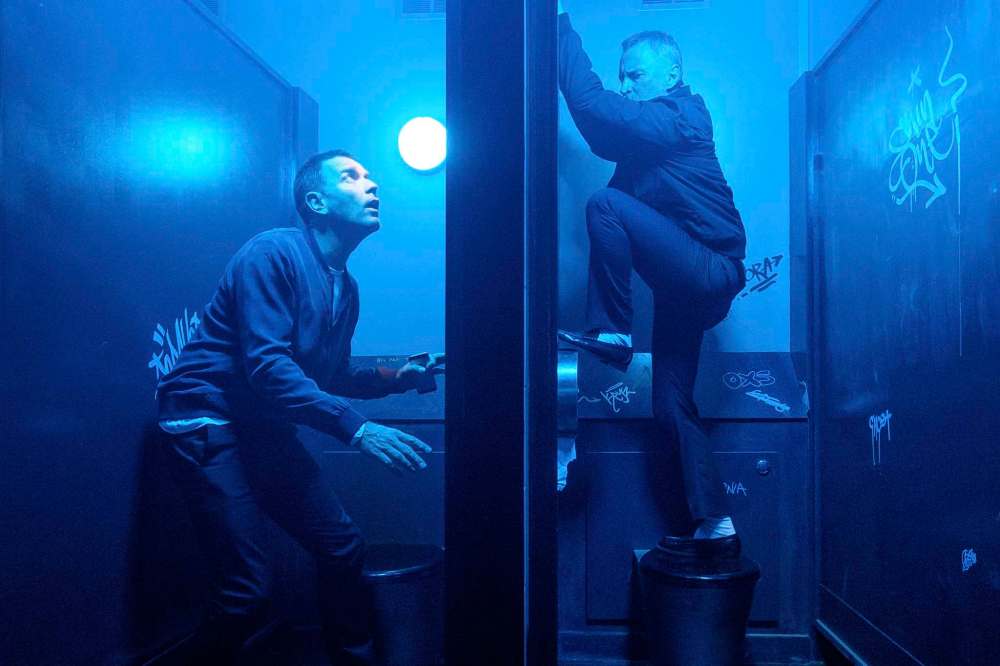
True to Trainspotting’s core ethic, it’s also subject to a lot of self-conscious analysis about 21st-century dislocation and the dangers of nostalgia, which at one point a character compares to being “a tourist in your own past.”
Although Trainspotting was his breakout film, Boyle has gone on to prove his bona fides with such hits as Slumdog Millionaire and the opening ceremony of the London Summer Olympics. Fluent, adroit and alert, he’s skilful to the point of being virtually incapable of making a bad film.
T2 bristles with his signature flourishes — an early scene features funny on-screen titles to help translate Begbie’s haggis-thick Scottish burr — as well as quick nods to the original film, whose signature scenes (Renton’s manic grin through the windshield of a car that’s almost killed him; the Worst Toilet in Scotland) are recapitulated with playful reverence. Once again, Hodge has written a clever script full of quicksilver references and timely jokes that cast a jaundiced eye on pre-Brexit Britain, technology, rampant consumerism and the “great wave of gentrification (that) has yet to engulf us,” as Simon says, referring to the lonely bar he manages while embroiling his Bulgarian girlfriend, Veronika (Anjela Nedyalkova), in sexual blackmail schemes.

Shot with verve and sensitivity by Anthony Dod Mantle, T2 is spiked with lots of flashbacks to the boys’ youth — often by way of lyrically scratchy home movies — that begin to make even their most sordid exploits ring with artisanal authenticity. The challenge here, as in the first film, is not to flinch from their depravity, but to humanize them enough that viewers still manage to care.
That’s far easier where Spud is concerned — Bremner infuses him with gawky, long-limbed vulnerability. It’s less effective when it comes to Simon and Begbie, whose nastiness can’t be erased by occasional erudition or grim slapstick humour.
As ever, McGregor makes for a sympathetic protagonist and reasonably trustworthy guide through a world most filmgoers never hope to see up close. The question is whether even Trainspotting’s most rabid admirers will feel compelled to take another trippy journey to the other side.
Its virtuosity, wit, fleet performances and cool self-awareness notwithstanding, T2 doesn’t feel like a necessary film as much as a respectful and respectable exercise in fan service. It’s Beauty and the Beast for filmdom’s edgier other half. They’re getting a terrific movie, even if the stakes feel exponentially lower this time around.
— Washington Post
Movie Review

T2 Trainspotting
Starring Ewen McGregor, Jonny Lee Miller, Ewen Bremner and Robert Carlyle
Grant Park
18A
117 minutes
3 1/2 stars out of 5
Other voices
T2 Trainspotting has one foot firmly planted in nostalgia and the other rooted in the present, and thanks in great part to Boyle’s unique, world-class talent, everything old feels new again.
— Richard Roeper, Chicago Sun-Times
T2 Trainspotting should not work as well as it does. In fact, it shouldn’t work at all. But up there on the screen, where it matters, the dark magic remains intact and logic be damned.
— Kenneth Turan, Los Angeles Times
There’s something reassuring about how little Sick Boy, Begbie, Spud and Renton have learned about life in the past two decades.
— Peter Howell, Toronto Star
Never mind plot: a lot of it isn’t even comprehensible.
— Camilla Long, Sunday Times
In its best moments, the film deploys an inventive range of flashbacks to the first film to show the extent to which nostalgia exerts its grip.
— Alistair Harkness, Scotsman
Advertisement Advertise With Us
Advertisement Advertise With Us