Skipping this Winnipeg class a mistake
Advertisement
Read this article for free:
or
Already have an account? Log in here »
To continue reading, please subscribe:

Digital Subscription
One year of digital access for only $205*
- Enjoy unlimited reading on winnipegfreepress.com
- Read the E-Edition, our digital replica newspaper
- Access News Break, our award-winning app
- Play interactive puzzles
*First annual payment billed as $205.00 + GST for one year. This annual subscription will automatically renew at $233.00 + GST every 52 weeks (10% off the regular annual price of $259.35). Offer available to new and qualified returning subscribers only. Cancel any time.
To continue reading, please subscribe:
Add Free Press access to your Brandon Sun subscription for only an additional
$1 for the first 4 weeks*
- Enjoy unlimited reading on winnipegfreepress.com
- Read the E-Edition, our digital replica newspaper
- Access News Break, our award-winning app
- Play interactive puzzles
*Your next Brandon Sun subscription payment will increase by $1.00 and you will be charged $17.95 plus GST for four weeks. After four weeks, your payment will increase to $24.95 plus GST every four weeks.
Read unlimited articles for free today:
or
Already have an account? Log in here »
Hey there, time traveller!
This article was published 27/11/2009 (6080 days ago), so information in it may no longer be current.
Should anyone need their faith restored in the public school system, all they need do is watch this quietly affecting Winnipeg-made documentary.
Filmmakers John Paskievich and John Whiteway show how a committed and idealistic teacher can make a difference in the lives of his students, and at the same time improve the wider community.
The 60-minute production, shot in 2008 at Gordon Bell High School, looks to have been made entirely without artifice.
Paskievich, whose previous documentaries (Ted Barlyuk’s Grocery and The Gypsies of Svinia, among them) have been marked by an austere esthetic, avoids any kind of Michael Moore-like showiness.
His camera remains largely still. There is no music and virtually no narration, except for bits of voice-over from the main subject. Whiteway, a nature documentarian and substitute teacher at Gordon Bell, handled the sound. He got Paskievich involved.
The editing, which they did together, is basic; the screen fades unobtrusively to black between scenes. Much of the time students talk directly to the camera.
"People get the wrong idea about our school," one girl says. "They assume that because we’re inner city, we’re not a good school. But Gordon Bell is full of great people and great things. There are a lot of different cultures, and I see that as a good thing."
But teacher Marc Kuly, a boyish fellow of about 30, had noticed what all his students knew by experience. The various ethnic subcultures — aboriginals, African, Arabic, Asian, as well as urban whites — kept to themselves.
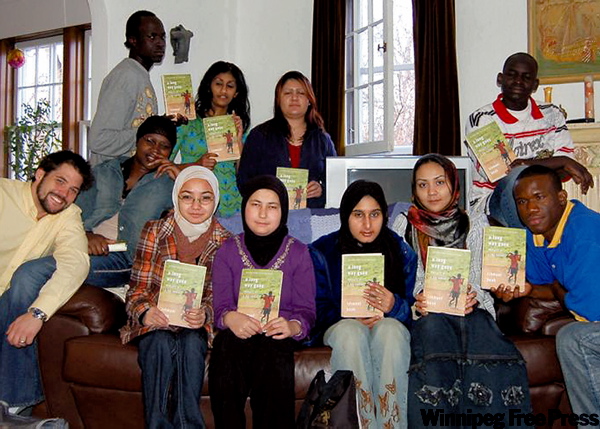
Kuly had read the famous 2007 memoir by Ishmael Beah, A Long Way Gone, which recounts the author’s harrowing time as a boy soldier in Sierra Leone in the 1990s.
When Kuly assigned it to his Grade 12 class, the normally skeptical crowd came alive. Many of these kids, from disadvantaged core-area homes or from war-torn lands themselves, had their eyes opened. Here was a young man confessing to experiences vastly worse than their own.
Kuly used the book as the starting point for his own storytelling project, in which he involved only volunteer students.
Meeting once a week outside of regular class, the teens agreed to tell each other their stories, and more important, to listen to each other’s stories, as a way of bridging the various solitudes that existed in the school.
Paskievich follows the process as the students open up, as Beah himself comes to visit them, and as they graduate from high school.
It’s hard to know what is more moving — the students’ emerging self-confidence or Kuly’s immense respect for what they’ve accomplished.
Not revealed is that Kuly had a professional connection to the New York-based storyteller Laura Simms, who fostered Beah in the U.S.
That may have been why Kuly was reading A Long Way Gone to begin with and why Beah agreed to travel to Winnipeg.
The camera captures Beah as a soft-spoken yet worldly presence with an Obama-like charisma. But it’s Kuly who emerges as the documentary’s unqualified star.
With hair unkempt and dressed like one of his students, he nonetheless comes across as the best kind of natural-born teacher.
In 2007, as the result of his storytelling class, Kuly was given an arts-education award by the Manitoba Foundation for the Arts.
It’s to Paskievich and Whiteway’s credit that they have documented this important project for posterity.
morley.walker@freepress.mb.ca