Staying in the picture
Sticking with Godfather role propelled Pacino to legendary career
Advertisement
Read this article for free:
or
Already have an account? Log in here »
To continue reading, please subscribe:

Digital Subscription
One year of digital access for only $205*
- Enjoy unlimited reading on winnipegfreepress.com
- Read the E-Edition, our digital replica newspaper
- Access News Break, our award-winning app
- Play interactive puzzles
*First annual payment billed as $205.00 + GST for one year. This annual subscription will automatically renew at $233.00 + GST every 52 weeks (10% off the regular annual price of $259.35). Offer available to new and qualified returning subscribers only. Cancel any time.
To continue reading, please subscribe:
Add Free Press access to your Brandon Sun subscription for only an additional
$1 for the first 4 weeks*
- Enjoy unlimited reading on winnipegfreepress.com
- Read the E-Edition, our digital replica newspaper
- Access News Break, our award-winning app
- Play interactive puzzles
*Your next Brandon Sun subscription payment will increase by $1.00 and you will be charged $17.95 plus GST for four weeks. After four weeks, your payment will increase to $24.95 plus GST every four weeks.
Read unlimited articles for free today:
or
Already have an account? Log in here »
Hey there, time traveller!
This article was published 04/12/2016 (3559 days ago), so information in it may no longer be current.
BEVERLY HILLS, Calif. — On this, almost everyone was agreed: Al Pacino was looking like a disaster as Michael Corleone.
Shooting had begun in early 1971. Pacino recalls the Paramount suits looking at the rushes and saying, “What the hell is this kid doing? And he’s short to boot.”
They thought he was delivering an “anemic” performance. The studio brass, Pacino says, “tried to fire me three times.”

There “was a movement not to have me in the part,” the 76-year-old actor recalls, sitting on the porch of his rental house in the flats of Beverly Hills.
“I didn’t want me in the part.”
Paramount had wanted Ryan O’Neal or Robert Redford to play Michael in The Godfather, America’s great epic about violence and family. Pacino himself thought he would be better as the hotheaded older brother instead of in the role that secured his stardom.
“Michael? Sonny would be more appropriate,” he remembers thinking.
But ultimately, he knew what he was doing.
“I was trying to create a character who you don’t know where you’re at with him,” Pacino says.
“I knew it was a tough part to pull off. Michael’s so insular, so private.”
Writer and director Francis Ford Coppola believed. He had always envisioned Pacino, already an acclaimed New York stage actor, as Michael.
“His intelligence is what I noted first. He knows how to use his gifts,” says Coppola. “He uses what he has, this striking magnetic quality, this smouldering ambiance.”
Then came the Sollozzo scene.
Michael, teeth clenched, eyes darting, grabs the gun hidden in the restaurant bathroom and shoots Corleone rival Sollozzo and corrupt New York police captain McCluskey. It’s the law-abiding son’s first mob hit, and it seals his fate as his father’s replacement.
The scene sealed the actor’s fate, too. Pacino, who will receive a Kennedy Center Honor today, stayed in the picture. Audiences saw what he was doing, having Michael’s character build with the story. Pacino, the New York Times noted, is “an actor worthy to have Brando as his father.”
● ● ●
Pacino is sipping tea, surrounded by hounds, in front of his white-columned house in this fabled, palm-lined enclave. He’s at ease, but he doesn’t fit, an inveterate New Yorker in a far too sunny place.
Buses loiter on his block every few minutes, tourists trying to steal a glimpse beyond the gates of the man whom film historian David Thomson in 2002 deemed “our greatest actor now.” Pacino is the winner of an Oscar (eight nominations), two Tonys, two Emmys, four Golden Globes (17 nominations) and a National Medal of Arts.
In person, he does not disappoint. He seduces. Call me Al. Here’s my cell number. A kiss on each cheek. Everything, except his physical stature, is outsize.
His skin is tanned the colour of cognac; the hair a tempest. His voice, a Bronx rasp, shades the world in italics. Where Robert De Niro recedes in public appearances, all nods and mumbles, Pacino offers a banquet of observations.
“Talk is therapy,” he says, opening his arms.
“Everything’s therapy. I’ve been in therapy my whole life.”
Among Pacino’s ancillary talents is making fine Italian suiting — he’s wearing a tuxedo jacket this day — look like thrift-store rejects. It’s Salvation Gabbana. The getup — baggy black T-shirt, baggy black pants, oversized silver and black ring — is impossible. But it all works.
“He never looks like a movie star,” says Ellen Burstyn, his co-president at the Actors Studio and co-star in Sea of Love.
“He always looks like he slept on someone’s couch.”
Pacino has been a star for 44 years, yet he still displays a penchant for risk and for working with young talent. Famous for saying no in the beginning of his career, “The last 20 years, I say yes more. I don’t know why,” he says.
He’s filming Hangman with Johnny Martin, an unknown director.
He’s also that rare actor who is not just admired but loved by his peers.
“I can’t think of any actor whom people care more about in films than Al,” says friend Alec Baldwin, who has appeared in two of his movies.
‘I can’t think of any actor whom people care more about in films than Al. There are actors who are admired, but Al they embrace’– Alec Baldwin on Al Pacino
“There are actors who are admired, but Al they embrace.”
In the span of a dozen years, beginning with 1971’s The Panic in Needle Park, he created a cinematic canon few can best: the first two Godfather movies, Serpico, Dog Day Afternoon (he initially turned down the great Sydney Lumet; “What can I say? I was ignorant”) and Scarface, eviscerated by critics at the time but ultimately placed atop pop culture’s altar.
More indelible lines of dialogue are associated with him than with almost any other actor, a testament not only to the way the roles were written but to how he came to own them.
He’s initially drawn to the script.
“I’m very text-oriented. The text is everything,” he says.
“The play’s the thing.”
Coppola says Pacino will “write out the whole part, the text of the dialogue, then interpret in the terms of language he would normally colloquially use.”
“Then he translates it into the language of the script.”
● ● ●
He keeps doing theatre, his first love, including a 2010 New York performance of Shylock in The Merchant of Venice that critics deemed revelatory. He has performed Richard III many times, including in Looking for Richard, a 1996 exploration of the work he directed and financed.
Hamlet is “my favourite play of Shakespeare,” he confesses. “I never thought of doing it. I didn’t feel right about it.”
Pacino has done exceptional television work: he played closeted New York superlawyer Roy Cohn, dying of AIDS, in Angels in America, pathologist and assisted suicide advocate Jack Kevorkian in You Don’t Know Jack, the legendary record producer in Phil Spector. He has also made dreck — perhaps the nadir was playing a version of himself in Adam Sandler’s Jack and Jill, which he prefers not to talk about.
And then he does. “My accountant was put in jail,” he says. “That was part of the genesis.”
Pacino was one of many celebrities who invested their savings with financial adviser Kenneth I. Starr, who pleaded guilty in 2010 to stealing at least US$59 million from his clients. Know for his loyalty, Pacino shrugged it off, friends say, and went on.
Work keeps him sane.
“He loves the whole aspect of making movies, and he’s sort of fearless,” says filmmaker Barry Levinson, who co-wrote the 1979 courtroom drama …And Justice for All and directed Pacino in You Don’t Know Jack and The Humbling, a 2014 movie made for less than US$2 million.
“He’s easy to work with. It’s fun. He’ll just say, ‘Let’s try this.’ You keep playing with it, keep trying and seeing what else is there.”
In the early days, Pacino was known as the actor who would ask for just one more take.
“Oh, a small amount” of takes, he laughs. “Like 30. I had Brian De Palma scratching his head.”
“He works really, really deeply,” says Burstyn.
“I don’t think anything interests him except creativity. He’s a real acting genius. The only other one who comes to mind is Laurence Olivier.”
Pacino grew up in an era that was more Vito than Michael.
An only child, he lived with his fragile mother, who was prone to depression and became addicted to barbiturates, and his Italian immigrant grandparents — his grandfather was from Corleone, Sicily — in a three-room, fifth-floor tenement apartment in the South Bronx.
His given name is Alfredo, but he was nicknamed Sonny — the name of his character in Dog Day Afternoon and James Caan’s character in The Godfather.
He recalls a junior high school teacher, Blanche Rothstein, came to the apartment and told his family, “You have to encourage your boy to act.”
“I wasn’t very good at school,” he says.
“I wasn’t focused on my classes. My mother had problems, and there was no money coming in.”
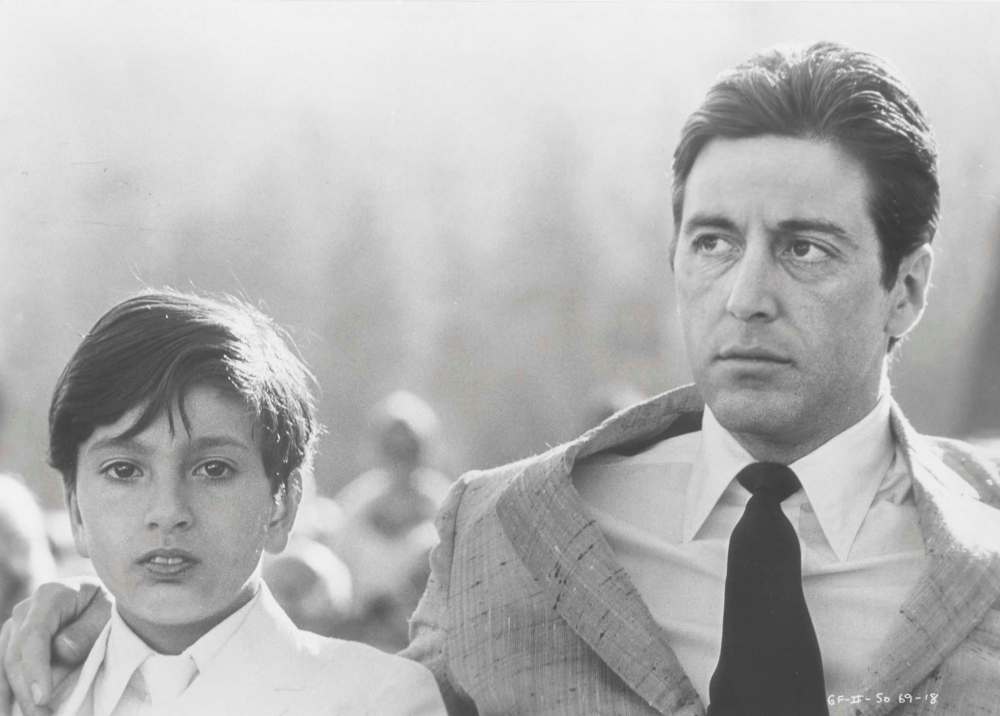
After 10th grade, he quit Manhattan’s High School for the Performing Arts. He worked at various jobs, including as a Standard Oil office messenger with John Cazale, who would play his weak brother, Fredo, in The Godfather and The Godfather: Part II.
His mother died when he was 21, and his grandfather a year and a half after that. The Actors Studio rejected him, only to accept him four years later. The studio’s famed Lee Strasberg later became his mentor and friend (and played gangster Hyman Roth, whom Michael ordered killed in the second Godfather).
When Pacino finally landed theatre work, the reviews were rhapsodic. In 1968, the New York Times called him “the best young actor in town.”
He can become so preoccupied with acting almost everything else falls by the wayside. There are stories of him misplacing cars, losing a new coat because, when he tried to go back to the store to pick it up, he’d forgotten where he’d bought it and had lost the receipt.
“Rehearsing is my favourite thing. It’s the closest you come to feeling like you’ve got something going,” he says.
“And then the product comes out and,” he stops, sighs, “you didn’t” meet your expectations. The beauty of rehearsal is “that you imagined how the role would be.”
He worked for four years on Looking for Richard and spent seven months rehearsing an Antigone production that was never staged. He admits bad reviews singe and he doesn’t read profiles of himself.
His only other driving passion is his children: Julie, a 27-year-old filmmaker, and 15-year-old twins Anton and Olivia. He shares joint custody of the twins with their mother, actress Beverly D’Angelo.
Hence the move to Los Angeles, a place where he never planned to live.
● ● ●
His massive 1920s house is decorated like graduate student housing — if the student happened to be particularly wealthy. Gym equipment and dress shoes collect in a corner of the living room, which is dominated by an enormous television that appears to be always on. Pacino loves sports, especially football (he played a coach in Oliver Stone’s Any Given Sunday), baseball and boxing.
Sullied dishes tower in a kitchen that appears to be an afterthought.
“Not to drop names,” says Pacino — are there names Al Pacino can drop? — “but Elizabeth Taylor used to come to my house and cook spaghetti.”
Let us pause for a moment to conjure that image.
The actress would ask Pacino’s friends, “How’s that boy doing?” Pacino recalls. “Did he get help around the house? Because he needs all the help he can get.”
The “boy” was 40 at the time. He got help.
“Women find him irresistible,” says Coppola. Pacino is celebrated for the company he has kept, a cavalcade of smart, accomplished actresses — Jill Clayburgh, Diane Keaton, Marthe Keller, Tuesday Weld, D’Angelo — many of whom make brief appearances in his conversation and are always spoken of warmly.
“I guess I’m boasting, but I’m friends with almost all of them,” he says. “It’s one or two things I can say that I’m happy about.”
Pacino has famously never married. (His father, who left the family when Al was 2, wed five times.)
“Sometimes I think I would have preferred that I did get married,” he muses.
“One reason is I would have found out so much more than I think that I know.”
He declines to discuss his current relationship, with Argentine actress Lucila Sola, 37.
He also resists making political statements of any kind, an anomaly in Hollywood.
“It’s like what Lee Strasberg said about swimming in the ocean: ‘I don’t want to get involved,’” the actor says.
Partly, it’s his courtly behaviour — he is faultlessly kind about his collaborators, even the failures. Over a long afternoon of conversation, he never disparages a director or an actor, even off the record, or a single associate, not even his former accountant.
Scarface, the 1983 movie that the actor calls an “operatic, Brechtian sort of treatise on greed and avarice,” written by Oliver Stone and directed by Brian De Palma, branded Pacino, in the lead role of Tony Montana, as a double-barreled actor of seething intensity. It’s a full-throttle performance, soaked in blood and powdered in cocaine, that’s not for everyone.

But the generalization Pacino is prone to histrionics misses his ability to delve deep into characters who are nothing like Montana. He has played plenty of cops and crooks — he’s playing a detective in Hangman — but he can exquisitely underplay a part, as in “Donnie Brasco,” where he portrays a fearful two-bit mob soldier who would register as lint to Michael Corleone.
● ● ●
Audiences pay a premium to watch Pacino become violent on the screen. After he became a star, he commanded US$14 million a picture. These days, “he gets five million” a movie, his manager told the New Yorker in 2014. “With a gun, seven million.”
Violent behaviour is actually anathema to him.
“I know it’s going to seem odd,” Pacino says, “but every time I go to do a movie and there’s a gun, I have to ask them to show me how to use it. And they’re like, ‘He’s putting me on.’ But I have an aversion to guns.”
After The Godfather, Pacino was offered almost everything, including roles that won other actors awards: Days of Heaven, Taxi Driver, Star Wars, Kramer vs. Kramer, Die Hard and Pretty Woman. He told the Independent last year, “There is a museum of mistakes, all the movies I rejected.”
Celebrity and drinking — he’s been sober since 1977 — wore him down.
“It was a ride, hard to compute. I wasn’t really helping it along. I was having the whole thing of fame,” he says.
After Revolution, a fiasco in which he played an 18th-century fur trader and reluctant soldier someone should have stopped him from doing, Pacino took a four-year break from movies, beginning in 1985.
“I was walking all over the city, seeing friends in Central Park. Having these little coffee klatches. It’s New York City, man, and I’m very happy there,” he says.
“It was sort of enriching in a way. I felt more like myself, and I was living with Diane. It was wonderful.”
One day, walking in the park, “This guy is passing me, he says: ‘Al, what the hell happened to you? You don’t make movies. You got to make movies, man, c’mon.’ I never saw anything like it.”
He needed money and, as it turns out, to work. Sea of Love, a 1989 romantic thriller in which he plays another detective, reignited his career.
In the pipeline is a play about Tennessee Williams and, finally, the long-awaited The Irishman with De Niro and Martin Scorsese, his first time with the famed director. (He and De Niro did Michael Mann’s 1995 Heat but famously had only one scene together.) Pacino will play Jimmy Hoffa.
Lear? “I’m ready. We’re talking about a movie on it,” he says.
Pacino long ago proved the studio brass wrong, that he’s the furthest thing from a disaster.
“You gotta realize yourself in all your roles. For me, the acting is very much a sanctuary,” he says.
“It’s a place where I go and feel as close to what I should be doing in life, and why I’m here.”
And so he acts, constantly.
— Washington Post