If Camerata Nova says Chant!, you’d better listen
Advertisement
Read this article for free:
or
Already have an account? Log in here »
To continue reading, please subscribe:

Digital Subscription
One year of digital access for only $205*
- Enjoy unlimited reading on winnipegfreepress.com
- Read the E-Edition, our digital replica newspaper
- Access News Break, our award-winning app
- Play interactive puzzles
*First annual payment billed as $205.00 + GST for one year. This annual subscription will automatically renew at $233.00 + GST every 52 weeks (10% off the regular annual price of $259.35). Offer available to new and qualified returning subscribers only. Cancel any time.
To continue reading, please subscribe:
Add Free Press access to your Brandon Sun subscription for only an additional
$1 for the first 4 weeks*
- Enjoy unlimited reading on winnipegfreepress.com
- Read the E-Edition, our digital replica newspaper
- Access News Break, our award-winning app
- Play interactive puzzles
*Your next Brandon Sun subscription payment will increase by $1.00 and you will be charged $17.95 plus GST for four weeks. After four weeks, your payment will increase to $24.95 plus GST every four weeks.
Read unlimited articles for free today:
or
Already have an account? Log in here »
Hey there, time traveller!
This article was published 08/03/2012 (5302 days ago), so information in it may no longer be current.
When you think about chant, what comes to mind? Likely a vision of Gregorian monks in ankle-length robes, walking through monastery hallways, deep in musical meditation. That’s the common perception, but there is much more to chant than found in religiously-based music.
See for yourself this Saturday (8 p.m.) and Sunday (2 p.m.) when Camerata Nova presents Chant! an exploration of chant from around the world, including some composed right here in our city.
It was a stroke of collaborative genius that devised this innovative program and if you follow Camerata Nova, you know that this is true to form. This 14-voice a capella singing group is not afraid to take risks. Packed houses indicate that their audiences love to take up the challenge, so it’s a win-win situation for all.
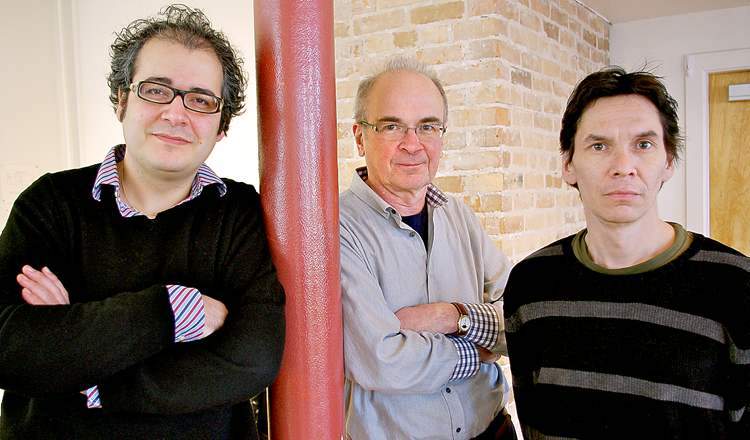
“We always had chant elements in our concerts,” said Mel Braun, the conductor of both performances. “We thought: why not do a whole program of it?”
Many of the singers, as well as artistic director Andrew Balfour, conductors Braun and Ross Brownlee, and board chairwoman Sandi Mielitz selected the repertoire and it is literally all over the map. Listeners will be taken on a musical travelogue through Greece, Italy, Ukraine, Tibet, Persia, Norway, France and more.
“We are singing in seven different languages, we counted,” said Braun, laughing.
Three new works will be debuted: Dies Eerie: Judgment Day Ride by Balfour, Pater Noster by Winnipeg composer Jim Hiscott, and Nafas (Breath) by Iranian-born Amir Amiri. A host of musicians will play various traditional and unusual instruments, including santur (72-string hammer dulcimer), electronic didgeridoo, marimba, and Taiko drums. There are even two Inuit throat singers, Melinda Tautu and Zeann Manernaluk, performing in Pérotin’s Viderunt Omnes, which dates back to the 13th century.
‘Different colours’
A program of this magnitude is a test. “The biggest challenge has been finding different colours,” said Braun, associate professor of voice and vocal department co-ordinator at the University of Manitoba faculty of music. “This is a great group to work with — they allow you to explore all kinds of stuff. They are adept at pure choral singing and have done a lot of Andrew’s (Balfour) music. His piece (Dies Eerie) evokes lots of scary images. In honouring his text and to make it come to life, we have been experimenting with different colours.”
The piece is written for choir, three percussionists and eight metronomes to be placed down the middle aisle of the hall. “We aren’t always singing ‘beautifully’. I hope that people will, in the best way, be frightened by Andrew’s work.”
Hiscott’s piece is inspired by Corsican chant. “We use more of a raw sound when singing it,” said Braun, “with ornamentation using quarter tones like in Middle Eastern singing.”
Amiri’s 13-minute Nafas was commissioned by Camerata Nova and is scored for choir, santur (Amiri is an accomplished player and will be the soloist) viola (Nancy Enns), marimba and other percussion (Alain Guilmette). It is based on Persian chant and, through a 100-year-old story of Iranian hero Rostam, explores the origins of hope. “There are sections in it where you sing the same phrase over and over,” said Braun, who then breaks into a demonstration by singing over the phone, “with only one small change — one different note.”
There a few nods to chant history, including the Kyrie from Palestrina’s Assumpta Est Maria, El Can de las Sybil — a ninth-century Sephardic chant and two Ukrainian songs. Popular Winnipeg composer Sid Robinovitch provides more local content with his robust and lively Adon Olam, written for the choir at the Shaarey Zedek Synagogue and which Braun says has “crazy exotic rhythms.”

Enns will also play young Norwegian composer Gjermund Larsen’s Polonese for fiddle and Taiko drummer and singer Phoebe Man will be featured in a Tibetan chant. “The choir improvises around Phoebe singing,” explained Braun.
“This concert is full of adventurous sounds that the choir is making and trying to communicate. Some of the themes are very interesting and we explore some profound subject matter,” said Braun.
Both performances are at Église Precieux-Sang, Manitoba architect Étienne Gaboury’s masterpiece at 200 Kenny St. Tickets are $25/adults, $20/seniors, $10/students and available at McNally Robinson Booksellers, at the door, by calling 918-4547 or at www.cameratanova.com
gwenda.nemerofsky@shaw.ca