Jazz legend Dave Brubeck, who helped define genre’s rhythms in 1950s and ’60s, dies at 91
Advertisement
Read this article for free:
or
Already have an account? Log in here »
To continue reading, please subscribe:

Digital Subscription
One year of digital access for only $205*
- Enjoy unlimited reading on winnipegfreepress.com
- Read the E-Edition, our digital replica newspaper
- Access News Break, our award-winning app
- Play interactive puzzles
*First annual payment billed as $205.00 + GST for one year. This annual subscription will automatically renew at $233.00 + GST every 52 weeks (10% off the regular annual price of $259.35). Offer available to new and qualified returning subscribers only. Cancel any time.
To continue reading, please subscribe:
Add Free Press access to your Brandon Sun subscription for only an additional
$1 for the first 4 weeks*
- Enjoy unlimited reading on winnipegfreepress.com
- Read the E-Edition, our digital replica newspaper
- Access News Break, our award-winning app
- Play interactive puzzles
*Your next Brandon Sun subscription payment will increase by $1.00 and you will be charged $17.95 plus GST for four weeks. After four weeks, your payment will increase to $24.95 plus GST every four weeks.
Read unlimited articles for free today:
or
Already have an account? Log in here »
Hey there, time traveller!
This article was published 05/12/2012 (5057 days ago), so information in it may no longer be current.
You don’t have to be a jazz aficionado to recognize “Take Five,” the smoky instrumental by the Dave Brubeck Quartet that instantly evokes swinging bachelor pads, hi-fi systems and cool nightclubs of the 1950s and ’60s.
“Take Five” was a musical milestone — a deceptively complex jazz composition that managed to crack the Billboard singles chart and introduce a new, adventurous sound to millions of listeners.
In a career that spanned almost all of American jazz since World War II, Brubeck’s celebrated quartet combined exotic, challenging tempos with classical influences to create lasting standards.
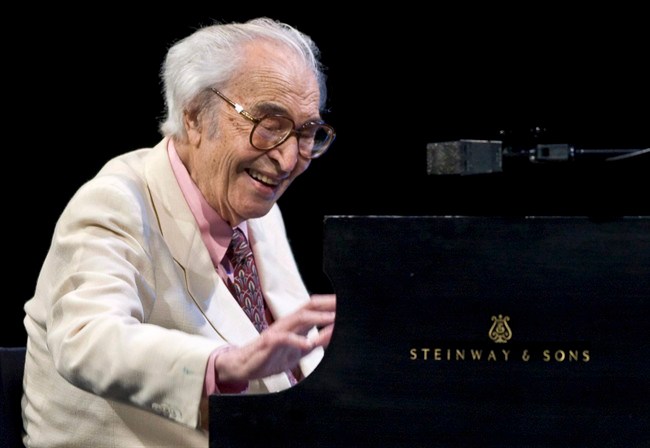
The pianist and composer behind the group, Brubeck died Wednesday of heart failure at a hospital in Norwalk, Connecticut. He was a day shy of his 92nd birthday.
Brubeck believed that jazz presented the best face of America to the world.
“Jazz is about freedom within discipline,” he said in a 2005 interview with The Associated Press. “Usually a dictatorship like in Russia and Germany will prevent jazz from being played because it just seemed to represent freedom, democracy and the United States.
“Many people don’t understand how disciplined you have to be to play jazz. … And that is really the idea of democracy — freedom within the Constitution or discipline. You don’t just get out there and do anything you want.”
The common thread that ran through Brubeck’s work was breaking down the barriers between musical genres — particularly jazz and classical music. He was inspired by his mother, a classical pianist, and later by his composition teacher, the French composer Darius Milhaud, who encouraged his interest in jazz and advised him to “keep your ears open” as he travelled the world.
“When you hear Bach or Mozart, you hear perfection,” Brubeck said in 2005. “Remember that Bach, Mozart and Beethoven were great improvisers. I can hear that in their music.”
Brubeck was always fascinated by the rhythms of everyday life. In a discussion with biographer Doug Ramsey, he recalled the rhythms he heard while working as a boy on cattle drives at the northern California ranch managed by his father.
The first time he heard polyrhythms — the use of two rhythms at the same time — was on horseback.
“The gait was usually a fast walk, maybe a trot,” he said. “And I would sing against that constant gait of the horse. … There was nothing to do but think, and I’d improvise melodies and rhythms.”
Brubeck combined classical influences and his own innovations on the seminal 1959 album “Time Out” by his classic quartet that included alto saxophonist Paul Desmond, drummer Joe Morello and bassist Eugene Wright.
It was the first jazz album to deliberately explore time signatures outside of the standard 4/4 beat or 3/4 waltz time. It was also the first million-selling jazz LP and is still among the bestselling jazz albums of all time.
Columbia executives blocked its release for nearly a year — until label President Goddard Lieberson intervened.
“They said, ‘We never put out music that people can’t dance to, and they can’t dance to these rhythms that you’re playing,'” Brubeck recalled in 2010. He also wanted a painting by Joan Miro on the cover, something else the record company had never done.
“I insisted that we go with something new,” he said. “And to their surprise, it became the biggest jazz recording they ever made.”
The album opens with “Blue Rondo a la Turk,” a piece inspired by Turkish street musicians Brubeck heard on a 1958 State Department tour. The piece was in 9/8 time — nine beats to the measure instead of the customary two, three or four beats — and blended folk rhythms with jazz and a Mozart piece.
The album also featured “Take Five,” the cool and catchy odd-metered tune that became the Brubeck quartet’s theme. The tune was derived from a pattern that Morello liked to play backstage. Brubeck asked Desmond to write a two-part melody over the rhythm, and Brubeck patched the pieces together.
“It was a song that people could relate to, and it influenced the future of the music,” said George Wein, a jazz pianist and founder of the Newport Jazz Festival.
Brubeck “proved that a song with five beats in it and one with nine beats in it could become popular,” pianist Herbie Hancock said in an email.
The jazz master played a key role in popularizing the first jazz festivals in the 1950s, playing at the Newport festival at least 50 times and helping to found the Monterey Jazz Festival.
He was also the first modern jazz musician pictured on the cover of Time magazine — on Nov. 8, 1954.
Brubeck always felt that his successful jazz career led fans to overlook the second career he launched as a jazz-inspired classical orchestral and choral composer in 1967 after disbanding his original quartet.
His experience in World War II led him to look beyond jazz to compose oratorios, cantatas and other extended works touching on themes involving religion, civil rights and peace.
“I knew I wanted to write on religious themes when I was a GI in World War II,” Brubeck said, recalling how he was trapped behind German lines in the Battle of the Bulge and nearly killed. “I saw and experienced so much violence that I thought I could express my outrage best with music.”
His interest in classical music was inspired by his mother, Elizabeth Ivey Brubeck, a classical pianist, who was initially disappointed by her youngest son’s interest in jazz. She later came to appreciate his music.
Born in Concord, California, on Dec. 6. 1920, Brubeck took piano lessons with his mother as a child. Then his father moved the family to a cattle ranch in the foothills of the Sierras.
When he enrolled at the College of the Pacific in 1938, Brubeck had intended to major in veterinary medicine and return to ranching. But while working his way through college by playing piano in nightclubs, he became smitten with jazz and changed his major to music. In 1942, he married Iola Whitlock, a fellow student who became his lifelong partner, librettist, and sometime manager.
Brubeck joined the Army as an infantry man, but ended up leading the semi-official Wolf Pack band attached to Gen. George S. Patton’s army. They played popular standards as well as some of his first original jazz tunes, including “We Crossed the Rhine,” based on the rhythm of trucks hitting the metal pontoon bridges as they entered Germany.
His band, which was one of the first integrated units in the then-segregated Army, reopened the Opera House in Nuremberg, the site of mass rallies organized by the Nazis, who had banned jazz.
Years later, the addition of Wright to Brubeck’s quartet made the group one of the nation’s best-known integrated music acts. A longtime champion of civil rights, Brubeck cancelled lucrative gigs at Southern universities and on television’s Bell Telephone Hour when the organizers insisted that he replace Wright. He refused to play in South Africa under apartheid.
After his discharge, he enrolled at Mills College in Oakland, California. That’s where he formed an octet, including Desmond on alto sax, Dave van Kreidt on tenor sax, Cal Tjader on drums and Bill Smith on clarinet. The group played Brubeck originals and standards by other composers. Their ground-breaking album “Dave Brubeck Octet” was recorded in 1946.
In 1949, Brubeck with Tjader and bassist Ron Crotty, both fellow octet members, formed a more commercially viable trio and cut their first records, which gained a national audience. After surviving a near-fatal diving accident in 1951, Brubeck formed a quartet by adding Desmond.
Brubeck continued performing with the latest version of his quartet until just past his 90th birthday, despite needing heart surgery and a pacemaker.

In a 2010 interview, Brubeck, who converted to Catholicism in 1980, envisioned an afterlife where he’d again see his family and jazz friends, including Louis Armstrong, Duke Ellington and Count Basie.
“If there’s a heaven,” Brubeck said, “let it be a good place for all of us to jam together and have a wonderful, wonderful musical experience.”
Brubeck is survived by his wife of 70 years, a daughter and four musician sons. Another son died in 2009.
___
Associated Press writers Pat Eaton-Robb in Hartford, Michelle R. Smith in Providence and the late Mary Campbell contributed to this report.