Stogies not included
Guitarists prize cigar-box axes for their strange sound, unique look
Advertisement
Read this article for free:
or
Already have an account? Log in here »
To continue reading, please subscribe:

Digital Subscription
One year of digital access for only $205*
- Enjoy unlimited reading on winnipegfreepress.com
- Read the E-Edition, our digital replica newspaper
- Access News Break, our award-winning app
- Play interactive puzzles
*First annual payment billed as $205.00 + GST for one year. This annual subscription will automatically renew at $233.00 + GST every 52 weeks (10% off the regular annual price of $259.35). Offer available to new and qualified returning subscribers only. Cancel any time.
To continue reading, please subscribe:
Add Free Press access to your Brandon Sun subscription for only an additional
$1 for the first 4 weeks*
- Enjoy unlimited reading on winnipegfreepress.com
- Read the E-Edition, our digital replica newspaper
- Access News Break, our award-winning app
- Play interactive puzzles
*Your next Brandon Sun subscription payment will increase by $1.00 and you will be charged $17.95 plus GST for four weeks. After four weeks, your payment will increase to $24.95 plus GST every four weeks.
Read unlimited articles for free today:
or
Already have an account? Log in here »
Hey there, time traveller!
This article was published 24/08/2013 (4755 days ago), so information in it may no longer be current.
Learncigarboxguitar.com is a website that teaches owners of cigar-box guitars how to play their instruments.
In case you’re unfamiliar, a cigar-box guitar is exactly what it sounds like: an axe whose body is fashioned from an empty cigar box.
The domain’s online songbook lists arrangements for a whack of popular tunes, among them Bad Moon Rising and Sweet Home Alabama. Administrators may want to add The Cat Came Back to the mix.

Last month, Fred Penner took time out from his busy, summer schedule to hit the St. Norbert Farmers’ Market. Only the two-time Juno Award-winner wasn’t shopping for veggies; he was looking for Wayne Seepish, a craftsman who sells his homemade, cigar-box guitars at the open-air hot-spot.
“Paul O’Neill, my main sideman when I perform, saw these instruments (first) and told me, ‘Fred, I’ve found your next guitar,’ ” Penner says, when reached on the road in Alberta. “I was intrigued so I went to the market and perused Wayne’s assortment until I found one that spoke to me. (Now) I need to practise my slide technique.”
Seepish is a bit of a luthier-come-lately. Before retiring in 2011, the 67-year-old sold security systems. About four years ago, Seepish was doing a quote for a customer on Arlington Street. In one corner of the fellow’s home were a couple of primitive-looking guitars, the likes of which Seepish had never seen before.
“I asked him what they were — he told me they were cigar-box guitars — and I said, ‘I have to have one,’ ” says Seepish, who bought his first six-string when he was a Grade 11 student at Miles Macdonell Collegiate. “The one he sold me was made from a beautiful, yellow Don Tomas cigar box.”
Seepish took his guitar home, where it was admired first by a neighbour, then by a couple of his brothers. All three had the same question: where can I get one, too? Seepish, already an accomplished woodworker on the side (some of his willow furniture was used in the shot-in-Winnipeg film, A Woman’s a Helluva Thing) decided he’d fill their orders, himself.
Thing is, guitar parts don’t exactly grow on trees. Or do they? Seepish makes his necks out of pretty much any piece of wood he can find: he stops in at lumberyards advertising free pallets, and regularly goes through the remnant section at Home Depot.
“So long as there aren’t any knots (in the wood) I’m not too picky,” he says. “But the pieces have to be the right length — about 36 inches — and width. If they’re too big, I can’t close the lid on the box, when I affix the neck to it.”
About those boxes: Seepish has become a familiar face at Thomas Hinds, a tobacconist located at 185 Carlton St. Once or twice a month, he pops into the store to see if they have any empty containers — preferably made from cedar — he can use. (Seepish pays the store a nominal fee for anything they turn over, which the owners donate to a local charity.)

As for the rest of his hardware — tuners, strings, grommets etc. — Seepish purchases those in bulk at an online store specializing in cigar-box guitars.
Start to finish, each guitar takes Seepish about 15 hours to build. He charges between $125 and $175 for the final products.
“When somebody buys one they don’t just fork over the money and walk away,” says Seepish, who recently bought a wireless amp from Long & McQuade so interested parties could try the guitars out on-site. “They usually look over them all first and play a few before deciding. I’ve sold some to wives who are buying them for their husbands, to grooms who are buying them for their best man… some people tell me they’re not even interested in playing ’em; instead, they’re buying it to display on the wall or in a guitar stand, like a piece of artwork.”
William Jehle is the author of One Man’s Trash: A History of the Cigar Box Guitar. He’s also the curator of the National Cigar Box Museum, in York, Pa.
“It was my own life-long curiousity about all things guitar that got me into these quirky instruments,” says Jehle in a telephone interview. “My first exposure to them was (in) a magazine (called) Make. At the time I was building ‘normal’ guitars… but once I saw the cigar-box guitar in that magazine, everything changed. I never built another normal guitar again.”
Jehle began researching his new hobby. Cigar-box guitars, he learned, grew primarily out of poverty. In the mid-1800s, people who couldn’t afford a real guitar affixed broom handles to whatever type of box they could turn up. (Jehle traced the invention of the cigar box to 1840; he found an etching of Civil War soldiers playing cigar-box guitars around a campfire, so he knows they existed by 1861, at least.)
“Once the book came out, people contacted me about their own cigar-box instrument stories,” he says, mentioning Paul McCartney, who brandished a cigar-box guitar when he appeared on Saturday Night Live earlier this year. “They had either built one or had family member that made one. It’s a great feeling to see someone remembering one; I get to see the childlike fascination in them wake up again.”
“Cigar-box guitars are a world-wide phenomenon,” says Max Shores, a filmmaker from Tuscaloosa, Ala., who wrote and directed the award-winning documentary, Songs Inside the Box, which centres around The Alabama Cigar Box Music Festival, an annual event staged in Huntsville. “A highly-respected builder of cigar-box guitars, Lenny P. Robert, is from Montreal. His company has produced instruments (for) Jack White of the White Stripes, The Edge of U2 and Billy Gibbons of ZZ Top.)
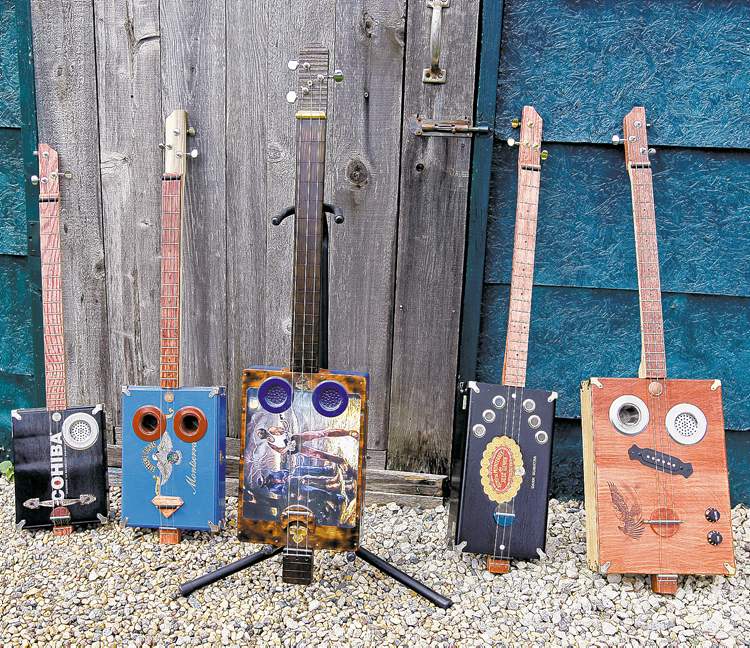
Shores credits the Internet for rekindling people’s interest in cigar-box guitars. He points to a website — cigarboxnation.com — that has more than 10,000 members.
“An interesting aspect for musicians is that cigar-box guitars free them to explore ideas that might not come to light with a regular guitar,” he says. “They can be made to sound much like a regular guitar but most have a more tinny sound, which can inspire new ideas.
“Many people find after building one they want to make more,” he goes on. “They learn from their first and want to make improvements on subsequent projects. It seems to become an obsession for some people.”
david.sanderson@freepress.mb.ca
Dave Sanderson was born in Regina but please, don’t hold that against him.
Our newsroom depends on a growing audience of readers to power our journalism. If you are not a paid reader, please consider becoming a subscriber.
Our newsroom depends on its audience of readers to power our journalism. Thank you for your support.