Planet of sounds
Music at Folklorama pavilions created by an exotic assortment of instruments

Advertisement
Read this article for free:
or
Already have an account? Log in here »
To continue reading, please subscribe:

Digital Subscription
One year of digital access for only $205*
- Enjoy unlimited reading on winnipegfreepress.com
- Read the E-Edition, our digital replica newspaper
- Access News Break, our award-winning app
- Play interactive puzzles
*First annual payment billed as $205.00 + GST for one year. This annual subscription will automatically renew at $233.00 + GST every 52 weeks (10% off the regular annual price of $259.35). Offer available to new and qualified returning subscribers only. Cancel any time.
To continue reading, please subscribe:
Add Free Press access to your Brandon Sun subscription for only an additional
$1 for the first 4 weeks*
- Enjoy unlimited reading on winnipegfreepress.com
- Read the E-Edition, our digital replica newspaper
- Access News Break, our award-winning app
- Play interactive puzzles
*Your next Brandon Sun subscription payment will increase by $1.00 and you will be charged $17.95 plus GST for four weeks. After four weeks, your payment will increase to $24.95 plus GST every four weeks.
Read unlimited articles for free today:
or
Already have an account? Log in here »
Hey there, time traveller!
This article was published 07/08/2015 (4050 days ago), so information in it may no longer be current.
Along with food and language, music is one of the most important parts of experiencing a culture in its truest form. Songs and melodies, and the instruments that create them, play a key role in the development of a cultural community’s identity — not only in a situational way (funeral songs, wedding songs, love songs, drinking songs), but also in the way certain sounds are immediately connected to specific areas of the world.
For example, an accordion is one of the characteristic sounds in music from Alpine countries, and you can’t listen to bagpipes without thinking of Scotland.
We asked a few Folklorama pavilion representatives to tell us about some of the most interesting instruments their countries have to offer — some of them may be more familiar than others, but all of them bring a distinct sound and story to the cultures they originated from. Here are five of the responses we received:
Doromb or “jaw harp” — Hungary-Pannonia Pavilion

The doromb, or jaw harp as it’s called in English, has been kicking around Europe since the fifth century, though many consider it to be one of the oldest instruments in the world, as it has been depicted in artwork as early as the third century BC.
With a shape that resembles a bottle opener, the little metal instrument is placed in the mouth and then plucked, relying on the vibration against the musician’s teeth created by the plucking to amplify the sound.
“Passage of air changes the sound,” says Lizzie Kovach, artistic director of the Hungary-Pannonia pavilion. “When no air is passed though, it’s more of a just a mild ‘boing.’”
There’s really no other way to describe the noise created by the doromb than a “boing” sound, ping-ponging back and forth as the musician plucks away.
The pitch of the doromb depends on its size and shape; it comes in a variety. This is the first year the pavilion has included the instrument in their show, and Kovach says it will be played as accompaniment for one of the men’s dances.
The Hungary-Pannonia Pavilion opens Sunday at the Burton Cummings Community Centre, 960 Arlington St.
Veena — Tamil Pavilion

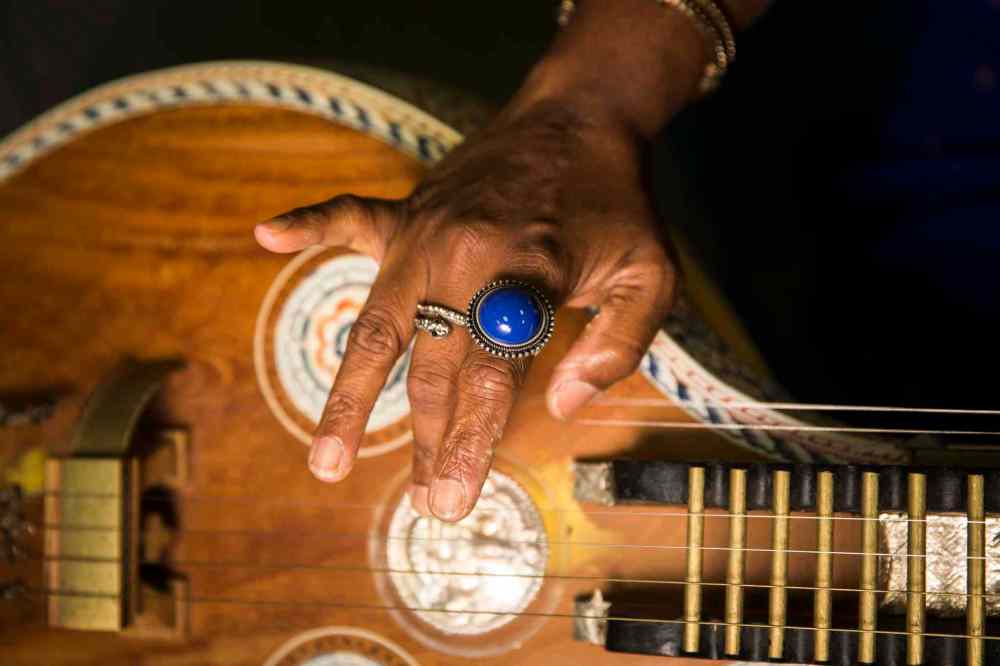
The veena is an ancient Indian string instrument that is plucked to create a sound most easily compared to that of a gentle version of a slide guitar. The musician playing it sits cross-legged on the floor, with the sound-generating chamber to the right and the string end of the instrument resting on the left knee.
The shaft of the veena has metal frets attached using beeswax, which dampens the vibration.
“There are four strings on the top that are used to play the notes using four fingers of the left hand. In addition, there are three strings on the player-side that are continuously strung by the little finger of the right hand to maintain the beat, while the middle three fingers of the right hand are used to pluck the strings to generate the sound,” says Sri Ranjan of the Tamil Pavilion.
The instrument dates back more than 5,000 years and is made from the wood of the jackfruit tree.
“The artisans who make these instruments choose the tree that has been growing near temples where the bells toll. They believe that the tree acquires better sound quality because it grew in a location where the bells chime and music is played on a daily basis,” says Ranjan.
The veena will be a feature of Tamil’s cultural display, where a video of the instrument being played will be on a loop.
The Tamil Pavilion completes a week-long Folklorama run tonight. It’s located at Burton Cummings Community Centre, 960 Arlington St.
Gusle — Serbian “Kolo” Pavilion

The gusle is a stringed instrument, but just barely — typically it only has one or two strings.
The instrument is held vertically between the knees of the musician, or gusier, with the fingers on the left hand used on the strings, while the right hand manoeuvres a bow.
The gusle’s shape is similar to that of a large mandolin, but unlike a typical stringed instrument, the strings are never pressed to the neck. The music created almost sounds Middle Eastern.
The instrument, usually made of maple, is closely tied to Serbia’s oral-poetry tradition and was often used to accompany epic poems depicting the era of the Ottoman occupation and Serbia’s subsequent struggle for liberation.
A gusle that’s more than 120 years old was donated to the Serbian “Kolo” pavilion in 2011 and will be featured in their cultural display, says media chairwoman Tatjana Draskovic.
The Serbian “Kolo” Pavilion opens Sunday at the St. James Civic Centre, 2055 Ness Ave.
Dhantal — Indo-Caribbean Paradise Pavilion

The dhantal is a metal rod with one rounded end and one sharp end, and its original purposehad nothing to do with music – it was a tool used to keep cattle from wandering away. Farm hands would tie a cow to the circular top section and stick the pointed end into the ground. When farmers finished their chores, they would sit together to play some music on the rods by hitting them with another piece of metal, often an old horseshoe.
The sound produced is “a very harmonious metallic sound that complemented the singing,” says Indo-Caribbean Paradise Pavilion co-ordinator Mohamed Alli.
The dhantal is a percussive instrument that could most easily be compared to the triangle, except it’s usually about a metre in length and looks more intimidating. The instrument will be played as part of the show at the pavilion.
The Indo-Caribbean Paradise Pavilion opens Sunday at Sargent Park School, 2 Sargent Park Pl.
Berimbau — Brazilian pavilion

If you’ve ever seen a capoeira demonstration, you’ve seen a berimbau in action. The deceptively simple-looking instrument is used to keep tempo for the Brazilian martial art that combines dance and acrobatics — the faster the beat, the faster the movements.
The berimbau consists of a wooden bow, or verga, made of a Brazilian wood that extends about 1 1/2 metres high with a steel string tightly strung from one end to the other. A gourd attached to the lower part of the verga acts as a resonator.
Simple enough, right? Wrong. Playing the berimbau is a multi-step process that involves holding the instrument in your right hand, wrapping the two middle fingers around the verga and placing the little finger in a loop of string near the gourd to balance the weight. A small stone or coin is held between the index and thumb fingers and acts as a pick, moving up and down the metal string to change the pitch. The gourd is then rested against the abdomen while the other hand holds a small wooden stick and a shaker — the stick is used to strike the string in order to make sound while the shaker is meant to accompany.
The berimbau can create three types of sounds — buzz, open string and a high pitch — depending on where the gourd is placed on the body and how the string is touched.
The Brazilian Pavilion will feature a berimbau orchestra at the beginning of each show in which several capoeiristas — those who practise the art of capoeira — will play the instruments together, making a “lovely combined sound,” says pavilion co-ordinator Susan Laspina.
The Brazilian Pavilion opens Sunday at the Heather Curling Club, 120 Youville St.
Erin.lebar@freepress.mb.ca
Twitter: @NireRabel
Our newsroom depends on a growing audience of readers to power our journalism. If you are not a paid reader, please consider becoming a subscriber.
Our newsroom depends on its audience of readers to power our journalism. Thank you for your support.
Our newsroom depends on a growing audience of readers to power our journalism. If you are not a paid reader, please consider becoming a subscriber.
Our newsroom depends on its audience of readers to power our journalism. Thank you for your support.
Advertisement Advertise With Us
Advertisement Advertise With Us