Remembering Cash, the great teacher
Advertisement
Read this article for free:
or
Already have an account? Log in here »
To continue reading, please subscribe:

Digital Subscription
One year of digital access for only $205*
- Enjoy unlimited reading on winnipegfreepress.com
- Read the E-Edition, our digital replica newspaper
- Access News Break, our award-winning app
- Play interactive puzzles
*First annual payment billed as $205.00 + GST for one year. This annual subscription will automatically renew at $233.00 + GST every 52 weeks (10% off the regular annual price of $259.35). Offer available to new and qualified returning subscribers only. Cancel any time.
To continue reading, please subscribe:
Add Free Press access to your Brandon Sun subscription for only an additional
$1 for the first 4 weeks*
- Enjoy unlimited reading on winnipegfreepress.com
- Read the E-Edition, our digital replica newspaper
- Access News Break, our award-winning app
- Play interactive puzzles
*Your next Brandon Sun subscription payment will increase by $1.00 and you will be charged $17.95 plus GST for four weeks. After four weeks, your payment will increase to $24.95 plus GST every four weeks.
Read unlimited articles for free today:
or
Already have an account? Log in here »
Hey there, time traveller!
This article was published 16/09/2023 (1089 days ago), so information in it may no longer be current.
“On the Sunday morning sidewalk wishing, Lord, that I was stoned ‘cause there’s something in a Sunday makes a body feel alone” — Sunday Morning Coming Down, written by Kris Kristofferson.
This week the anniversary of one of the saddest events of the human journey came and went with hardly a mention anywhere. There is no greater motivation for yours truly to host these twice weekly visits with Free Press readers than the opportunity to give credit where credit is due to the giants who shape our civilization, especially those who speak to us when we’re feeling lost in a place called Lonesome.
Johnny Cash spoke to my lonesome for my entire life. I first heard him on those country stations that my little transistor radio pulled in when I was eight. I never went to sleep without my little radio feeding me music and conversation, finding joy for a child living in a house where joy never knocked on the door.
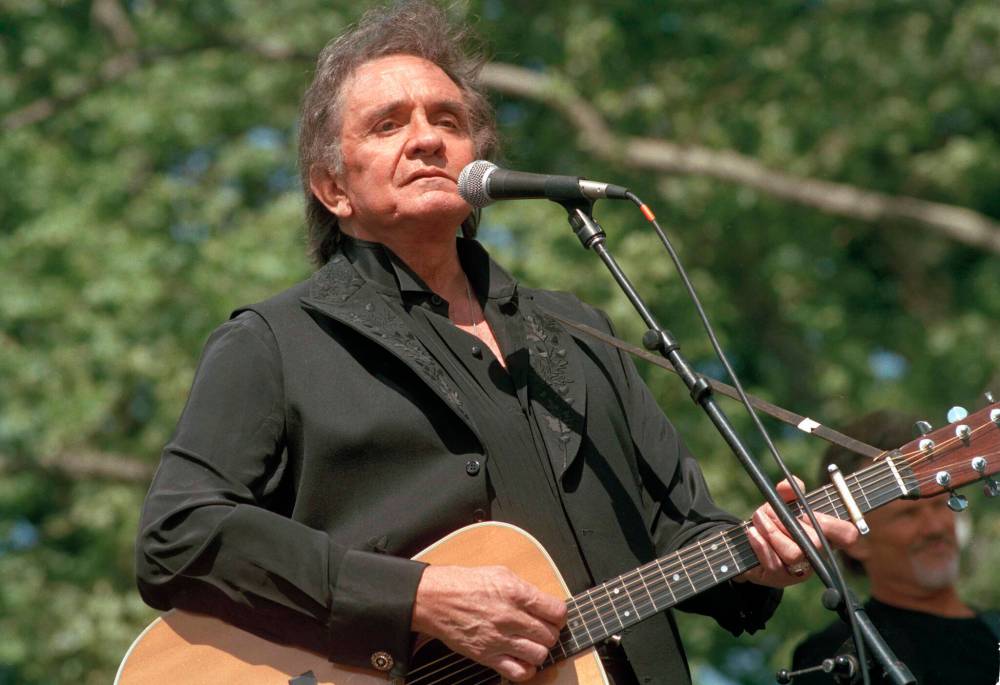
Joe Tabacca / Associated Press files
Johnny Cash, pictured performing in 1993, served as a powerful and lyrical teacher for columnist Charles Adler. Cash died 20 years ago this week.
Johnny Cash died 20 years ago this week. I didn’t just admire his talent. I loved the man who turned my Adam’s apple into a football when he sang Kristofferson’s Sunday Morning Coming Down. I listened to his music for 60 years and when joy did knock on the door with offers to host radio shows, getting paid to play his music and extol his virtues was one of the highlights of my life. Because public communications is my bread and butter, people often ask me to name the greatest communicator I’ve ever experienced.
It’s a trick question. You’re supposed to say JFK, MLK, Reagan, Clinton, Obama. Some Canadians from my generation feel they are supposed to say Pierre Trudeau or Brian Mulroney.
The only reason I have been able to stay in the saddle for over half a century is because I have never cared a lick about what you were supposed to say about anything. The general public tunes out most public conversations because most professional conversationalists always say what they’re supposed to say. It’s not against the law to be predictable, forgettable and boring. The problem with living in the world of “supposed to say” never applies any balm to the soreness of living with a chromosome called lonesome. We all have it, by the way. It has nothing to do with being or living alone. It has to do with the reality that attacks your conscience when you see things and say things just to get along.
I was 10 when I first Johnny Cash sing The Ballad of Ira Hayes.
“Gather round me people there’s a story I would tell about a brave young Indian you should remember well from the land of the Pima Indian — A proud and noble band.. When war came, Ira volunteered and forgot the white man’s greed.”
The song is a true story about Ira Hayes becoming a Marine and a hero in the Second World War where he helped to plant the U.S. Flag at Iwo Jima. But Hayes, just like so many members of his tribe and other Indigenous people, were abandoned by a country he served.

“He died drunk early one morning in the land he fought to save,” Cash sang. “Two inches of water in a lonely ditch was a grave for Ira Hayes.”
Johnny Cash made me feel feelings for things I knew nothing about. I grew up with “Cowboys and Indians” on TV. My true report card would have said: 100 per cent ignorant of Indigenous history in the U.S. and Canada. Johnny Cash wasn’t just a car companion. He was the best teacher I never had. Johnny Cash on my dash riding shotgun kept me company for decades of battles with sleep and solitude along what Gordon Lightfoot called Ribbons of Darkness. It wouldn’t be wrong to say he kept me out of many a lonely ditch.
Johnny Cash communicated with me when my soul was running on empty in a way that educated professional communicators never did. Those names you’re supposed to say all made great speeches. But rhetoric doesn’t warm you on a cold night in a cheap motel.
Johnny Cash, the greatest communicator I ever experienced, was taken from us 20 years ago this week. But thankfully and fortunately, his vivid and sometimes painful stories, have an everlasting life that does not exist in my vehicle for all those names you’re supposed to say.
Charles Adler is a longtime political commenter and podcaster.