

Acclaimed pianist applies deft touch to Chopin catalogue
Advertisement
Read this article for free:
or
Already have an account? Log in here »
To continue reading, please subscribe:
Monthly Digital Subscription
$0 for the first 4 weeks*
- Enjoy unlimited reading on winnipegfreepress.com
- Read the E-Edition, our digital replica newspaper
- Access News Break, our award-winning app
- Play interactive puzzles
*No charge for 4 weeks then price increases to the regular rate of $19.95 plus GST every four weeks. Offer available to new and qualified returning subscribers only. Cancel any time.
Monthly Digital Subscription
$4.99/week*
- Enjoy unlimited reading on winnipegfreepress.com
- Read the E-Edition, our digital replica newspaper
- Access News Break, our award-winning app
- Play interactive puzzles
*Billed as $19.95 plus GST every four weeks. Cancel any time.
To continue reading, please subscribe:
Add Free Press access to your Brandon Sun subscription for only an additional
$1 for the first 4 weeks*
*Your next subscription payment will increase by $1.00 and you will be charged $16.99 plus GST for four weeks. After four weeks, your payment will increase to $23.99 plus GST every four weeks.
Read unlimited articles for free today:
or
Already have an account? Log in here »
Hey there, time traveller!
This article was published 28/09/2024 (469 days ago), so information in it may no longer be current.
The Winnipeg Symphony Orchestra bared its poetic soul Thursday night, when it featured internationally acclaimed Canadian pianist Charles Richard-Hamelin performing Chopin’s Piano Concerto No. 2 in F minor, Op. 21.
Born in Lanaudière, Quebec, the silver medalist and winner of the Krystian Zimerman Prize at the prestigious 2015 International Chopin Piano Competition repeats the work tomorrow during the WSO’s Shirley Loewen Sunday Classics series, with the 2 p.m. matinee also including Bruckner’s Adagio for String Orchestra from his String Quintet in F major.
The newly minted series is dedicated to the memory of Loewen — a beloved local patron of the arts for over 50 years with her philanthropist/entrepreneur husband Bill Loewen — and offers encore performances of classical gems heard earlier in the weekend. (Tickets and info are available at wso.ca.)
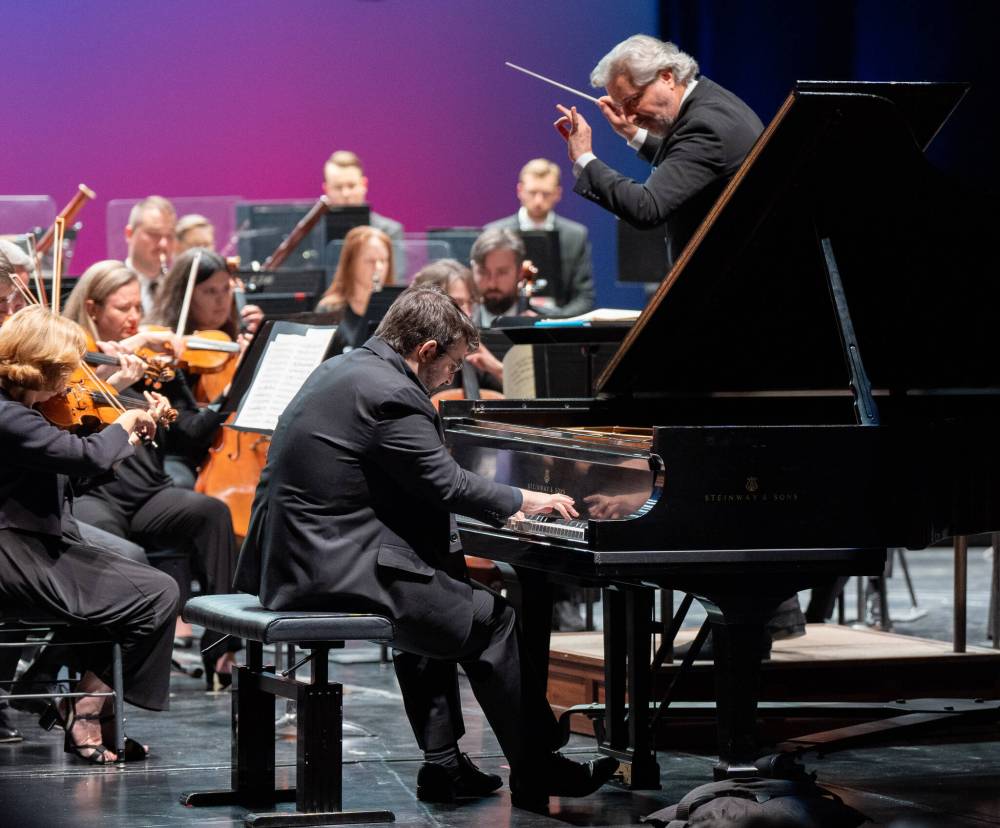
MARK RASH PHOTO
Canadian pianist Charles Richard-Hamelin returned to Winnipeg with a memorable performance.
The weeknight concert proved a warm reunion between Richard-Hamelin and Daniel Raiskin, who also led the pianist’s WSO debut back in September 2018. It was the inaugural concert of the maestro’s tenure, which was recently extended to the 2029-30 season.
After a relatively brief orchestral introduction, Richard-Hamelin marked his first entry during the opening Maestoso, immediately displaying his sensitive artistry with every note carefully placed, every chord artfully voiced, with a flexible rubato the hallmark of the composer’s style.
There are certain pieces in the classical canon seemingly destined for that proverbial desert island. The subsequent, stunningly gorgeous Larghetto, penned by the lovesick, then 19-year-old composer desperate to capture the heart of singer Constantia Gladowska is one such work that only grows sweeter, and more tender upon each hearing.
It’s also where Richard-Hamelin shone most brightly, with his deeply-felt performance, luminous tone and feather-light fioritura embellishments suspending time itself and transporting 809 audience members to their happiest place.
Raiskin’s expansive approach saw him sensitively cuing each tutti section, which created a seamless dialogue between orchestra and soloist, with both forces growing more impassioned by the minute. Near the end, Hamelin-Richard’s declamatory outburst — rendered freely with operatic intensity over the always striking col legno effects of the strings — was a highlight, ultimately leading to final, bell-like tones in his uppermost register.
Then it became time for the spirited finale, Allegro vivace, a boot-stomping, highly stylized mazurka from Chopin’s Polish homeland that became a kinder, gentler incarnation in Richard-Hamelin’s hands.
Nonetheless, it further showcased his dazzling virtuosity, with his fingers nimbly tossing off rapid-fire runs and double thirds until reaching its triumphant close.
After receiving an enthusiastic standing ovation with three curtain calls, the artist treated listeners to his encore of Chopin’s Waltz in C Sharp Minor, Op. 64, No. 2, adding a further grace note to the evening with his highly intimate performance.
The 75-minute (no intermission) program rounded out with Sibelius’s Symphony No. 7 in C major, Op. 105, a remarkably compact, one-movement work originally premièred as Fantasia sinfonica No. 1 in 1924, and packed with the musical ideas and sentiment of a full, more typical four-movement symphonic “formula.”

As living organisms, all orchestras possess their own unique flavour, personality and predilections, owing (partially) to the relationship between maestro and musicians. The WSO has always thrived in performing works from the Nordic climes, with Sibelius — last heard on this stage in 2014 — one of its favourites to play.
Written at the pinnacle of his career between 1914 and ’24, it also became the Finnish composer’s last major work, although he lived for 33 more years.
After the roughly 22-minute piece climbed out of its lugubrious depths with a slowly rising C major scale, Raiskin led the players throughout its shimmering textures and rich sonorities, one section bleeding into the next in this well-paced performance.
The final melding together of sonic forces did not disappoint, underpinned by principal timpanist Justin Gingrich’s thundering drum rolls, as powerful as the dawning of sunrise over an ice-packed fjord, leading to the night’s second ovation.
holly.harris@shaw.ca
Holly Harris writes about music for the Free Press Arts & Life department.
Our newsroom depends on a growing audience of readers to power our journalism. If you are not a paid reader, please consider becoming a subscriber.
Our newsroom depends on its audience of readers to power our journalism. Thank you for your support.