If the ‘West End’ goes dark

Advertisement
Read this article for free:
or
Already have an account? Log in here »
To continue reading, please subscribe:

Digital Subscription
One year of digital access for only $205*
- Enjoy unlimited reading on winnipegfreepress.com
- Read the E-Edition, our digital replica newspaper
- Access News Break, our award-winning app
- Play interactive puzzles
*First annual payment billed as $205.00 + GST for one year. This annual subscription will automatically renew at $233.00 + GST every 52 weeks (10% off the regular annual price of $259.35). Offer available to new and qualified returning subscribers only. Cancel any time.
To continue reading, please subscribe:
Add Free Press access to your Brandon Sun subscription for only an additional
$1 for the first 4 weeks*
- Enjoy unlimited reading on winnipegfreepress.com
- Read the E-Edition, our digital replica newspaper
- Access News Break, our award-winning app
- Play interactive puzzles
*Your next Brandon Sun subscription payment will increase by $1.00 and you will be charged $17.95 plus GST for four weeks. After four weeks, your payment will increase to $24.95 plus GST every four weeks.
Read unlimited articles for free today:
or
Already have an account? Log in here »
Hey there, time traveller!
This article was published 05/12/2025 (284 days ago), so information in it may no longer be current.
There may have been a blizzard that night, when my father dropped me off on Ellice Avenue, though it was so long ago it’s hard to remember. What I remember is the flutter in my chest as I stepped out of the car, and the hint of paternal worry in my father’s eyes as he told me to have a great time, and that he would pick me up later.
With that, I clutched my ticket in my hands and walked wide-eyed into the West End Cultural Centre.
It was my first real concert, and first time being out on my own. I felt very grown-up, although I was just 14 years old, and transfused with the particular adolescent thrill of seeing one’s musical idols in person — in this case, an up-and-coming band from Newfoundland called Great Big Sea.
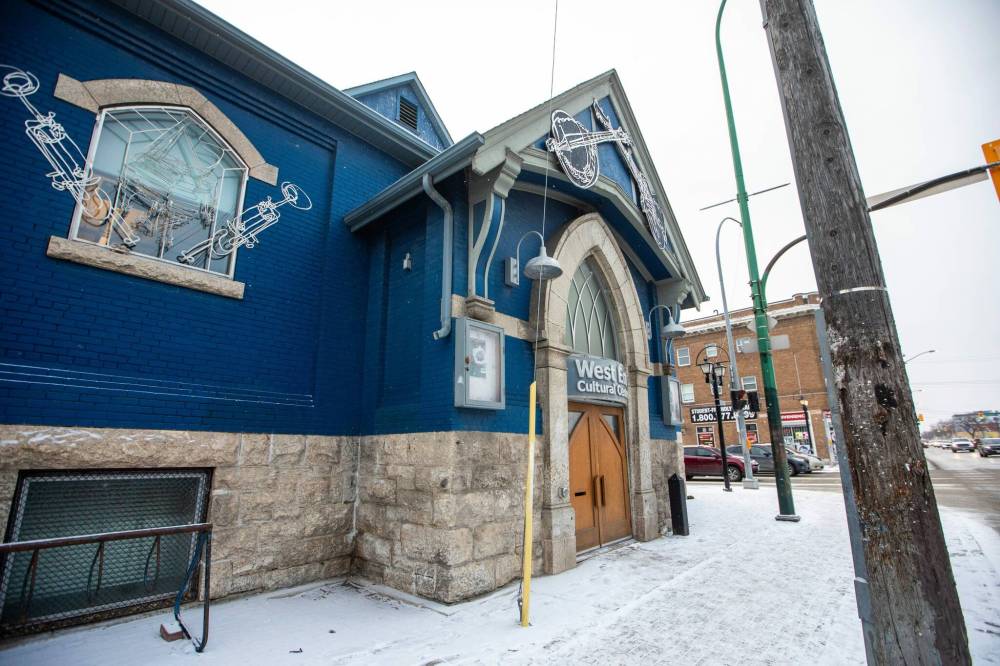
MIKAELA MACKENZIE / FREE PRESS
On Monday, the West End Cultural Centre put out a statement on social media asking supporters for financial help to the tune of $50,000 by Dec. 31 in order to keep its programs going.
I’d discovered them one night on MuchMusic, which, like most Canadian teens of the era, I’d watch raptly for hours. Within a few years, the band would become a national sensation, launching Celtic kitchen-party tunes into the Canadian mainstream; but at the time, few knew them: they were just breaking out of The Rock.
That night, I discovered what it is to love live music, to truly experience it as a collaboration between artist and audience, as an exultation of what it means to be alive. That night, I threw myself into the throng of a small but joyful crowd, and danced until I couldn’t feel my legs.
What I didn’t know, at that first concert, was that the venue would soon become one of the most reliable heartbeats of my teens and 20s. In some of those years, I was at the WECC nearly every week, taking in performances from every discipline and genre: folk and punk, roots, experimental sound art, family entertainers, poetry, alternative theatre.
That was the niche for which the West End Cultural Centre was best suited. Since 1987, the WECC — or simply the ‘West End,’ as fans most commonly call it — has played a unique role in the city’s live-music landscape, offering a stage for music, arts and culture as a registered non-profit.
It was always a humble, curious space. Fitted inside an old brick church on an unlovely corner of Ellice and Sherbrook, the WECC made its name mostly on the strength of its community — the people who believed in its mission to bring a full breadth of music and the arts to Manitobans in a creative and accessible way.
Now, perhaps, that mission is in peril. On Monday, the WECC put out a statement on its Instagram account, asking for supporters’ help. “The WECC is in a tough financial spot right now,” it said, then laid out the problem: the venue needs $50,000 by Dec. 31 to keep its programs going.
It’s not an enormous figure. But the urgency of the request, coming so late in the year and when many supporters will already be strapped with holiday spending, is alarming. It’s hard to imagine a Winnipeg without the WECC, a venue which is loved not just here, but right across Canada; countless touring artists built their careers there, and came to see it as home.
Why now? In one Facebook discussion about the sudden funding request, commenters offered their opinions as to why the venue is struggling: mostly, that it wasn’t booking enough musical acts they’d heard of (some of this is likely generational), and fears of venturing into the area at night. The latter can’t really be helped; it also isn’t new.
Across Canada, live music is in an uncertain space.
But it isn’t only the WECC facing these problems — it’s just that, as a non-profit, the WECC can make such an ask.
Across Canada, live music is in an uncertain space. The pandemic proved a death knell for many venues, and while a good number found revenues bounced back in 2023, not many live venues are on truly stable financial footing: a report by the Canadian Live Music Association released early this year outlined lingering uncertainty in the sector.
This is, most likely, partly a symptom of a deeper shift in culture: people are slowly retreating from shared cultural life.
We are retreating into phones, into video games, into Netflix; as costs of living rise, the amount we can spend on even stepping outside our own homes dwindles.
It’s an old problem. The spaces where art thrives carry value beyond money, but without money, they cannot exist. The more they bleed away, the fewer places there are for art to thrive, and the more it slips out of our lives. We fill the space with other things, and these days there are many such options; but nothing can truly replace sharing the arts live.
This is, most likely, partly a symptom of a deeper shift in culture: people are slowly retreating from shared cultural life.
A few weeks ago, on the Friday night of Grey Cup Festival weekend, Alan Doyle — the gregarious frontman of Great Big Sea, now a nationally-beloved solo artist — rolled into the RBC Convention Centre for a rollicking headliner show. During a break between songs, Doyle spoke with affection about that long-ago WECC gig.

It was the first time his band had ever played Winnipeg, he told the crowd, now more than 30 years ago. It marked the beginning of a long relationship with this city that so embraced his music, a relationship that, in itself, formed a conversation between Canada East and West, linking two parts of the country that were long culturally and geographically disconnected.
A Winnipeg without the West End Cultural Centre would be a much poorer city, but it isn’t just Winnipeg that would feel the loss.
It would mean one less space for those national community-building cultural conversations to happen; one less space to explore the endless textures of what we can create with our minds and our voices and our hands.
It’s time to rally around the WECC, and prevent that.
melissa.martin@freepress.mb.ca
Melissa Martin
Reporter-at-large
Melissa Martin reports and opines for the Winnipeg Free Press.
Every piece of reporting Melissa produces is reviewed by an editing team before it is posted online or published in print — part of the Free Press‘s tradition, since 1872, of producing reliable independent journalism. Read more about Free Press’s history and mandate, and learn how our newsroom operates.
Our newsroom depends on a growing audience of readers to power our journalism. If you are not a paid reader, please consider becoming a subscriber.
Our newsroom depends on its audience of readers to power our journalism. Thank you for your support.
Melissa Martin
Reporter-at-large
Melissa Martin reports and opines for the Winnipeg Free Press.
Every piece of reporting Melissa produces is reviewed by an editing team before it is posted online or published in print — part of the Free Press‘s tradition, since 1872, of producing reliable independent journalism. Read more about Free Press’s history and mandate, and learn how our newsroom operates.
Our newsroom depends on a growing audience of readers to power our journalism. If you are not a paid reader, please consider becoming a subscriber.
Our newsroom depends on its audience of readers to power our journalism. Thank you for your support.
Related Articles
Manitoba’s cultural sector is struggling… and thriving



Advertisement Advertise With Us
Advertisement Advertise With Us