Protest songs capture horror, hope in times of turmoil

Advertisement
Read this article for free:
or
Already have an account? Log in here »
To continue reading, please subscribe:

Digital Subscription
One year of digital access for only $205*
- Enjoy unlimited reading on winnipegfreepress.com
- Read the E-Edition, our digital replica newspaper
- Access News Break, our award-winning app
- Play interactive puzzles
*First annual payment billed as $205.00 + GST for one year. This annual subscription will automatically renew at $233.00 + GST every 52 weeks (10% off the regular annual price of $259.35). Offer available to new and qualified returning subscribers only. Cancel any time.
To continue reading, please subscribe:
Add Free Press access to your Brandon Sun subscription for only an additional
$1 for the first 4 weeks*
- Enjoy unlimited reading on winnipegfreepress.com
- Read the E-Edition, our digital replica newspaper
- Access News Break, our award-winning app
- Play interactive puzzles
*Your next Brandon Sun subscription payment will increase by $1.00 and you will be charged $17.95 plus GST for four weeks. After four weeks, your payment will increase to $24.95 plus GST every four weeks.
Read unlimited articles for free today:
or
Already have an account? Log in here »
Hey there, time traveller!
This article was published 30/01/2026 (258 days ago), so information in it may no longer be current.
Bruce Springsteen has always held a mirror up to America.
Sometimes that looks like 1975’s Born to Run, about escaping small-town suffocation and hitting the open road. Sometimes that looks like 2001’s American Skin (41 Shots), about the 1999 killing of Amadou Diallo, an unarmed 23-year-old Guinean student who was hit by 19 of the 41 rounds fired at him by the NYPD. And sometimes that looks like 1993’s Streets of Philadelphia, which was about the AIDS crisis.
On Wednesday, Springsteen released Streets of Minneapolis, an appropriately Dylan-esque protest song about ICE’s reign of terror in Minnesota. The Boss does not mince words, calling out “Trump’s thugs,” “Miller and Noem’s dirty lies” and naming the two “left to die on snow-filled streets,” Alex Pretti and Renée Good.
No, it’s not subtle. But it can’t be. These are not times for subtlety.
Streets of Minneapolis was written, recorded and released in a matter of days. It sounds urgent and maybe a little unfinished — a song itching to be released. Not overthought or overproduced, just out.
The lyrics are pointed and toothy; their rough edges are not buffed by metaphor. They are explicit and headline topical, no room for interpretation, eschewing irony and satire for unvarnished earnestness.
And the song is also incredibly, righteously angry.
This is not a song to retreat or escape into. It’s a song that confronts, that forces you to look at something head on. (I suspect this is the actual sensation people are feeling when they find protest music “cringe.” It’s discomfort.)
What is happening in Minneapolis is hard to look at. But we need to look. Directly and unflinchingly. These are our neighbours.
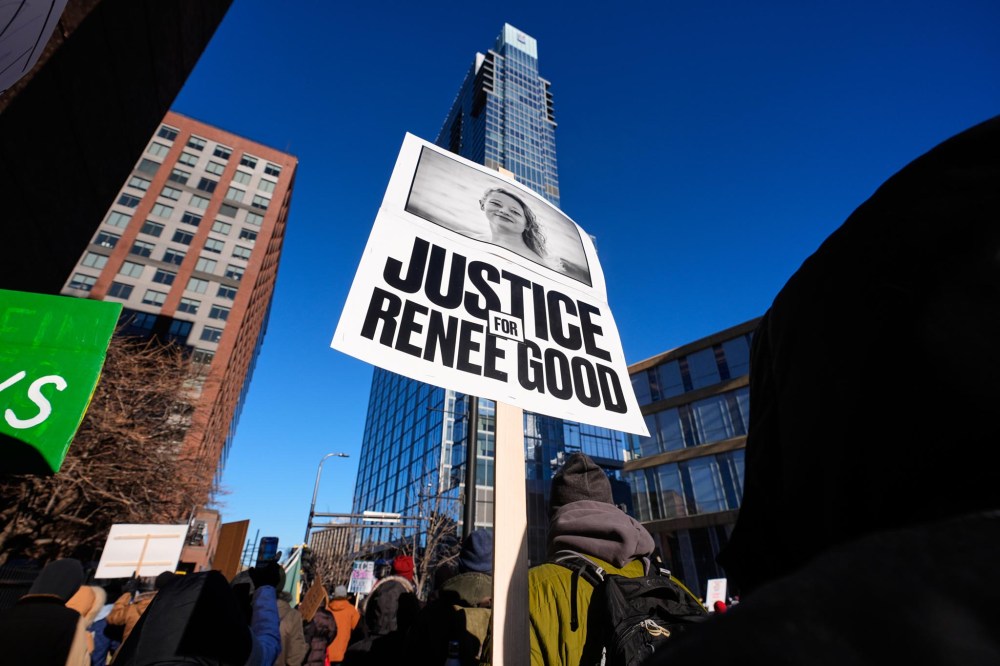
Protest songs are a rich folk tradition that has spread across all genres (particularly hip hop and punk), across all decades. They are historical records that function like journalism, snapshots of a time and place.
But more importantly, they act as the voice of the people.
Authoritarianism abhors art. Art is too subversive, too scary. Art is ideas. Art endures. There’s a reason Woody Guthrie wrote, “This machine kills fascists” on his guitar and Pete Seeger wrote, “This machine surrounds hate and forces it to surrender” on his banjo: art is resistance.
There are plenty of modern examples of protest songs, though perhaps not as many as proportional to the horrors. The protest songs that soundtracked one’s coming of age tend to be particularly vivid: for me, those are the ones U.S. president George W. Bush inspired in the early 2000s, including Bu$hleaguer, from Pearl Jam’s 2002 album, Riot Act.
Green Day’s punk rock opera American Idiot, which came out in 2004, was also a direct response to disillusionment following 9/11 and the Iraq War. (Green Day has changed certain lyrics to reference U.S. President Donald Trump during live shows.)
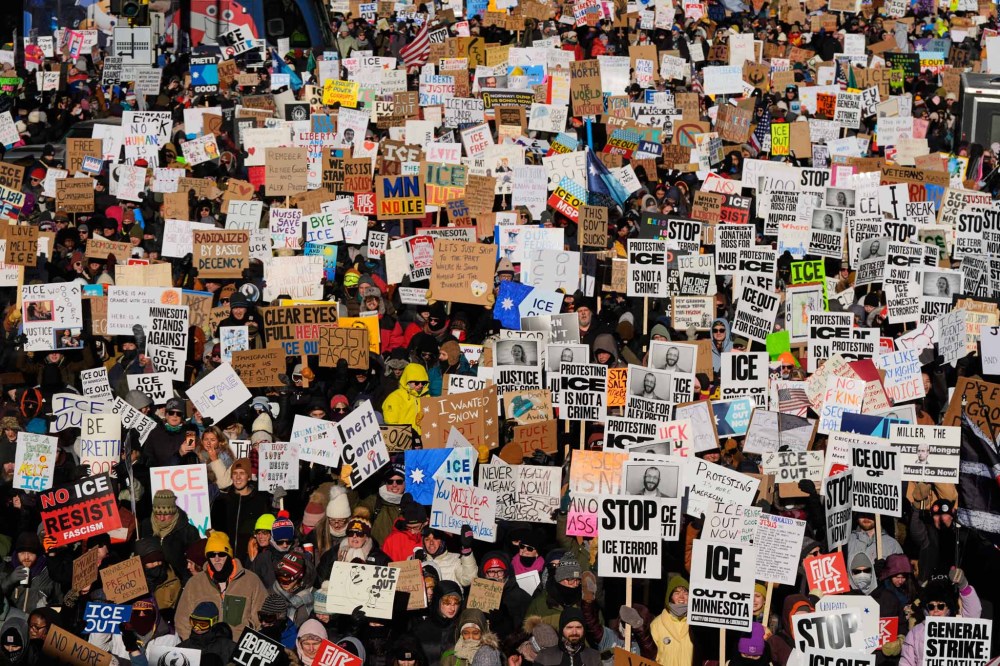
Springsteen, encouragingly, isn’t the only one to release songs protesting ICE in recent weeks. There’s punk outfit NOFX’s Minnesota Nazis, British singer-songwriter Billy Bragg’s City of Heroes and the Celtic punk band Dropkick Murphys’ Citizen I.C.E., a new version of their satirical recruitment song Citizen C.I.A. (Sample update: “Too scared to join the military/too dumb to be a cop.”)
And even if they aren’t writing and recording songs, artists are showing up in other ways. They are withdrawing from performing at the renamed Kennedy Centre. They are speaking up at their own shows. All of this counts.
But there’s something uniquely powerful in immortalizing a moment in time in song.
The most haunting lyric in Streets of Minneapolis is when Springsteen refers to right now as “the Winter of ‘26.” Because one day, this will be history. And history seems so easily repeated these days.
“Here in our home, they killed and roamed/In the winter of ’26/We’ll remember the names of those who died/On the streets of Minneapolis,” he sings in the chorus.
I hope he’s right.
winnipegfreepress.com/jenzoratti
Jen Zoratti is a columnist and feature writer working in the Arts & Life department, as well as the author of the weekly newsletter NEXT. A National Newspaper Award finalist for arts and entertainment writing, Jen is a graduate of the Creative Communications program at RRC Polytech and was a music writer before joining the Free Press in 2013. Read more about Jen.
Every piece of reporting Jen produces is reviewed by an editing team before it is posted online or published in print – part of the Free Press‘s tradition, since 1872, of producing reliable independent journalism. Read more about Free Press’s history and mandate, and learn how our newsroom operates.
Our newsroom depends on a growing audience of readers to power our journalism. If you are not a paid reader, please consider becoming a subscriber.
Our newsroom depends on its audience of readers to power our journalism. Thank you for your support.
Jen Zoratti is a columnist and feature writer working in the Arts & Life department, as well as the author of the weekly newsletter NEXT. A National Newspaper Award finalist for arts and entertainment writing, Jen is a graduate of the Creative Communications program at RRC Polytech and was a music writer before joining the Free Press in 2013. Read more about Jen.
Every piece of reporting Jen produces is reviewed by an editing team before it is posted online or published in print – part of the Free Press‘s tradition, since 1872, of producing reliable independent journalism. Read more about Free Press’s history and mandate, and learn how our newsroom operates.
Our newsroom depends on a growing audience of readers to power our journalism. If you are not a paid reader, please consider becoming a subscriber.
Our newsroom depends on its audience of readers to power our journalism. Thank you for your support.
Related Articles
Bruce Springsteen sings out against Trump in 'Streets of Minneapolis'




Advertisement Advertise With Us
Advertisement Advertise With Us