A powerful mix of culture and craft
Dutcher's debut brings ancestors' melodies, wordsinto present day

Advertisement
Read this article for free:
or
Already have an account? Log in here »
To continue reading, please subscribe:

Digital Subscription
One year of digital access for only $205*
- Enjoy unlimited reading on winnipegfreepress.com
- Read the E-Edition, our digital replica newspaper
- Access News Break, our award-winning app
- Play interactive puzzles
*First annual payment billed as $205.00 + GST for one year. This annual subscription will automatically renew at $233.00 + GST every 52 weeks (10% off the regular annual price of $259.35). Offer available to new and qualified returning subscribers only. Cancel any time.
To continue reading, please subscribe:
Add Free Press access to your Brandon Sun subscription for only an additional
$1 for the first 4 weeks*
- Enjoy unlimited reading on winnipegfreepress.com
- Read the E-Edition, our digital replica newspaper
- Access News Break, our award-winning app
- Play interactive puzzles
*Your next Brandon Sun subscription payment will increase by $1.00 and you will be charged $17.95 plus GST for four weeks. After four weeks, your payment will increase to $24.95 plus GST every four weeks.
Read unlimited articles for free today:
or
Already have an account? Log in here »
Hey there, time traveller!
This article was published 16/06/2018 (3022 days ago), so information in it may no longer be current.
It’s not often an album is so profoundly beautiful and legitimately unique you can’t help but stop everything else you’re doing and just listen.
Such is the case with Jeremy Dutcher’s debut effort, Wolastoqiyik Lintuwakonawa.
Dutcher — who is now based in Toronto — grew up in Tobique First Nation, one of six Wolastoqiyik reserves in New Brunswick, about 180 kilometres northwest of Fredericton, near the province’s border with Maine.
There are few Wolastoq speakers left — Dutcher, 27, is one of them — and much of their music had been lost in the decades following the introduction of the Indian Act. However, one song had been brought back to the community by an elder, Maggie Paul, after a trip to the archives at the Canadian Museum of History in Gatineau, Que., in the 1980s. Knowing Dutcher’s passion for both music and the Wolastoq language and history, she advised that he, too, visit the archives to seek out more music, photos and stories.At the time, five years ago, Dutcher was studying music at Dalhousie University in Halifax, though the operatic tenor eventually shifted to anthropology. Dutcher heeded Paul’s suggestion and visited the museum, a journey that combined his two fields of study.
He spent two weeks in the archives transcribing songs that were recorded onto wax cylinders more than a century ago, using the melodies and the words of his ancestors as the foundation for new compositions.
“My whole time at the museum was incredibly transformative. The whole point of this work was about accessibility and letting people know about the archive, and I didn’t know a thing about it growing up. It wasn’t until Maggie mentioned it. And it’s not just songs, either, it’s important to acknowledge it’s also photographs from decades ago, which I use on some of the liner and artwork for the singles. Also stories. There’s so much in there that needs to come out and be shown to the people,” Dutcher says.
The result of his archival digging is an 11-track album that is a true collision of cultures; Dutcher’s operatic training used to reimagine the past music of his people with a contemporary lens. It is both progressive and traditional; completely fresh, yet respectful of its inspiration. It also has earned a spot on the Polaris Award long list, announced Thursday.
“I think it’s interesting for this one, specifically, since it was so rooted within the melody, I really wanted to make sure that was coming forward the most, so all the time, compositionally, I would be going back to, ‘OK, but what did the melody want to say here, how does it want to move?’ he says.
“I tried to be very aware of the movement; the melodies, they’re not what I thought of in terms of traditional music, they really go a lot of places, so I really just wanted to respect that and let it lead… It is music that moves, so for me, the compositional challenge was just to be responsive to that movement.”
Though this project was one made simply out of love — for his culture and for music — Dutcher is aware of the weight that comes along with making art that is so rooted in history; it is purposeful in a much larger way, dense with emotion and meaning.
“Certainly, that’s something… even in the past couple of weeks, because I went home and got to share this, and the way it was responded to I think it really drove home to me the deep responsibility that now comes with this work. I’d always been involved in our music-making at home when I was growing up, but there is something different when you start making your own art and you start creating and you use the language; it takes on all these different layers of meaning,” he says.
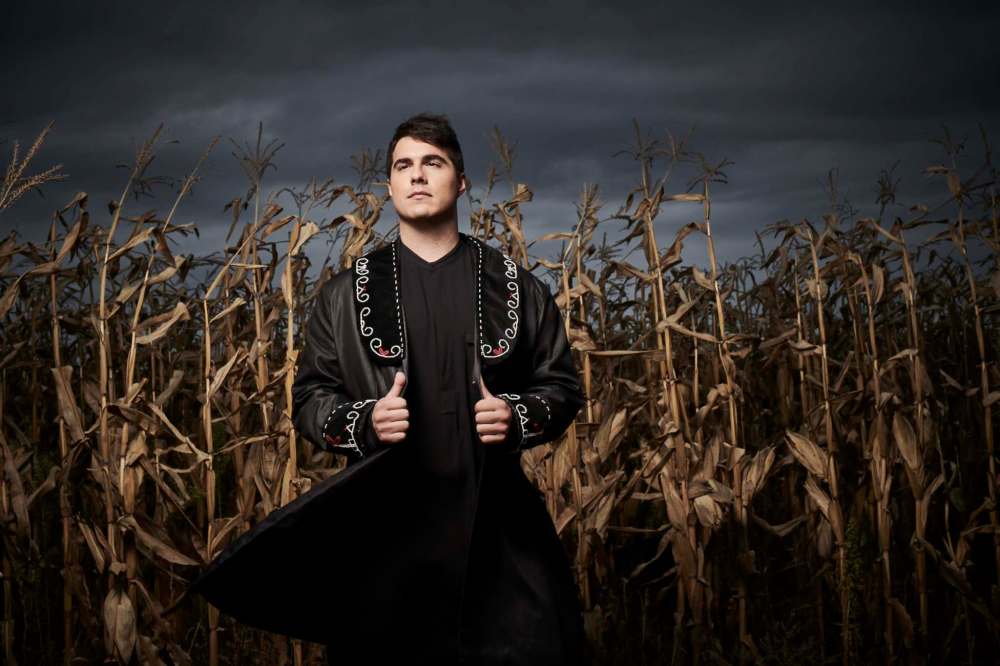

“At the outset, I don’t know that I fully understood the scope of what I was entering into; for me, it was always this fun project, this sort of pet project I was working on while I was in school and entering the workforce and doing all these things… It was always kind of a very insular thing, this work, and so now that it’s sort of out in public, and most importantly in the hands of my people now, it’s definitely taken on a different shape.”
Dutcher says this album is meant to be a conversation between him and the other members of his community; a link to the past that also provides inspiration for the future. His intention was not to make something political, nor to open up a discussion about reconciliation, but if his music has an impact beyond his own culture, he’s all for it.
“This album was really… I wanted it to be a direct conversation between me and other Wolastoqiyik people, and certainly non-Indigenous people and Indigenous people from other nations are welcome to come and witness that and to think about the kinds of things I’m talking about — linguistic reclamation and cultural resurgence are things that don’t just affect my community, obviously, they are important things that a lot of Indigenous people are grappling with right now,” he says.
“On so many fronts, there is so much hurt that has happened in this country and I do believe music is healing, and I think if this can reach people in a way that touches them and pushes the conversation forward, then that’s really cool. I’m all about that. But in terms of setting out to have that goal, that’s too lofty for me.”
erin.lebar@freepress.mb.ca Twitter: @NireRabel
Our newsroom depends on a growing audience of readers to power our journalism. If you are not a paid reader, please consider becoming a subscriber.
Our newsroom depends on its audience of readers to power our journalism. Thank you for your support.
Concert preview
Sākihiwē Festival
Jeremy Dutcher
● Tonight, 7 p.m., Central Park (400 Edmonton St.)
● Sunday, 4 p.m., Turtle Island Recreation Centre (510 King St.)
● Admission is free
● For further information about other concerts and events happening at the Sākihiwē Festival this weekend, visit sakihiwe.ca
Our newsroom depends on a growing audience of readers to power our journalism. If you are not a paid reader, please consider becoming a subscriber.
Our newsroom depends on its audience of readers to power our journalism. Thank you for your support.
Advertisement Advertise With Us
Advertisement Advertise With Us