Cancelled tours just part of pianist’s ‘turbulent life’
Pandemic gives performer time to practise, when he's not studying neuropsychology
Advertisement
Read this article for free:
or
Already have an account? Log in here »
To continue reading, please subscribe:

Digital Subscription
One year of digital access for only $205*
- Enjoy unlimited reading on winnipegfreepress.com
- Read the E-Edition, our digital replica newspaper
- Access News Break, our award-winning app
- Play interactive puzzles
*First annual payment billed as $205.00 + GST for one year. This annual subscription will automatically renew at $233.00 + GST every 52 weeks (10% off the regular annual price of $259.35). Offer available to new and qualified returning subscribers only. Cancel any time.
To continue reading, please subscribe:
Add Free Press access to your Brandon Sun subscription for only an additional
$1 for the first 4 weeks*
- Enjoy unlimited reading on winnipegfreepress.com
- Read the E-Edition, our digital replica newspaper
- Access News Break, our award-winning app
- Play interactive puzzles
*Your next Brandon Sun subscription payment will increase by $1.00 and you will be charged $17.95 plus GST for four weeks. After four weeks, your payment will increase to $24.95 plus GST every four weeks.
Read unlimited articles for free today:
or
Already have an account? Log in here »
Hey there, time traveller!
This article was published 15/04/2021 (2002 days ago), so information in it may no longer be current.
Those with sharp eyes might have noticed that the Honens International Piano Competition, held every three years in Calgary, quietly — albeit not surprisingly — postponed its 2021 fall event until next year, yet another COVID-19 casualty.
Helmed by artistic director/pianist Jon Kimura Parker and named for its late benefactor, Esther Honens, the competition has helped launch high-profile performance and recording careers for a galaxy of classical music stars since its inception in 1992. Honens offers the world’s largest cash prize for piano, a cool $100,000, in addition to a comprehensive, three-year artistic and career-development program valued at $500,000.
“This is less of a decision than it is the acceptance of an inevitability,” president and CEO Neil Edwards says of the necessary “pause,” announced March 3. “However, we also feel very fortunate that we’re able to move everything from one year to another, unlike so many of our colleague organizations that have lost entire arts seasons or more.”
Edwards says this year’s already selected 50 quarterfinalists — including seven Canadians — who hail from 18 different countries and from an unprecedented initial field of 130 applicants, will be invited back next spring to perform their solo recitals in hub cities Berlin and New York City, with a further winnowed-down group of 10 semi-finalists then (fingers crossed) travelling to Calgary for the finals in October 2022.
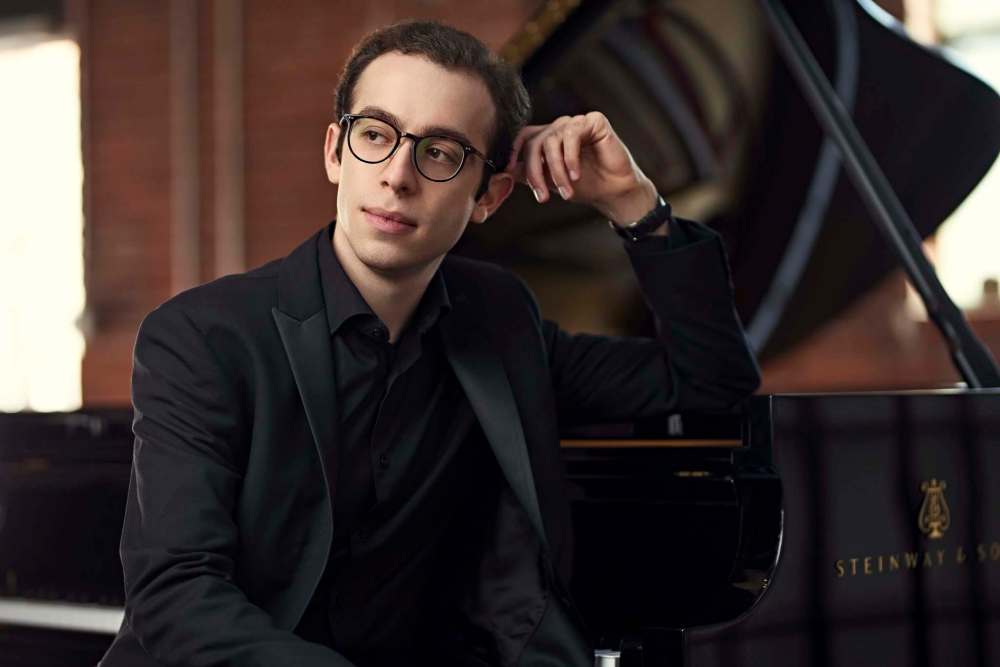
There were no global pandemics on the horizon when Georgian pianist Nicolas (Nico) Namoradze, now 28, garnered top prize as Honens’ latest laureate in September 2018, his artistry hailed by critics as “sparkling… sensitive and coloristic” (New York Times) and “simply gorgeous” (Wall Street Journal).
“Life is full of surprises,” the artist says of his win in a Zoom interview from his Berlin home. After taking the bold move of stepping out of the limelight to explore his artistic voice for four years prior to entering the competition, the pianist, by then “fully charged,” electrified listeners with his performances of Brahms’ Piano Concerto No. 2 in B flat major, Op. 83, among others, as well as his own Etudes, described as “fearsomely challenging.”
“I often say if there were only one competition I could have chosen to enter, it would have been the Honens,” Namoradze says. “It’s really a mentorship where you receive this incredible team of people committed to your success during those critical first years. It’s important to begin on solid ground, and Honens has provided that for me.”
The Hungarian-raised artist marked his orchestral debut at age 12, and completed his undergraduate studies in Budapest, Vienna and Florence before moving to New York City for his master’s degree at the Juilliard School.
He also has a connection to Winnipeg. One of his teachers is Grammy-winning pianist Emanuel Ax, who immigrated here from Poland with his parents in the late 1950s. The Axes initially set up shop, literally, in Winnipeg’s North End, before eventually departing for New York City in 1961. Ax, who still has family here, last performed with the Winnipeg Symphony Orchestra in September 2018; Namoradze’s own WSO debut, originally billed for Oct. 31, 2020, was shelved because of the global pandemic. He’s expected to appear with the orchestra sometime in the near future — something he’s eagerly looking forward to.
Ax, who keeps in regular touch with his protegé, heralds him as “set to become one of the truly important artists of his generation.”
Namoradze’s other teachers in piano have included Yoheved Kaplinsky, Zoltán Kocsis, Matti Raekallio and Elisso Virsaladze, as well as John Corigliano in composition (the latter served as distinguished guest artist for the Winnipeg New Music Festival in its earliest years).
When some are busily tending sourdough starters, bingeing on Netflix or toiling over jigsaw puzzles, Namoradze, whose Honens-sponsored tours of Japan, the U.S. and Canada were cancelled this season, has been spending lockdown grounded in Germany, practising up to five hours a day on his hybrid Yamaha “AvantGrand” piano, as well as pursuing another lifelong passion.
After having already successfully defended his doctoral dissertation, titled Macroharmony in Ligeti’s Etudes, Book 3, the cerebral artist, who taught for four years at Queens College, has embarked on post-doctoral studies in neurosciences, with a special interest in neuropsychology and neuroplasticity, through the Institute of Psychiatry, Psychology and Neurosciences, King’s College London.
He says cognitive sciences fit in well with another practice of his: mindfulness and meditation. This habit is further reinforced by a love for yoga, qi gong and tai chi, which became critically important tools during the nail-biting Honens finals in 2018, and help him maintain a razor-sharp focus in what he calls “a very turbulent kind of lifestyle” as a professional musician.
He’s also exploring his compositional voice and recently released an acclaimed album on the Hyperion label, highlighting the lesser-known music of late-romantic British composer York Bowen.

Namoradze was able to make his London debut at Wigmore Hall in February 2020, followed by a solo recital the next month at Boston’s Isabella Stewart Gardner Museum. Both were performed for now-rare in-person audiences during that tiny sliver of time last spring before lockdown hit, and then streamed for viewers online.
“As a performer, you either play for a live audience where you can feel the response of those living beings in the hall, or you do a recording where you have what (Canadian pianist Glenn) Gould called that kind of embryonic security of the studio,” he explains.
“Streaming is an in-between point between those two settings, where you may not have a live audience in front of you, but you’re still playing ‘live to audiences’ in that moment. There may be hundreds or even thousands of people listening, but I can’t see them. The question then becomes, how do you get that energy that you’d get in live performance from that kind of an audience?
“Interestingly enough, one can simulate that experience, and still have that feeling that the notes you’re playing are touching someone’s ears and heart in that very moment… I believe that the music world will be much more interconnected in a post-pandemic era,” he predicts. “It will be much less localized with the dissolution of boundaries, and I think that’s a good thing.”
holly.harris@shaw.ca
Holly Harris writes about music for the Free Press Arts & Life department.
Our newsroom depends on a growing audience of readers to power our journalism. If you are not a paid reader, please consider becoming a subscriber.
Our newsroom depends on its audience of readers to power our journalism. Thank you for your support.