

Fears become reality
New Pornographers co-founder jarred by current events

Advertisement
Read this article for free:
or
Already have an account? Log in here »
To continue reading, please subscribe:
Monthly Digital Subscription
$1 per week for 24 weeks*
- Enjoy unlimited reading on winnipegfreepress.com
- Read the E-Edition, our digital replica newspaper
- Access News Break, our award-winning app
- Play interactive puzzles
*Billed as $4.00 plus GST every four weeks. After 24 weeks, price increases to the regular rate of $19.95 plus GST every four weeks. Offer available to new and qualified returning subscribers only. Cancel any time.
Monthly Digital Subscription
$4.99/week*
- Enjoy unlimited reading on winnipegfreepress.com
- Read the E-Edition, our digital replica newspaper
- Access News Break, our award-winning app
- Play interactive puzzles
*Billed as $19.95 plus GST every four weeks. Cancel any time.
To continue reading, please subscribe:
Add Free Press access to your Brandon Sun subscription for only an additional
$1 for the first 4 weeks*
*Your next subscription payment will increase by $1.00 and you will be charged $16.99 plus GST for four weeks. After four weeks, your payment will increase to $23.99 plus GST every four weeks.
Read unlimited articles for free today:
or
Already have an account? Log in here »
Hey there, time traveller!
This article was published 05/10/2017 (3087 days ago), so information in it may no longer be current.
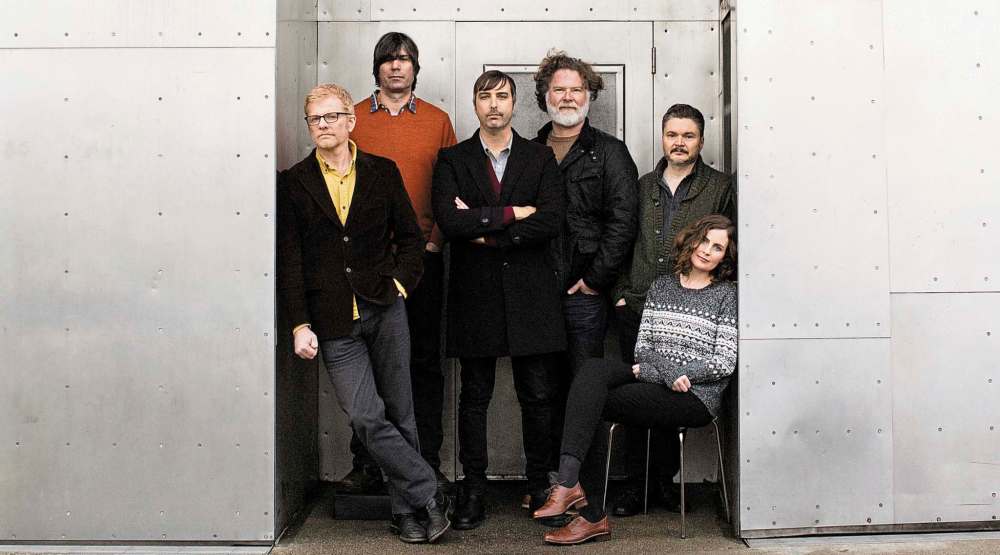
Indie-rockers the New Pornographers released their seventh full-length record earlier this year; Whiteout Conditions, a pop-rock-focused, synth-heavy collection inspired in part by the German experimental-rock genre of krautrock.
The album marks a lot of firsts for the group, which plays the Burton Cummings Theatre Saturday night, since it was formed in Vancouver 20 years ago. Whiteout Conditions is the first album not released on Matador Records since the band’s debut, and the first album without the input of co-founding singer-songwriter Dan Bejar, leaving frontman Carl Newman with the bulk of the songwriting duties.
As the Free Press connected with Newman to chat about the record Monday afternoon, people were finding out about the extent of the Sunday-night shooting horror in Las Vegas, along with the news legendary musician Tom Petty had died (a premature, factually incorrect report that became accurate later that night).
Of course, questions about Whiteout Conditions made their way into the conversation a bit later, but when speaking to an artist who is known for his thoughtful interviews and willingness to talk politics openly, it felt necessary to address both Tom Petty and Las Vegas first.
Erin Lebar: I hate to be the bearer of bad news, but it’s just been confirmed by a few major news outlets that Tom Petty died.
Carl Newman: That’s awful news. He’s one of the big ones.
Erin: I assume you’re a Petty fan?
Carl: Yeah, it’s hard not to be a fan of Tom Petty. He was in a rare group, you know? Everybody liked him; it was totally heartland rock. I’m sure country fans loved Tom Petty but like, other people thought he was cool as well. You listen to those songs and his work with Jeff Lynne… I always thought Tom Petty and Jeff Lynne was a pretty great combo.
Erin: I also wanted to discuss with you another upsetting event that happened today — the mass shooting in Las Vegas. Most people’s first thoughts are, “Why is this happening again? This is horrific.” But because it was a live-music event, a space that you guys occupy almost every night when you’re on tour, and also not the first live-music event something like this has happened at in recent memory, does it impact you in a stronger way?
Carl Newman: Yeah, it’s terrifying. Even more so with the Bataclan in Paris, where you think like, “Hey, that was an underground band,” that could have been us. I gotta say, though, it’s not something that passes through my head. When I think of the horror of it, it’s not like, “Oh, I play music and it happened at a concert,” it’s just an anger and sadness of the world, that it’s all so enabled. And it’s all such a predictable pattern. The response is always the same. Somebody wrote last year, I think, about Newtown, and it said Newtown was basically the end of the gun debate because if America decided it was OK that kids were murdered, they were OK with anything. Because this one is awful, but it’s still not as horrifying as Newtown, because the murder of innocent children will always just seem like the worst thing in the world, if you’re measuring tragedy against tragedy, you know? So that’s why a lot of people get angry.
Erin: And then you have the White House saying it’s not the time to talk about gun control.
Carl: Yeah, exactly. It’s like after 9/11, saying, “Now is not the time to talk about the problem with terrorism.” People would have laughed in your face if you said that. It’s like, “Let’s let people grieve and talk about terrorism in a few days.” Like, “No. This is a f—ing problem right now, let’s go straight to the causes of why this is happening.” And also the other point that has been made many times… mass shootings happen so often you would never talk about it because there’s one every day or two, if you have to leave a day or two between them to talk about. That’s a good, permanent way out of ever talking about it.
Erin Lebar: Changing lanes only slightly here, I know you’ve spoken a lot about the run-up to the U.S. election last year inspiring a few of the tracks on the album, but at the time you were writing, those concerns were speculative — now that those fears have actualized, do those songs take on a new life?
Carl: I mean, I guess so — yeah, like the song High Ticket Attraction is about a fear that is reality now and what do we do now that we’re sitting inside of it. It’s just a battle, an internal and external battle, day in and day out.
Erin: This is the first album on your own label — Collected Works Records. Are there any major differences doing it that way as opposed to a major label release?
Carl Newman: Not really, and that’s one of the reasons why we did it. We just realized that we’re at a point where our name is a bigger selling point than the label’s name. Like, when you’re a baby band, you might get signed to Sub Pop or Merge or Matador and the fact that you’re on that label helps — your label is the name and you’re just the unknown name hoping that the label will help you… So for that reason, we just thought, “Let’s go with the best option.” Concord (Records) came to us and were willing to be the umbrella company that handles our own little imprint and it just seemed like the best deal. It felt like a good place to go.
Erin: What are you most proud of with this record?
Carl: The song Play Money is my favourite. I just like when I do something that feels like a song I haven’t done before. When something feels new to me, I feel very happy about it, and I felt that way about play money. And there are other songs where I like them, but I think, “Oh, this sounds so much like me.” And it’s not always the hit, it’s not always a focus track on the album. Like on Brill Bruisers, the song I liked the most was called Hi-Rise, and I had to fight to keep that on the record. I was like, “No! I think this is the best thing I’ve done in a long time, this has gotta go on the record,” and it was just because I liked the vibe of it. I guess that’s just my musical taste… maybe I don’t have the most mainstream musical taste because I don’t always pick the hit. I’m always shocked what people want to choose as the single.
Erin Lebar: Is it hard to find that feeling of newness with so many years of writing and composing under your belt?

Carl: Yeah, I think it is. I think everybody… you realize after a while that you have a style, you have a certain kind of song that you write, but I still try and get away from it. I don’t want to be completely predictable. For me a lot of songwriting now, half of it is arrangement. Maybe I have the words and the chords and the melody, but I listen to it and think, “What else does it do?” I don’t want to be a singer-songwriter, I don’t want to be the guy who stands up and plays a song on an acoustic guitar, I’ve never really wanted to be that. Even when the song is done and it’s at that point, I have to figure out what else to do with it, and that’s half the work.
This interview has been condensed and edited for length.
erin.lebar@freepress.mb.ca
Twitter: @NireRabel
Our newsroom depends on a growing audience of readers to power our journalism. If you are not a paid reader, please consider becoming a subscriber.
Our newsroom depends on its audience of readers to power our journalism. Thank you for your support.
Concert preview

The New Pornographers
Saturday, 8 p.m.
Burton Cummings Theatre
Tickets start at $27, available at Ticketmaster
Our newsroom depends on a growing audience of readers to power our journalism. If you are not a paid reader, please consider becoming a subscriber.
Our newsroom depends on its audience of readers to power our journalism. Thank you for your support.
Advertisement Advertise With Us
Advertisement Advertise With Us