Roof structures failed before Radiohead stage came down, inquest hears

Advertisement

Advertise with us

TORONTO - Metal structures meant to hold a roof over a stage during a Radiohead concert in Toronto were the first pieces to fail as the entire setup came crashing down nearly seven years ago, killing the band's drum technician and injuring several others, a coroner's inquest heard Monday.

Read this article for free:


or

Already have an account? Log in here »

To continue reading, please subscribe:

Subscribe and receive a limited-edition Free Press branded hat or tote.

Digital Subscription

One year of digital access for only $205*

  • Enjoy unlimited reading on winnipegfreepress.com
  • Read the E-Edition, our digital replica newspaper
  • Access News Break, our award-winning app
  • Play interactive puzzles

*First annual payment billed as $205.00 + GST for one year. This annual subscription will automatically renew at $233.00 + GST every 52 weeks (10% off the regular annual price of $259.35). Offer available to new and qualified returning subscribers only. Cancel any time.

To continue reading, please subscribe:

Add Free Press access to your Brandon Sun subscription for only an additional

$1 for the first 4 weeks*

  • Enjoy unlimited reading on winnipegfreepress.com
  • Read the E-Edition, our digital replica newspaper
  • Access News Break, our award-winning app
  • Play interactive puzzles
Start now

*Your next Brandon Sun subscription payment will increase by $1.00 and you will be charged $17.95 plus GST for four weeks. After four weeks, your payment will increase to $24.95 plus GST every four weeks.

Hey there, time traveller!
This article was published 25/03/2019 (2746 days ago), so information in it may no longer be current.

TORONTO – Metal structures meant to hold a roof over a stage during a Radiohead concert in Toronto were the first pieces to fail as the entire setup came crashing down nearly seven years ago, killing the band’s drum technician and injuring several others, a coroner’s inquest heard Monday.

A Ministry of Labour engineer who helped investigate the collapse was among those who testified as the inquest into the death of Scott Johnson got underway.

Saeed Khoorsand said the pickup trusses bearing the weight of the roof grid — which itself held tens of thousands of kilograms in lighting and other equipment — were “the weakest link in the stage that caused the whole roof system to collapse.”
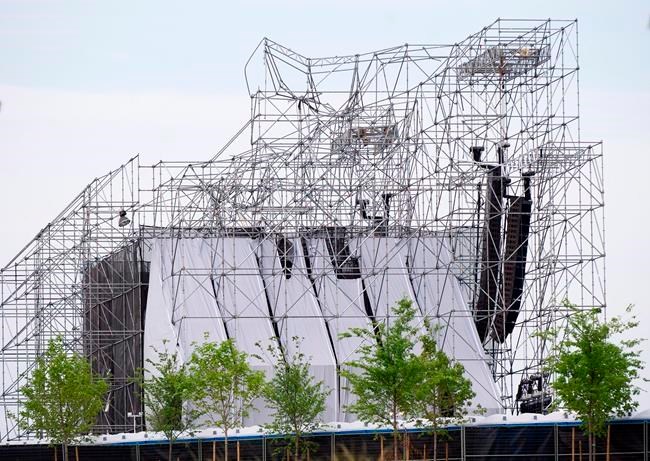
A collapsed stage is shown at Downsview Park in Toronto on Saturday, June 16, 2012. An inquest is set to get underway today into the fatal stage collapse at a Radiohead concert in Toronto nearly seven years ago. The band's drum technician, Scott Johnson, was killed when a massive structure crashed down on him on June 16, 2012 - just hours before Radiohead was set to take the stage at Downsview Park. THE CANADIAN PRESS/Nathan Denette

Khoorsand also pointed to some discrepancies between the plans and the materials used in building the outdoor stage, noting the trusses at the site weren’t as thick as they should have been according to the drawings, while some beams were larger.

The plans had been reviewed and checked by an engineer, Domenic Cugliari, just over a week before the incident, he said.

Johnson, who was Radiohead’s drum technician, was crushed by the falling roof and died just hours before the band was set to take the stage at Downsview Park on June 16, 2012.

Charges in the case, against Cugliari and others, were stayed because the matter took too long to get to trial.

The inquest, which is expected to hear from roughly 25 witnesses, will examine the circumstances around Johnson’s death, but will not assign blame. A jury may make recommendations aimed at preventing similar incidents.

“What happened to Scott was tragic but if we can’t learn from it … there’s no benefit at all from his death,” Prabhu Rajan, one of the lawyers assisting the coroner, said outside the inquest.

Rajan said he expects evidence will show some gaps in the current system. For example, he said, the concert was to take place on federal land, which meant there was no need to seek a building permit — a form of third-party oversight.

“I think that should give everybody some concern, some pause,” he said.

The inquest also heard Monday from a man hired to tune Radiohead’s pianos for the show, who said he heard the stage creaking in the wind shortly before the structure gave way.

Wayne Ferguson said he noticed it after a light breeze hit the stage’s back curtain around 3:30 p.m. or 3:45 p.m. and tried to see what was going on above them.

Ferguson testified that he was asked to leave the stage around 3:50 p.m. so that others could perform a soundcheck, but Johnson — who was stationed near him — stayed behind.

Ferguson and his daughter were sitting at a picnic bench facing the stage shortly afterward when there was a loud noise, he said.

“We heard a huge crack and within, like, two seconds the whole roof collapsed,” Ferguson told the inquest. He described seeing beams piercing through the back grid of the stage and immediately calling 911.

A paramedic who was one of the first at the scene testified he found Johnson trapped under the stage with no vital signs.

“There was nothing we could do for him, especially because we couldn’t extricate him,” Stephan Krasl said.

Johnson’s father and Radiohead’s drummer described the shock and grief they felt when they received the grim news, as well as the lingering trauma from that day.

Johnson’s family and the British band have been highly critical of the judicial process, but said they hoped the inquest would bring some of the answers they did not get through the courts.

“That causes me great concern that the case wasn’t completed,” Ken Johnson said. “It’s painful but I’m quite happy that events here will resolve all that.”

The band’s drummer, Philip Selway, testified that the incident was “personally traumatizing” for them and their crew, and made them feel “vulnerable” onstage.

Outside, Selway said he felt it was important to attend the proceeding.

“After all the charges were stayed, we had a real sense of injustice from it and nothing constructive, from our point of view, came out of that court case,” he said. “So we feel a responsibility to Scott, we feel a responsibility to Mr. and Mrs. Johnson, and our crew, and to our audience as well to keep pursuing this.”

Thirteen charges were laid under provincial health and safety laws against the show’s promoter, Live Nation, contractor Optex Staging and Cugliari, the engineer.

But the case went off the rails when the presiding judge at trial declared he had lost jurisdiction after being appointed to a higher court. Another judge declared a mistrial and a new hearing was planned.

Defence lawyers argued the charges should be stayed because the delays violated their clients’ rights to a timely trial, which was expected to wrap up in mid-2018, five years after charges were laid. The new judge agreed, noting the Supreme Court’s so-called Jordan decision, which set a ceiling of 18 months for proceedings in provincial court.
Report Error Submit a Tip

More Stories

Acquisition of former residential school grounds will help educate future generations: premier

Connor McDowell and Morgan Modjeski 6 minute read Preview

Acquisition of former residential school grounds will help educate future generations: premier

Connor McDowell and Morgan Modjeski 6 minute read Yesterday at 8:31 PM CDT

Premier Wab Kinew says a former Brandon-area campground acquired by the province will help educate future generations about the horrors of residential schools.

“We live in an era where people are trying to deny what happened in residential schools,” Kinew said during a Tuesday afternoon visit to Turtle Crossing Campground, near the former Brandon Indian Residential School. “It’s an important part of our national history, and keeping that truth alive.”

Kinew officially announced the province’s plan Tuesday, in partnership with the City of Brandon, to acquire and protect the site where the bodies of more than 50 Indigenous children are located.

The premier said the property has “huge national significance” for education about residential school history because it is one of the “most documented” in the country. He carried photographs, and some 20th century newspaper clippings from the Brandon Sun around the site Tuesday.

Read
Yesterday at 8:31 PM CDT

Hero fought to remember children lost at residential school

Niigaan Sinclair 5 minute read Preview

Hero fought to remember children lost at residential school

Niigaan Sinclair 5 minute read Yesterday at 6:25 PM CDT

The story of the gravesites of students who attended the Brandon Indian Residential School underneath the Turtle Crossing Campground is truly a Manitoba tragedy.

Read
Yesterday at 6:25 PM CDT

Province to acquire campground near former residential school

Morgan Modjeski 3 minute read Preview

Province to acquire campground near former residential school

Morgan Modjeski 3 minute read Yesterday at 6:00 AM CDT

A burial site for dozens of children who died while attending the Brandon Indian Residential School will be acquired by the province, the Free Press has learned.

Premier Wab Kinew will announce the province’s plan to protect Turtle Crossing Campground at a news conference in Brandon Wednesday to mark National Day for Truth and Reconciliation. The move is in partnership with the City of Brandon.

The graves of at least 56 children are located at the campground, the Sioux Valley Dakota Nation has said, pointing to a geophysical study conducted by an archaeology firm in 2018.

There have been longstanding concerns from Indigenous leaders and community members that people were camping on the resting place of children victimized by colonialism.

Read
Yesterday at 6:00 AM CDT

What does the PC stand for in party’s name? Seems to be Pretty Confused

Tom Brodbeck 5 minute read Preview

What does the PC stand for in party’s name? Seems to be Pretty Confused

Tom Brodbeck 5 minute read Yesterday at 1:11 PM CDT

It should have been obvious from the beginning that the Manitoba Progressive Conservative party was going to have trouble holding itself together under Obby Khan.

Read
Yesterday at 1:11 PM CDT

Radiohead stage had weak roof structures, inquest hears

Paola Loriggio, The Canadian Press 5 minute read Preview

Radiohead stage had weak roof structures, inquest hears

Paola Loriggio, The Canadian Press 5 minute read Monday, Mar. 25, 2019

TORONTO - Metal structures meant to hold a roof over a stage during a Radiohead concert in Toronto were the first pieces to fail as the entire setup came crashing down nearly seven years ago, killing the band's drum technician and injuring several others, a coroner's inquest heard Monday.

A Ministry of Labour engineer who helped investigate the collapse was among those who testified as the inquest into the death of Scott Johnson got underway.

Saeed Khoorsand said the pickup trusses bearing the weight of the roof grid — which itself held tens of thousands of kilograms in lighting and other equipment — were "the weakest link in the stage that caused the whole roof system to collapse."

Khoorsand also pointed to some discrepancies between the plans and the materials used in building the outdoor stage, noting the trusses at the site weren't as thick as they should have been according to the drawings, while some beams were larger.

Read
Monday, Mar. 25, 2019

Canada resorting to its tried and true playbook

Niigaan Sinclair 5 minute read Preview

Canada resorting to its tried and true playbook

Niigaan Sinclair 5 minute read Monday, Sep. 28, 2026

In 1846, Britain faced an emergency influenced by the Irish famine, so leaders repealed the country’s “Corn Laws” and restrictions on imported food and grain, transitioning to a system of free trade.

This created a crisis in the then Province of Canada, which had relied on British “preferential” status to prop up its agricultural and resource industries.

As a result, Canada looked south for new markets and eventually negotiated a free trade agreement with the United States.

This required land to be acquired and converted for industrial use quickly, so Canada quickly dispatched Commissioner William Robinson to negotiate with Indigenous communities along Lake Huron and Lake Superior for land.

Read
Monday, Sep. 28, 2026