Grisly murder tale better told without embellishment
Advertisement
Read this article for free:
or
Already have an account? Log in here »
To continue reading, please subscribe:

Digital Subscription
One year of digital access for only $205*
- Enjoy unlimited reading on winnipegfreepress.com
- Read the E-Edition, our digital replica newspaper
- Access News Break, our award-winning app
- Play interactive puzzles
*First annual payment billed as $205.00 + GST for one year. This annual subscription will automatically renew at $233.00 + GST every 52 weeks (10% off the regular annual price of $259.35). Offer available to new and qualified returning subscribers only. Cancel any time.
To continue reading, please subscribe:
Add Free Press access to your Brandon Sun subscription for only an additional
$1 for the first 4 weeks*
- Enjoy unlimited reading on winnipegfreepress.com
- Read the E-Edition, our digital replica newspaper
- Access News Break, our award-winning app
- Play interactive puzzles
*Your next Brandon Sun subscription payment will increase by $1.00 and you will be charged $17.95 plus GST for four weeks. After four weeks, your payment will increase to $24.95 plus GST every four weeks.
Read unlimited articles for free today:
or
Already have an account? Log in here »
Hey there, time traveller!
This article was published 05/11/2009 (6134 days ago), so information in it may no longer be current.
What defines a documentary as a documentary? What makes a horror movie horrific?
And where’s the line that separates one from the other?
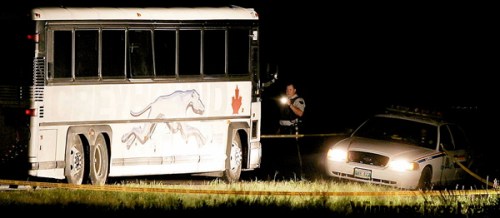
These are questions viewers will be prompted to ponder after watching this week’s instalment of CBC’s the fifth estate, which is titled Bus 1170 and provides a sort-of-documentary but undeniably horrifying exploration of the grisly murder that took place aboard a Greyhound bus in rural Manitoba in July 2008.
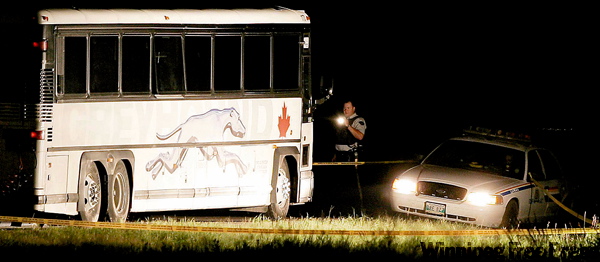
It’s a story that, for a whole lot of reasons, needs to be told, retold, examined and re-examined until all the lingering questions about the incident and the RCMP’s handling of it have been answered.
It’s the manner in which it’s told in this report, which veers far away from traditional documentary style and deep into the realm of ’50s B-movie dramatics, that might leave some viewers — particularly here, where the terror still resonates deeply — feeling more unsettled than informed.
Bus 1170, written and reported by veteran correspondent Bob McKeown, states its up-front intention as an attempt to delineate the two series of mostly random events that led to killer Vincent Li and victim Tim McLean being on the same eastbound bus.
"It’s a story," McKeown says while standing on the shoulder of the Trans-Canada Highway at the site of the July 29, 2008, murder, "in which seemingly unimportant and minor decisions and quirks of fate would turn out the difference between life and death."
He adds, as a quick, parental-warning afterthought: "It is not a story for young children or the faint of heart."
What follows is a mostly chronological retelling of events, bolstered by slowly emerging profiles of both victim and killer.
McLean, it turns out, was an outgoing, somewhat overactive sort who loved meeting people and revelled in his life on the carnival circuit — and enjoyed sharing his thoughts and adventures by capturing them on video. Because of that, we’re given a fairly colourful look at McLean and some of his carny cohorts as they goof their way across Western Canada in the summer of 2008.
Li, of course, is a more elusive commodity. In order to bring his story to life, McKeown and company decided to hire an actor to portray Li, re-enact some of the behaviour he is reported to have exhibited on the bus and, most disturbingly, repeat the words spoken by Li after the murder during hours of interviews with the province’s chief forensic psychiatrist, Dr. Stanley Yaren.
The stone-faced actor is shown making statements such as "I am the evil son of an evil God," and "God told me he was bad; God told me to kill him; God told me if I didn’t kill him, he would kill me."
The dramatizations do provide sort of a shorthand entry point into certain events and explanations, but there’s also an unmistakable sense that the story is being cheapened by their inclusion. Segments that take place on the bus are accompanied by some pretty flimsy suspense-movie background music, and images of the actor, as Li, pulling a knife from his duffel back as he sits beside another actor playing a sleeping McLean, just feel like flat-out exploitation for drama’s sake.
The most powerful moments in Bus 1170 are those in which real-life people affected by the murder are interviewed — including McLean’s parents, a couple of folks who were passengers on the bus, and a truck driver who stopped to see if he could help.
Their haunting accounts of the event, and the way their lives have been forever changed by it, along with the questions they raise about the RCMP’s handling of the situation, are what make Bus 1170 both compelling and valuable.
The dramatizations are a distraction, and an unwelcome one, at that. If it was the CBC’s intention to create a suspenseful yarn rather than an informative report, the network would have been better served by taking this story out of the hands of its news division and turning it over to an independent producer specializing in "inspired by actual events" TV movies.
Tim McLean’s story needs to be told, as many times as is required for all the satisfactory answers to be found.
But it needs no embellishment.
brad.oswald@freepress.mb.ca