Get to the bottom of the lakes
Advertisement
Read this article for free:
or
Already have an account? Log in here »
To continue reading, please subscribe:

Digital Subscription
One year of digital access for only $205*
- Enjoy unlimited reading on winnipegfreepress.com
- Read the E-Edition, our digital replica newspaper
- Access News Break, our award-winning app
- Play interactive puzzles
*First annual payment billed as $205.00 + GST for one year. This annual subscription will automatically renew at $233.00 + GST every 52 weeks (10% off the regular annual price of $259.35). Offer available to new and qualified returning subscribers only. Cancel any time.
To continue reading, please subscribe:
Add Free Press access to your Brandon Sun subscription for only an additional
$1 for the first 4 weeks*
- Enjoy unlimited reading on winnipegfreepress.com
- Read the E-Edition, our digital replica newspaper
- Access News Break, our award-winning app
- Play interactive puzzles
*Your next Brandon Sun subscription payment will increase by $1.00 and you will be charged $17.95 plus GST for four weeks. After four weeks, your payment will increase to $24.95 plus GST every four weeks.
Read unlimited articles for free today:
or
Already have an account? Log in here »
Hey there, time traveller!
This article was published 08/12/2011 (5420 days ago), so information in it may no longer be current.
Talk about pulling the plug.
Discovery Channel, home of an ever-increasing roster of speculative-science programming that employs cutting-edge technology to imagine what Earth, or space, or various eras of prehistoric creatures, might have been like if modern folk were able to get a first-hand look, has created another evening of “What if?” programming.
Past efforts have taken viewers on a dizzying journey to the edge of the universe, walked among dinosaurs and searched for evidence that the mythical lost city of Atlantis actually existed. The network’s latest digital-effects-driven special tackles a subject that’s much closer to home and, at first blush, seems rather mundane by comparison: exploring the history and underwater topography of the Great Lakes.
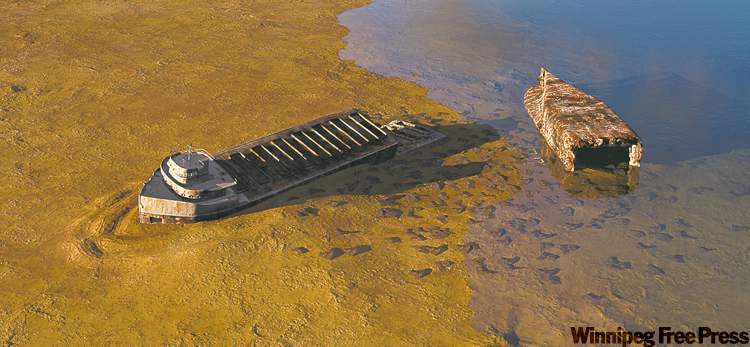
Drain the Great Lakes, which airs Sunday at 7 p.m. on Discovery, sets a fairly modest goal for itself but then far exceeds it by considering several very interesting aspects of the lake system. It isn’t as sexy or challenging as those earlier shows, but it’s still quite engaging because it deals such familiar and relatable subject matter.
The underlying premise (pun fully intended) here is that in recent years, scientists have been able to start mapping the bottom of the Great Lakes using techniques such as side-scan sonar and multi-beam devices; that information, paired with Discovery’s latest CGI graphics, allows filmmakers to digitally “drain” the Great Lakes to examine what lies beneath.
The first stop is Lake Superior, which narrator Wayne Abbott (also the special’s co-writer, director of photography and editor) describes as “the largest, deepest and most mysterious” of the Great Lakes. On the south shore of Superior, near a series of cliffs known as Pictured Rocks National Shoreline, the Drain team removes the water (an effect that is disappointingly unconvincing) to expose an alien-looking landscape some 400 metres below the water’s surface. The cause of the terrain’s heavily contoured shape is identified as massive glaciers that covered the entire Great Lakes some 20,000 years ago.
Near the bridge that crosses the Straits of Mackinac (between lakes Michigan and Huron), scientist Steve Blasco of the Geological Survey of Canada points to evidence that suggests huge fluctuations — perhaps as much as 50 metres — in the lakes’ level during the past 10,000 years.
“We know that climate change will affect lake levels,” he says. “We can look at the past and use it as a key to the future, to help us understand what Mother Nature and what mankind are going to do to lake levels, and we can then determine what we need to do in the future to adapt.”
Some of Drain the Great Lakes‘ exploration is just about basic human curiosity. New digital images suggest that during the lakes’ lowest levels (some 8,000 years ago), many huge waterfalls existed (and, interestingly, Niagara Falls did not) and there may have been human settlements on what now lies hundreds of metres below the current lake surface.
Another scientist examines evidence of fault lines beneath the surface of Lake Ontario near Toronto, warning that earthquakes are much more frequent than most people believe. The special also devotes a segment to the Great Lakes’ history of shipwrecks (some 6,000 in all, spread over the five lakes) and pays special attention to the biggest and best-known nautical disaster, the Edmund Fitzgerald.
Drain the Great Lakes doesn’t offer up any jaw-slackening “Wow!” moments. But it’s still good enough to justify not pulling the plug, if you know what I mean.
brad.oswald@freepress.mb.ca
TV REVIEW

Drain the Great Lakes
Narrated by Wayne Abbott
Sunday at 7 p.m.
Discovery
3 stars out of 5