Film examines Olympic hero’s German triumph, U.S. tragedy

Advertisement

Advertise with us

The one thing Jesse Owens never needed -- unless, that is, he was sprinting against a thoroughbred racehorse -- was a head start.

Read this article for free:


or

Already have an account? Log in here »

To continue reading, please subscribe:

Subscribe and receive a limited-edition Free Press branded hat or tote.

Digital Subscription

One year of digital access for only $205*

  • Enjoy unlimited reading on winnipegfreepress.com
  • Read the E-Edition, our digital replica newspaper
  • Access News Break, our award-winning app
  • Play interactive puzzles

*First annual payment billed as $205.00 + GST for one year. This annual subscription will automatically renew at $233.00 + GST every 52 weeks (10% off the regular annual price of $259.35). Offer available to new and qualified returning subscribers only. Cancel any time.

To continue reading, please subscribe:

Add Free Press access to your Brandon Sun subscription for only an additional

$1 for the first 4 weeks*

  • Enjoy unlimited reading on winnipegfreepress.com
  • Read the E-Edition, our digital replica newspaper
  • Access News Break, our award-winning app
  • Play interactive puzzles
Start now

*Your next Brandon Sun subscription payment will increase by $1.00 and you will be charged $17.95 plus GST for four weeks. After four weeks, your payment will increase to $24.95 plus GST every four weeks.

Opinion

Hey there, time traveller!
This article was published 01/05/2012 (5267 days ago), so information in it may no longer be current.

The one thing Jesse Owens never needed — unless, that is, he was sprinting against a thoroughbred racehorse — was a head start.

But PBS gives the famed U.S. Olympian a chance to get out of the gate early, airing its new American Experience profile a couple of months before the inevitable crush of Olympic-year programming overwhelms the prime-time lineup.

It’s a smart move — Jesse Owens, which airs tonight at 7 on Prairie Public TV, is a fascinating and surprisingly in-depth biography that deserves not to be lost in the looming wave of London-games clutter.
CP
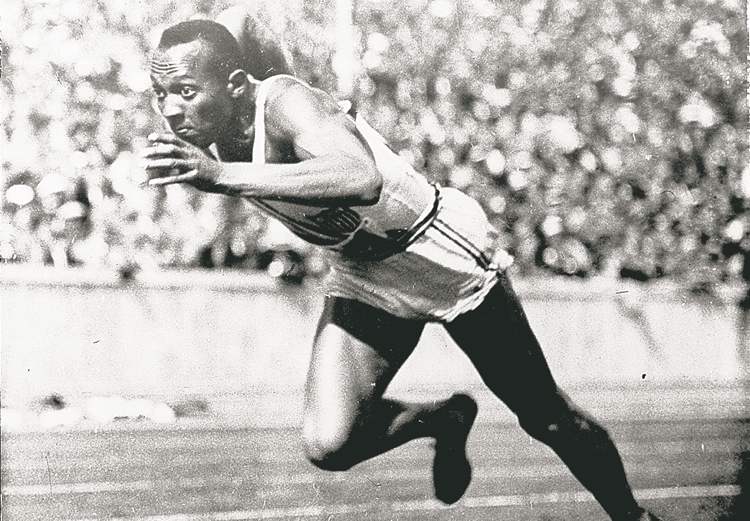
This 1936  file photo  shows Owens  in action  in a 200-metre preliminary  heat at the  Summer Olympic Games in Berlin.
CP This 1936 file photo shows Owens in action in a 200-metre preliminary heat at the Summer Olympic Games in Berlin.

The hour-long documentary, produced and directed by Laurens Grant and narrated by Andre Braugher, offers the expected overview of Owens’ athletic achievements and the sociopolitical impact of his quartet of gold-medal wins at the 1936 Olympics in Hitler-ruled Germany. But it also provides a deftly layered portrait of the track star as a human being whose worldwide fame and popularity were ultimately not enough to break down the barriers of racism he faced in his own country.

The film opens with a look at Owens’ early life, from his birth in Alabama in 1913 and his family’s move to Cleveland in the early ’20s to escape the south’s racial oppression; his early athletic exploits are described, including his rise to national prominence as a member of Ohio State University’s track team.

It’s then that Jesse Owens becomes really interesting, as the film traces the parallel lines of the sprinter’s early success and the rise of Nazi fanaticism in Hitler’s Germany.

Owens, for his part, nearly opted out of the games, having joined a group of U.S. athletes calling for a boycott of the ’36 Olympics because of Germany’s rising tide of anti-Semitism. Pressure from American Olympic Committee president Avery Brundage — a known Hitler sympathizer — eventually forced Owens and others to keep quiet and participate in the games.

After his first gold-medal triumph, in the 100 metres, Owens was denied the traditional privilege of being congratulated by the host nation’s leader. “Do you really think I will allow myself to be photographed shaking hands with a Negro?” said Hitler.

Two more events (long jump, 200 metres), two more gold medals. Officially, Owens’ Olympic commitment was fulfilled, but at the last minute, he and African American teammate Ralph Metcalfe were added to the 4 x 100 relay team in place of Jewish sprinters Marty Glickman and Sam Stoller — after U.S. officials bowed to pressure from the Germans, who would apparently rather have had blacks win medals than Jews.

Owens, again, was a reluctant participant, but his fourth gold medal simply added to his fame.

Unfortunately, when Owens returned to the U.S., wondering which of the many lucrative offers he’d received in Berlin he would accept, he found the back-home reality to be rather stark and depressing. On a hero’s-welcome tour of New York City, he and his wife were unable to find a hotel that would accept black customers; when one manager reluctantly agreed to take them in, it was with the condition that Owens enter and leave through the service entrance.

Employment proved hard to come by; eventually, Owens became a novelty act, accepting exhibition races against horses for the public’s amusement.

“A lot of people felt that he was not dignifying himself,” says daughter Beverly Owens Prather. “But when you have a family to feed and you have no job, you do what you have to do to feed your family, as long as it’s honest.”

Shortly after having been the most beloved athlete in the world, Owens was jobless, broke and in trouble with the IRS. He faded into anonymity for more than a decade; it wasn’t until the late ’50s, at the dawn of the Cold War, that he returned to public life as what one observer describes as “a professional good example” of what America aspired to be.

As much as it is a story of triumph, Jesse Owens is — as PBS producer Mark Samels offers — “a cautionary tale of the ephemeral life of an athlete … (and) an emblematic story about sports in America.”


Report Error Submit a Tip

More Stories

Netminder no stranger to heavy workload as Jets new No. 1 readies for regular-season start

Ken Wiebe 7 minute read Preview

Netminder no stranger to heavy workload as Jets new No. 1 readies for regular-season start

Ken Wiebe 7 minute read Wednesday, Sep. 30, 2026

Stuart Skinner is quick to admit that he wasn’t always wired this way.

As the Winnipeg Jets new starting goalie prepares for his fifth NHL season, Skinner conceded that the accountability aspect that is now synonymous with his character took some time to build up.

“As I grew up and got older, you go through certain things in life that either build character or make things worse for you. It depends on your choice and your decision,” Skinner said during a recent conversation with the Free Press. “I learned it through trial and error. I learned that, sometimes, it’s hard to get honest with yourself… For me, it’s definitely been a road for me to get to a place like this.

“It definitely is one of my pillars. Accountability is so important because that brings you into a spot of what you’re going to do next. It’s easy to let yourself off the hook. I’m more in the business of putting myself on the hook.”

Read
Wednesday, Sep. 30, 2026

Minimum wage hikes set to begin across five provinces

The Canadian Press 2 minute read Preview

Minimum wage hikes set to begin across five provinces

The Canadian Press 2 minute read Updated: Yesterday at 3:12 PM CDT

The minimum wage is going up in five provinces.

The bumps of between 25 and 40 cents come in Ontario, Prince Edward Island, Nova Scotia, Manitoba and Saskatchewan.

Like other government announcements, Ontario has tied the increase to the rising cost of living.

It's moving its minimum wage up to $17.95 an hour, while P.E.I. is boosting it to $17.30 and Nova Scotia moves it to $17.

Read
Updated: Yesterday at 3:12 PM CDT

Jets new backup Stevenson ‘stoked’ to be in tandem with Skinner

Mike McIntyre 6 minute read Preview

Jets new backup Stevenson ‘stoked’ to be in tandem with Skinner

Mike McIntyre 6 minute read Wednesday, Sep. 30, 2026

It didn’t take long to get the dirt on the newest member of the Winnipeg Jets.

Meet Clay Stevenson, who has no problem if you prefer to refer to him by his long-standing nickname of “Mud.”

“You know, Clay is in the mud, and there you go. That’s it, right there,” Stevenson said Wednesday with a laugh. “I got it in juniors when I was playing in Coquitlam, and kind of stuck ever since.”

Stevenson is now hoping to make a name for himself in a city that, quite fittingly, translates to “muddy water” in Cree. The 27-year-old from Alberta was placed on waivers by the Washington Capitals and claimed by the Jets, who were looking to clarify a goaltending situation which was as murky as the Red River.

Read
Wednesday, Sep. 30, 2026

Thriller has steam to spare, but story slogs

Alison Gillmor 4 minute read Preview

Thriller has steam to spare, but story slogs

Alison Gillmor 4 minute read 2:01 AM CDT

Based on a 2018 book by hugely popular, wildly polarizing author Colleen Hoover (whose novels It Ends with Us, Regretting You and Reminders of Him have also been made into movies), this new adaptation is being billed as a sexy psychological thriller.

Read
2:01 AM CDT

Small businesses outline election priorities

Robin Bezte 5 minute read 2:00 AM CDT

Since moving to Winnipeg earlier this year, I have come to know the city through its small businesses. As a new Exchange District resident, grabbing coffee at Little Sister, walking through The Forks Market and stopping at Pho Hoang for lunch have become part of my routine. These are the places that give Winnipeg’s neighbourhoods their character and have helped make a new city feel like home.

That is why an empty storefront never feels like just vacant real estate. It represents someone’s investment and hope. When a small business disappears, the community loses a piece of itself.

On Oct. 28, Manitobans in most municipalities will choose their next mayors, reeves and councillors. While city councils may not set interest rates or negotiate global trade agreements, they do have some control over many of the barriers entrepreneurs encounter day to day, from property tax bills and permit applications to public safety and construction disruptions.

Ahead of the upcoming elections, the Canadian Federation of Independent Business (CFIB) surveyed Manitoba small business owners to get a sense of their municipal priorities and concerns.

Transit, roads and city council’s priorities

Erna Buffie 5 minute read Preview

Transit, roads and city council’s priorities

Erna Buffie 5 minute read 2:00 AM CDT

Did any of you happen to notice that the week of Sept. 14 marked an interesting confluence of events in Winnipeg? First up was the mayoral debate on public transit. Second was an announcement that the city would be undertaking a survey to determine whether their citizens’ “transportation needs” are being met.

Read
2:00 AM CDT