

PBS’s Dust Bowl documentary history lesson, cautionary tale

Advertisement
Read this article for free:
or
Already have an account? Log in here »
To continue reading, please subscribe:
Monthly Digital Subscription
$0 for the first 4 weeks*
- Enjoy unlimited reading on winnipegfreepress.com
- Read the E-Edition, our digital replica newspaper
- Access News Break, our award-winning app
- Play interactive puzzles
*No charge for 4 weeks then price increases to the regular rate of $19.95 plus GST every four weeks. Offer available to new and qualified returning subscribers only. Cancel any time.
Monthly Digital Subscription
$4.99/week*
- Enjoy unlimited reading on winnipegfreepress.com
- Read the E-Edition, our digital replica newspaper
- Access News Break, our award-winning app
- Play interactive puzzles
*Billed as $19.95 plus GST every four weeks. Cancel any time.
To continue reading, please subscribe:
Add Free Press access to your Brandon Sun subscription for only an additional
$1 for the first 4 weeks*
*Your next subscription payment will increase by $1.00 and you will be charged $16.99 plus GST for four weeks. After four weeks, your payment will increase to $23.99 plus GST every four weeks.
Read unlimited articles for free today:
or
Already have an account? Log in here »
Hey there, time traveller!
This article was published 17/11/2012 (4795 days ago), so information in it may no longer be current.
Call it a history lesson, if you like. Or, perhaps, a warning.
Given the increased number of weather- and climate-related catastrophes in recent years, Ken Burns says it would be unwise to consider his latest PBS documentary series, The Dust Bowl, merely an examination of past events with no future implications.
“Conventional wisdom and shorthand history seem to always relegate the story of the Dust Bowl to just a handful of storms and an inevitable connection to John Steinbeck’s The Grapes of Wrath,” Burns said when he met with the press last summer during PBS’s portion of the U.S. networks’ semi-annual press tour in Los Angeles. “We quickly discovered, however, a much more complex, tragic, and interesting story that continues to resonate today. This is a cautionary tale… but is still a story of our complex and often fraught relationship with the land.
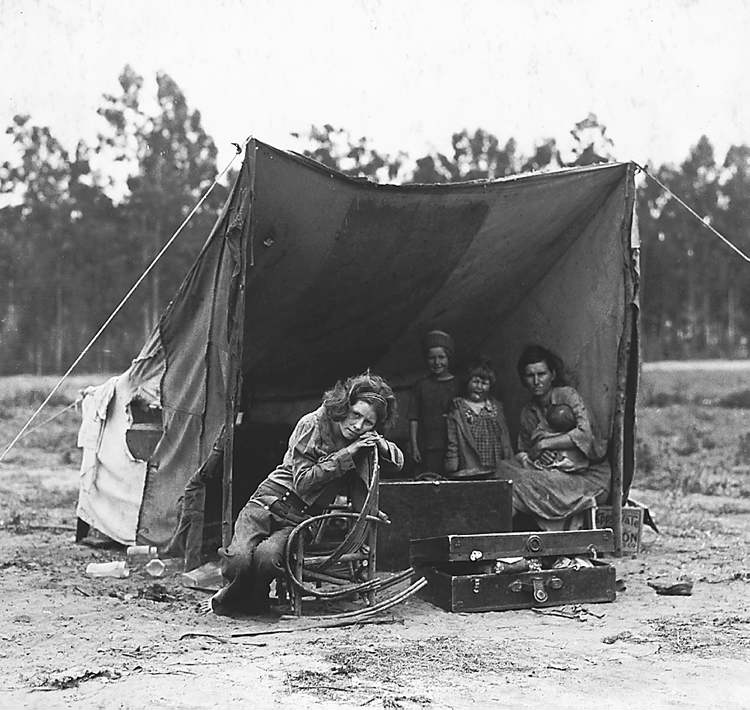
“This is the story of the greatest man-made ecological disaster in American history, a 10-year apocalypse punctuated by hundreds, hundreds of terrifying black blizzards that killed not only farmers’ crops and cattle, but their children, too.
“And all of this was superimposed on the greatest economic catastrophe in the history of the world, the Depression. It was an epic of human pain and suffering, but it is also the story of heroic perseverance.”
The Dust Bowl, a two-part, four-hour documentary that airs Sunday and Monday at 8 p.m. on Prairie Public TV, is American-history storytelling in the classic Ken Burns style, employing a seamless mix of still images and grainy motion-picture footage laid over a period soundtrack. In addition to the expert perspectives featured in Burns’s earlier projects, such as The Civil War and Jazz, The Dust Bowl also includes the vivid recollections of several people who were eyewitnesses to the fury of the Dirty ’30s.
“More than any other film we have made, it is an oral history populated less by historians and experts than those who survived those horrible days,” Burns says. What’s particularly interesting about this documentary project is that unlike The Civil War or Jazz or Baseball, which were distinctly and limitedly American stories, The Dust Bowl is an examination of an historical event whose impact straddled the Canada-U.S. border.
The same economic, agricultural and ecological conditions that Burns explores from an American perspective were also present on the Canadian Prairies — first, the stock-market crash of 1929 caused wheat prices to plummet, and then the decade-long drought and dust storms that began in 1930 turned Canada’s wheat belt into an unproductive wasteland.
“Our film is about nature, but it’s also about human nature,” said Dust Bowl co-producer and writer Dayton Duncan. “We believe that we can ignore the limits of the environment, and of nature, if it suits our purposes, and that if things are going on a roll, they will continue to go on a roll.
“We are human beings, and we think … that either we can control nature or we can just ignore nature. We can do neither, and that’s what the cautionary tale is about.”
— — —
Also new on the historical-documentary front is the new History TV series Mankind: The Story of All of Us, an ambitious 12-hour project that examines the against-the-odds triumph of our unique species on our unique planet.
The series, which premieres Monday at 8 p.m. on History, breaks the story of humankind’s existence into chapters defined by the accomplishments that allowed us to survive and advance. Monday’s première includes two segments — Inventors, which starts with early man’s creation of rudimentary tools and clothing and follows through to explore agricultural techniques, city building and the ever-advancing machinery of war; and Iron Men, which focuses on the discovery and refinement of the metal that fundamentally altered the course of human history.
It’s a lot to take in, but Mankind: The History of All of Us looks to be a thoughtful attempt at addressing a story that many would consider too big to be told on TV.
brad.oswald@freepress.mb.ca Twitter: @BradOswald
TV PREVIEW
The Dust Bowl
Produced by Ken Burns
Sunday and Monday at 8 p.m.
PPTV

Mankind: The Story of All of Us
Narrated by Josh Brolin
Monday at 8 p.m.
History
Our newsroom depends on a growing audience of readers to power our journalism. If you are not a paid reader, please consider becoming a subscriber.
Our newsroom depends on its audience of readers to power our journalism. Thank you for your support.
Our newsroom depends on a growing audience of readers to power our journalism. If you are not a paid reader, please consider becoming a subscriber.
Our newsroom depends on its audience of readers to power our journalism. Thank you for your support.
Advertisement Advertise With Us
Advertisement Advertise With Us