Hannibal’s food styling scenes will be missed
Advertisement
Read this article for free:
or
Already have an account? Log in here »
To continue reading, please subscribe:

Digital Subscription
One year of digital access for only $205*
- Enjoy unlimited reading on winnipegfreepress.com
- Read the E-Edition, our digital replica newspaper
- Access News Break, our award-winning app
- Play interactive puzzles
*First annual payment billed as $205.00 + GST for one year. This annual subscription will automatically renew at $233.00 + GST every 52 weeks (10% off the regular annual price of $259.35). Offer available to new and qualified returning subscribers only. Cancel any time.
To continue reading, please subscribe:
Add Free Press access to your Brandon Sun subscription for only an additional
$1 for the first 4 weeks*
- Enjoy unlimited reading on winnipegfreepress.com
- Read the E-Edition, our digital replica newspaper
- Access News Break, our award-winning app
- Play interactive puzzles
*Your next Brandon Sun subscription payment will increase by $1.00 and you will be charged $17.95 plus GST for four weeks. After four weeks, your payment will increase to $24.95 plus GST every four weeks.
Read unlimited articles for free today:
or
Already have an account? Log in here »
Hey there, time traveller!
This article was published 27/06/2015 (4122 days ago), so information in it may no longer be current.
Last week NBC announced that Hannibal would not be renewed for a fourth season, although fervid Fannibals are holding out hope for renewal on premium cable or a streaming service. This is not a surprising turn, given that this ambitiously surreal serial-killer series has always looked like nothing else on network TV.
Nowhere is this more clear than in its hilariously baroque food styling.
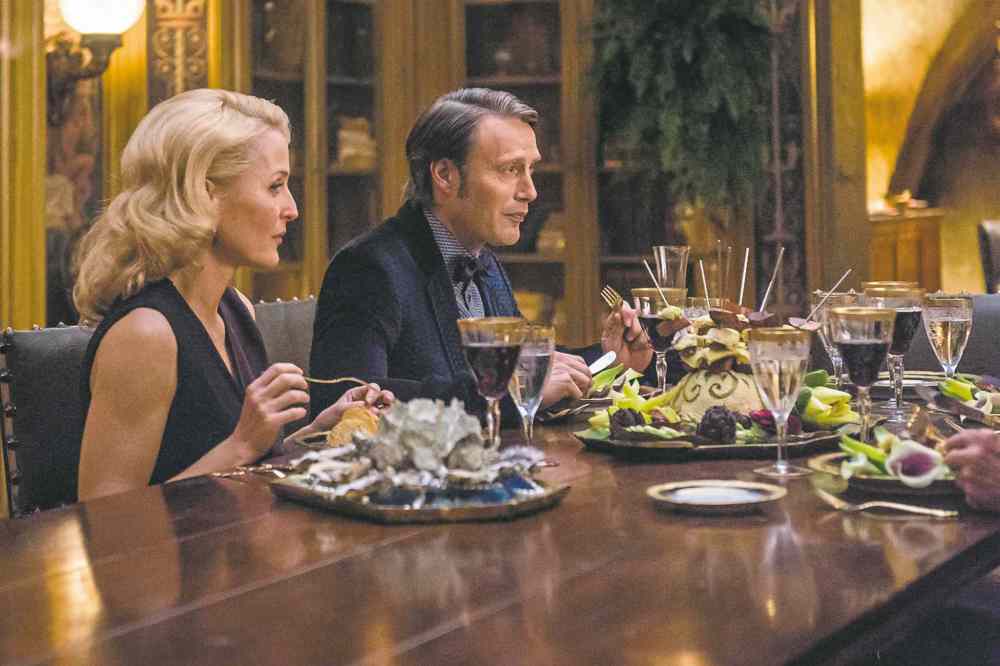
Queasily beautiful, sumptuously repulsive and delectably funny all at once, Hannibal’s dining scenes are food porn in the purest, nastiest sense. In fact, they are food snuff porn, since along with the duxelles and the roasted ortolan and the late harvest Vidal sauce, Hannibal is usually serving up bits of people.
Hannibal, the anti-hero of Thomas Harris’s books and several movie adaptations, may be a cannibal killer, but he’s an exquisitely refined cannibal killer. When he’s not adding to his very high death toll, he can be found translating medieval Italian poetry, composing harpsichord music or sketching scenes from The Iliad.
Hannibal is also an excellent cook — a master of the theatrical flambé, a wizard of knife skills, and, of course, a dab-hand with unusual off-cuts. (He puts the “awful” in offal.) He serves tongues and lungs, rouladen and osso buco and Sacromonte omelet, complex and subtle dishes marred only by the dubious provenance of their ingredients. Hannibal (played in his current incarnation by Danish actor Mads Mikkelsen) uses a Chroma by F.A. Porsche chef’s knife and a Palladium vacuum coffee maker. Why, he has his very own butcher’s band saw! The show has equipped him with a serial-killer dream kitchen.
Showrunner Bryan Fuller has always said that he’s aiming to make an “early ’80s pretentious art film,” and the series is art-directed almost to death. The costume designer is currently reimagining the gentleman’s plaid suit for the 21st century. The set designer likes to put $40,000 George Nakashima benches in FBI meeting rooms. (This odd budget allocation might explain why the Feds seem so understaffed in the “catching serial killers operating under our noses” department.) The artiness is especially apparent in the over-the-top imagery of the food sequences, which are concocted by Toronto-based food stylist Janice Poon and consulting chef Jose Andres. “What he eats is what defines him,” Poon has said of the show’s titular character. Mikkelsen’s approach to Hannibal is severely understated — his handsome visage is rarely disturbed by anything as vulgar as a facial expression — but he communicates flamboyantly through his cookery.
The food is elaborate, often vaguely threatening, whether it’s the clammy whiteness of rare fungi, the disturbing darkness of black chicken soup or the gelatinous trembling of Peruvian anchovies in aspic. Poon spends a lot of time replicating Hannibal’s “beyond good and evil” approach to sourcing his meat. (How do you make prosciutto out of a human arm?) She also goes a little nutty with Hannibal’s table centrepieces, which started out looking like rich 17th-century still-life paintings but have become increasingly outlandish and passive-aggressive. With lots of deep purple and blood red and pointy edges and dead things with horns and claws and tentacles, Hannibal’s food styling is simultaneously enticing and repellent, rather like the man himself.
The table talk in Hannibal can be tedious, with much sub-Nietzschean philosophizing about the thin red line between love and hate, betrayal and forgiveness, creation and destruction, God and the devil. The diningroom setting, however, is all dark comedy, and it’s this unstable mix of solemnity and silliness, bloody viscera and intricate artifice that gives the series its unusual, sometimes unreadable tone.
Are these queasy feasts and their overly precious presentation meant to satirize our conspicuous consumption, our Food Channel obsession with “plating,” our tendency to Instagram everything before we eat it?
Are they meant to make us complicit in Hannibal’s crimes? After all, if you eat with your eyes first, as celebrity chefs tell us, then these scenes make us all cannibals.
Or are they flattering us, appealing to our foodie snobbery, plying us with inside knowledge, urging us to identify with the sophisticated eaters and not the unfortunate eaten? As Hannibal’s therapist Dr. Du Maurier might say, “We no longer have ethical concerns. Only esthetical.”

As a critic for The Guardian suggests, Hannibal is “slasher TV for the chattering classes.” Corpses have been stacking up over the three seasons, but they are always artfully arranged and freighted with symbolism, posed as Botticelli paintings or Damien Hirst installations or Italian baroque sculpture.
The “serial killer as artiste” trope is taken to loony extremes in Hannibal, both in the crime scenes and the kitchen followups. With its combination of cannibalism and chamber music, gore and gorgeousness, depravity and design, the series allows us to watch one of the most violent shows on TV while maintaining a Hannibal-like sense of ironic detachment.
But maybe we should ask ourselves, as Hannibal asks Dr. Du Maurier, are we observers or participants? Are we merely viewers, or guests at the table?
Let’s hope we can figure this out before the end of season 3.