A Canadian story

Actor explores how his immigrant parents came to this country

Advertisement

Advertise with us

What makes a Canadian a Canadian? And what makes an immigrant an immigrant? And while it’s possible, and very common, to be both, is there an emotional process that makes a person feel more like one than the other?

Read this article for free:


or

Already have an account? Log in here »

To continue reading, please subscribe:

Subscribe and receive a limited-edition Free Press branded hat or tote.

Digital Subscription

One year of digital access for only $205*

  • Enjoy unlimited reading on winnipegfreepress.com
  • Read the E-Edition, our digital replica newspaper
  • Access News Break, our award-winning app
  • Play interactive puzzles

*First annual payment billed as $205.00 + GST for one year. This annual subscription will automatically renew at $233.00 + GST every 52 weeks (10% off the regular annual price of $259.35). Offer available to new and qualified returning subscribers only. Cancel any time.

To continue reading, please subscribe:

Add Free Press access to your Brandon Sun subscription for only an additional

$1 for the first 4 weeks*

  • Enjoy unlimited reading on winnipegfreepress.com
  • Read the E-Edition, our digital replica newspaper
  • Access News Break, our award-winning app
  • Play interactive puzzles
Start now

*Your next Brandon Sun subscription payment will increase by $1.00 and you will be charged $17.95 plus GST for four weeks. After four weeks, your payment will increase to $24.95 plus GST every four weeks.

Hey there, time traveller!
This article was published 12/01/2017 (3516 days ago), so information in it may no longer be current.

What makes a Canadian a Canadian? And what makes an immigrant an immigrant? And while it’s possible, and very common, to be both, is there an emotional process that makes a person feel more like one than the other?

For Canadian actor Peter Keleghan, these are vexing questions — not because he’s unsure about where his heart’s loyalty lies, but because he’s spent a lifetime trying to understand why his parents think and feel the way they do.

CBC
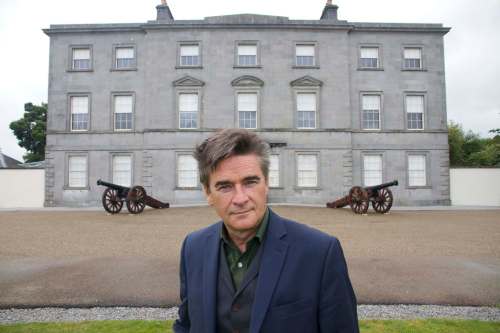
Peter Keleghan at the site of the Battle of Boyne.
CBC Peter Keleghan at the site of the Battle of Boyne.

Keleghan, one of this country’s most recognizable and constantly employed actors with credits that range from The Newsroom, The Red Green Show and Made in Canada to Murdoch Mysteries and Workin’ Moms, steps out of the scripted-TV realm this week to engage in a documentary exploration of his family’s roots and motivations.

Once an Immigrant, which airs Thursday, Jan. 12, at 9 p.m on CBC’s Firsthand, follows the Quebec-born performer as he seeks a deeper understanding of his parents’ very different immigrant experiences in order to more fully appreciate the way they view the country they call home.

The film is divided into two distinct chapters, since his “amicably separated” parents live far from one another and have very different stories. The first half focuses on Keleghan’s mother, Rita, who was born in Ireland and hasn’t been back there since Peter and his sister were young children. Rita has lived in Canada for more than half a century but has rebuffed the notion of becoming a citizen; as a gift for her 90th birthday, Peter and sister Tecky take her across the pond for one last visit to the Emerald Isle.

It’s a lovely, wistful journey, filled with picturesque meanderings and sometimes-unexpected reunions with friends and relations. During one dinner party with long-lost family members, Rita offers an observation: “Once an immigrant, always an immigrant, if you’re coming out of Ireland. It’s something you hold in your heart always… at least, for me.”

Still, Rita talks proudly of her adopted Canadian home, and offers, at best, mixed feelings at the notion of returning to Ireland. Peter’s conversational explorations reveal a simple truth about his mother’s refusal to fully adopt Canada through citizenship: as a staunch Irish Catholic, she simply can’t wrap her head around the idea of pledging allegiance to England’s monarch. “If you put a Canadian instead of the Queen on the ($20) bill, I’m in there,” she offers.
CBC
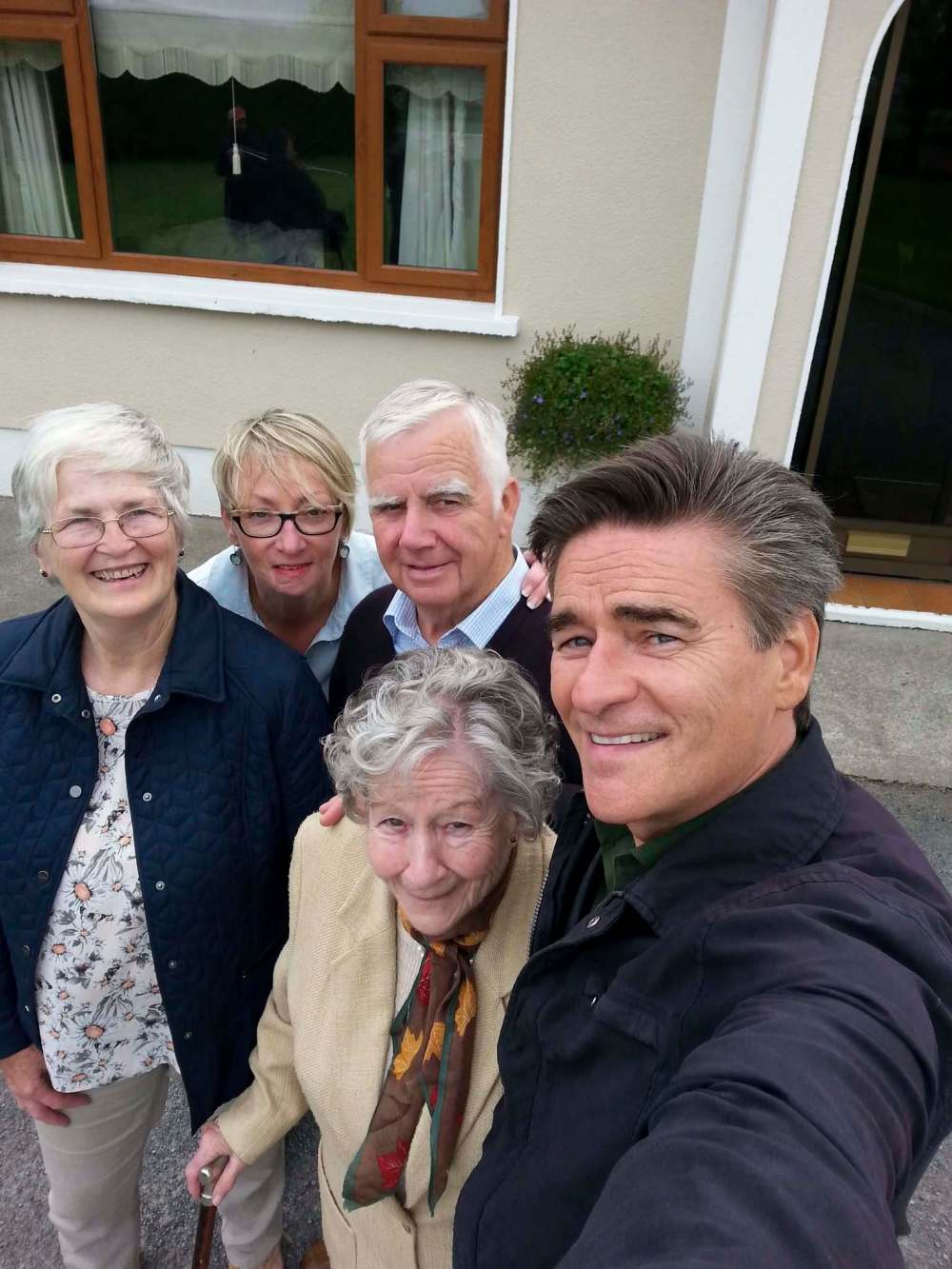
Peter Keleghan with mom Rita, sister Tecky, and his aunt and uncle at their B&B in Kilkenny.
CBC Peter Keleghan with mom Rita, sister Tecky, and his aunt and uncle at their B&B in Kilkenny.

The second half of Keleghan’s journey involves visiting his father, Stanislaw Krakus (who encouraged Peter to take his mother’s last name when embarking on an acting career), in rural Quebec. A Polish immigrant who was 10 years old when the Nazis invaded his homeland — resulting in several horrific years spent shuttling through a series of forced-labour camps — Stan ended up in England, alone, after the Second World War. He eventually became an engineer; after meeting Rita, who was vacationing in England, and a two-year courtship, the couple married and travelled to Canada for their honeymoon.

They never left.

Unlike Rita, however, Stan became a Canadian citizen at the earliest opportunity. What perplexes his son, however, is why someone who’s so joyfully Canadian chooses to live way out in the country, so far away from other Canadians. The answer, again, turns out to be simple: after his childhood and young-adult ordeal, Stan has no interest in living in an overcrowded urban environment filled with people who might be inclined to discriminate against an immigrant.

“Do you want to live in a ghetto?” he says, answering his son’s question with a question.

Once an Immigrant doesn’t offer anything in the way of universal truths about the Canadian experience, but that isn’t the point. Keleghan — ably assisted here by co-writer Steve Lucas and director Michael McNamara — is a gifted storyteller with a couple of captivating yarns to share. Which, of course, is a quintessentially Canadian thing to do.

brad.oswald@freepress.mb.caTwitter: @BradOswald

Report Error Submit a Tip

More Stories

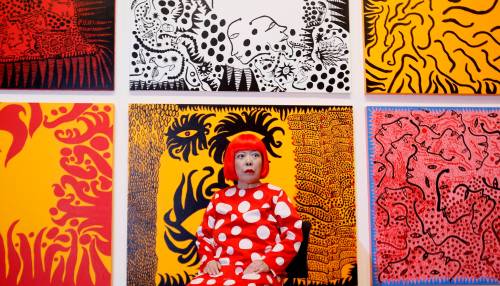
Kusama embraced dots which crowded her vision

Jen Zoratti 4 minute read Preview

Kusama embraced dots which crowded her vision

Jen Zoratti 4 minute read 2:00 AM CDT

In 2012, just as I was leaving the Tate Modern in London, I noticed an exhibition that I had nearly missed: The Obliteration Room by Yayoi Kusama, the famed Japanese artist with the bright-red bob known for her use of repetition and polka dots.

I had read about this exhibition but had no idea it was on while I was in the U.K. Conceived as an interactive exhibition for children and first put up at the Queensland Art Gallery in 2002, it begins as a monochromatic white room, furnished with all-white furniture and objects that visitors are then encouraged to cover with the multi-coloured dot stickers they are given on entry.

The idea is that, over weeks, the pristine room becomes “obliterated” by dots of colour.

Obviously, I beelined for it. I was handed my sheet of stickers, all different sizes of circles, and sent to add to a work that hundreds of people had already contributed to.

Read
2:00 AM CDT

Of frogs, roses, kings and a Great Lake

Editorial 4 minute read Preview

Of frogs, roses, kings and a Great Lake

Editorial 4 minute read 2:01 AM CDT

A rose by any other name would smell as sweet, as the saying goes. Basically, if you change something’s name, you don’t actually change the nature of the thing.

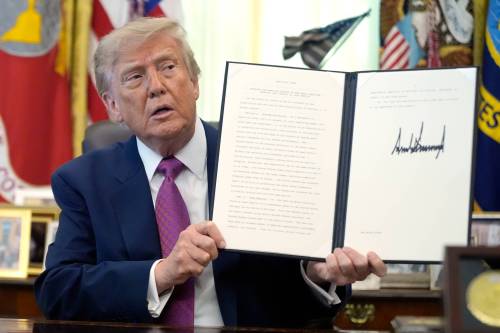
That being said, if even 15 years ago an American president had called an entire news conference to announce he was renaming one of the Great Lakes by writing on a map with a red pen and issuing an executive order purporting to rename Lake Ontario as “Lake America,” all and sundry would question his mental health.

Maybe, after witnessing so much from Donald Trump, we’ve all just been hardened off and the foolish is now expected daily. Perhaps it’s the political equivalent of the fable of the boiling frog.

As the fable goes, drop a frog into a pot of boiling water and it will jump right out. But put the frog in room temperature water and bring the pot to a boil, the frog will stay until its death. (It’s unlikely the frog would actually wait.)

Read
2:01 AM CDT

Catch the Devil follows serial con man preying on victims along the Gulf Coast — then repatedly duping law enforcement

Reviewed by Jordan Ross 4 minute read Preview

Catch the Devil follows serial con man preying on victims along the Gulf Coast — then repatedly duping law enforcement

Reviewed by Jordan Ross 4 minute read 2:00 AM CDT

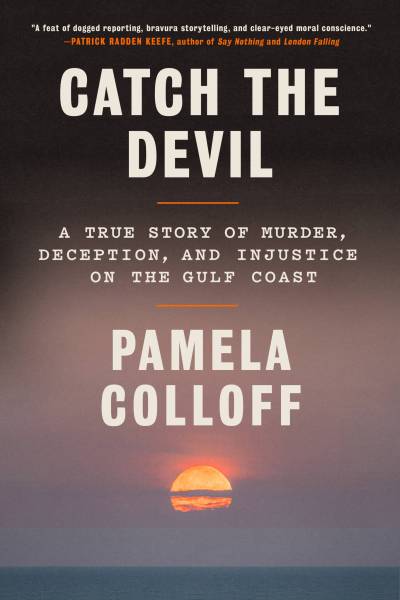
The debut book from Pamela Colloff, a Texas-based investigative reporter for ProPublica and staff writer for the New York Times Magazine, complicates romantic notions of the scam artist and invites readers to reflect on the systems that enable them.

Read
2:00 AM CDT

Motion seeks to remove longtime head of Southern Chiefs’ Organization due to ‘behaviour’ concerns

Carol Sanders 4 minute read Preview

Motion seeks to remove longtime head of Southern Chiefs’ Organization due to ‘behaviour’ concerns

Carol Sanders 4 minute read Wednesday, Aug. 26, 2026

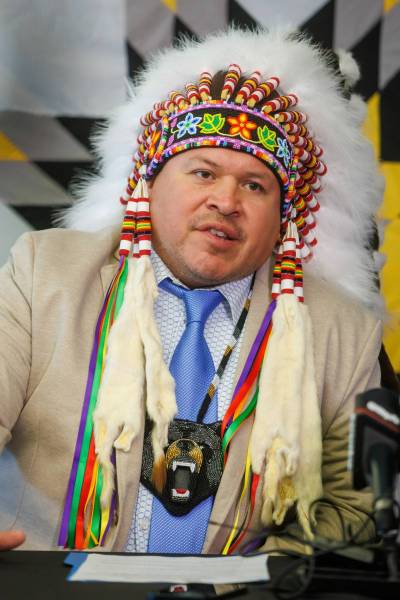
For the second time in a year, the leadership of Southern Chiefs’ Organization Grand Chief Jerry Daniels is being called into question.

A motion obtained by the Free Press calls “immediately” for a special summit of the 33 SCO chiefs to consider removing Daniels, who’s been at the helm since 2017.

The Aug. 17 motion, put forward by Lake Manitoba First Nation Chief Cornell McLean and Bloodvein First Nation Chief Lisa Young, cites concerns about “governance, leadership, accountability, transparency, organizational decision-making and confidence of member Nations in the current leadership of the organization.”

McLean would not provide specific examples Wednesday but said the “behaviour” of Daniels is a concern.

Read
Wednesday, Aug. 26, 2026

Frank Kriz was always willing to lend a hand to someone in need

Jim Timlick 7 minute read Preview

Frank Kriz was always willing to lend a hand to someone in need

Jim Timlick 7 minute read 2:00 AM CDT

Frank Kriz never wore a halo or wings, but talk to the many people he helped during his life and you would swear the man was a real-life angel.

For those who were fortunate enough to call him friend, he was always there to lend a hand, whether it was helping fix a wiring issue in someone’s house or organizing a group camping trip.

“He lived for other people, for helping other people,” says close friend Brian Turner.

“He was a very special guy that way. There’s no one like him that I know. Everyone has a little piece of him, in a sense, with how he fixed something for them or helped them out with something. That was his legacy.”

Read
2:00 AM CDT

A Canadian story

Brad Oswald 4 minute read Preview

A Canadian story

Brad Oswald 4 minute read Thursday, Jan. 12, 2017

What makes a Canadian a Canadian? And what makes an immigrant an immigrant? And while it’s possible, and very common, to be both, is there an emotional process that makes a person feel more like one than the other?

For Canadian actor Peter Keleghan, these are vexing questions — not because he’s unsure about where his heart’s loyalty lies, but because he’s spent a lifetime trying to understand why his parents think and feel the way they do.

Keleghan, one of this country’s most recognizable and constantly employed actors with credits that range from The Newsroom, The Red Green Show and Made in Canada to Murdoch Mysteries and Workin’ Moms, steps out of the scripted-TV realm this week to engage in a documentary exploration of his family’s roots and motivations.

Once an Immigrant, which airs Thursday, Jan. 12, at 9 p.m on CBC’s Firsthand, follows the Quebec-born performer as he seeks a deeper understanding of his parents’ very different immigrant experiences in order to more fully appreciate the way they view the country they call home.

Read
Thursday, Jan. 12, 2017