Netflix shows its idiosyncrasies with bizarre satire Okja

Advertisement
Read this article for free:
or
Already have an account? Log in here »
To continue reading, please subscribe:

Digital Subscription
One year of digital access for only $205*
- Enjoy unlimited reading on winnipegfreepress.com
- Read the E-Edition, our digital replica newspaper
- Access News Break, our award-winning app
- Play interactive puzzles
*First annual payment billed as $205.00 + GST for one year. This annual subscription will automatically renew at $233.00 + GST every 52 weeks (10% off the regular annual price of $259.35). Offer available to new and qualified returning subscribers only. Cancel any time.
To continue reading, please subscribe:
Add Free Press access to your Brandon Sun subscription for only an additional
$1 for the first 4 weeks*
- Enjoy unlimited reading on winnipegfreepress.com
- Read the E-Edition, our digital replica newspaper
- Access News Break, our award-winning app
- Play interactive puzzles
*Your next Brandon Sun subscription payment will increase by $1.00 and you will be charged $17.95 plus GST for four weeks. After four weeks, your payment will increase to $24.95 plus GST every four weeks.
Read unlimited articles for free today:
or
Already have an account? Log in here »
Hey there, time traveller!
This article was published 08/07/2017 (3350 days ago), so information in it may no longer be current.
Okja, an absolutely nutty movie available through Netflix, is a hybrid story about a hybrid creature.
The creature is a “superpig” that an agrochemical corporation has supposedly discovered in some rustic Chilean farming outpost but has actually been genetically engineered in a hellish underground facility. A beautifully realized computer-generated character, Okja the superpig is a little doggish, a little hippo-y, and altogether endearing.
Okja the movie is also a mashup. Combining broad blockbuster appeal and loopy, idiosyncratic scripting, it’s partly a sweet and sincere Girl and her Pig fable, partly a vicious anti-capitalist satire. It’s part slapstick Keystone Kops comedy, part grotesque horror, part ironic use of John Denver music, part terrifying showcase of Tilda Swinton’s teeth. In some ways, the film plays like a 21st-century Korean E.T., but it’s absolutely not for children.
Okja has also been released on a hybrid platform, screening theatrically in some big venues, including Cannes, but mostly available through Netflix streaming. Cannes audiences booed the Netflix logo, viewing it as a devious digital threat to the glory of traditional cinema. But frankly, it’s hard to imagine a film this bonkers-crazy being released by a major movie studio.
For its expanding slate of original programming, Netflix — at least so far — has a reputation for offering filmmakers both big-budget money and indie creative freedom, a combination increasingly rare in the franchise-fixated world of the mainstream movie houses. South Korean director Bong Joon Ho needs this kind of room to move, his subversive sensibility co-existing with a love of big spectacle and pricey special effects.
Bong’s 2006 work The Host is a wacky, scary creature-feature that also happens to be a pointed allegory about the American military presence in Korea. Snowpiercer (2013), set aboard a train perpetually circling though a post-apocalyptic ice age, is a high-pressure action movie about worldwide income inequality.
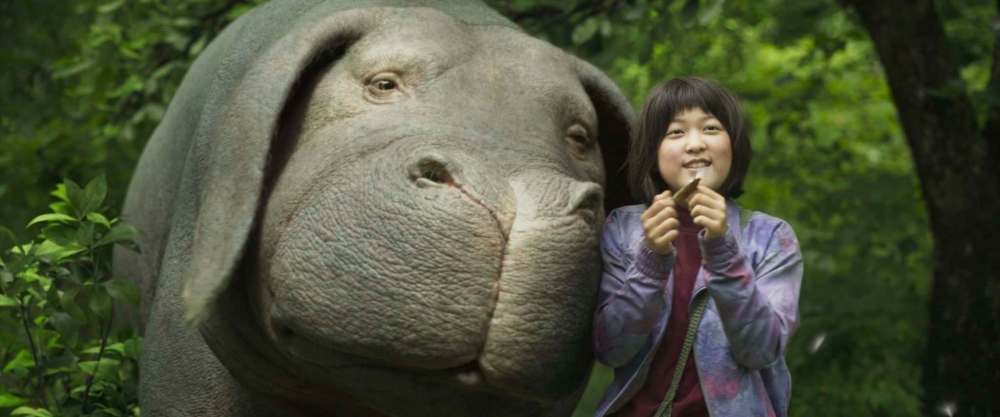
Okja is a gruesomely graphic but weirdly whimsical indictment of factory farming. Our heroine, Mija (An Seo Hyun), is a forthright and stubborn little girl who for 10 years has been her superpig’s free-range companion in the hills of rural Korea. When Mija learns that Okja is destined for the slaughterhouse, her rescue plan drags her into the intersecting agendas of idealistic animal rights activists, scheming agribusiness capitalists and clueless celebrities.
The activists are strictly non-violent and slightly confused, constantly apologizing to anyone who is being inconvenienced by their animal heists while simultaneously arguing among themselves to the point of schism. Paul Dano plays their leader, ideologically pure but with just a whisper of Julian Assange-ish Messianic menace.
Swinton, who played a Thatcherite martinet in Snowpiercer, is Lucy Mirando, the incongruously girlish CEO of a Monsanto-like multinational that is trying to rebrand itself with some bogus “core values” and the gloss of greenwashing. The Scottish Swinton is somehow more American than any actual American could be, as Lucy peddles her corporate co-optation of words like “local,” “authentic,” “artisanal” and “organic,” repackaging consumption as self-realization.
The utterly unhinged Jake Gyllenhaal is “Dr. Johnny,” working the knee-socks-and-shorts look as a TV zoologist so desperate to regain his sinking ratings he doesn’t care what happens to the animals.

The film functions as a profound critique of the arbitrary ways in which we categorize animals as either pets or meat, contrasting slow, lovely, pastoral scenes of Mija and her superpig pal with the Boschian tortures of Mirando’s experimental breeding facility and slaughterhouse. (Again, this movie is NOT for children.)
It’s also an examination of the modern, globally-connected economy that is itself genuinely global. Bong co-wrote the script with British journalist and screenwriter Jon Ronson (Frank). The rural Korean sequences and the New York scenes have equal heft, with the international cast (which also includes Steven Yuen, Byun Heebong and Giancarlo Esposito) deftly working across languages and cultures. In Okja, the phrase, “translation is sacred” is both a major plot point and an inside joke.
With its mix of high camp and low comedy, unsettling violence and extreme adorableness, the movie can be bumptious and broad (in the case of Gyllenhaal’s grating, shrieking performance, way too broad). But it’s also exuberant, ambitious and original.
Ultimately, Bong’s work puts movie-lovers in a contradictory position. Netflix is an inexpensive and widely accessible platform, and I’m glad it’s greenlighting weird, whacked-out films like this. But, wow, I wish I could have seen Okja on a big screen.
alison.gillmor@freepress.mb.ca
Studying at the University of Winnipeg and later Toronto’s York University, Alison Gillmor planned to become an art historian. She ended up catching the journalism bug when she started as visual arts reviewer at the Winnipeg Free Press in 1992.
Our newsroom depends on a growing audience of readers to power our journalism. If you are not a paid reader, please consider becoming a subscriber.
Our newsroom depends on its audience of readers to power our journalism. Thank you for your support.
Studying at the University of Winnipeg and later Toronto’s York University, Alison Gillmor planned to become an art historian. She ended up catching the journalism bug when she started as visual arts reviewer at the Winnipeg Free Press in 1992.
Our newsroom depends on a growing audience of readers to power our journalism. If you are not a paid reader, please consider becoming a subscriber.
Our newsroom depends on its audience of readers to power our journalism. Thank you for your support.
Advertisement Advertise With Us
Advertisement Advertise With Us