Jan. 6 hearings prove truth can make for compelling TV

Advertisement
Read this article for free:
or
Already have an account? Log in here »
To continue reading, please subscribe:

Digital Subscription
One year of digital access for only $205*
- Enjoy unlimited reading on winnipegfreepress.com
- Read the E-Edition, our digital replica newspaper
- Access News Break, our award-winning app
- Play interactive puzzles
*First annual payment billed as $205.00 + GST for one year. This annual subscription will automatically renew at $233.00 + GST every 52 weeks (10% off the regular annual price of $259.35). Offer available to new and qualified returning subscribers only. Cancel any time.
To continue reading, please subscribe:
Add Free Press access to your Brandon Sun subscription for only an additional
$1 for the first 4 weeks*
- Enjoy unlimited reading on winnipegfreepress.com
- Read the E-Edition, our digital replica newspaper
- Access News Break, our award-winning app
- Play interactive puzzles
*Your next Brandon Sun subscription payment will increase by $1.00 and you will be charged $17.95 plus GST for four weeks. After four weeks, your payment will increase to $24.95 plus GST every four weeks.
Read unlimited articles for free today:
or
Already have an account? Log in here »
Hey there, time traveller!
This article was published 09/07/2022 (1527 days ago), so information in it may no longer be current.
It’s been called “the breakout show of the summer” and “must-see TV.” It’s a blockbuster of a series, packed with twists and turns. It’s prestige television for political wonks.
I’m talking, of course, about the Jan. 6 select committee hearings in Washington, D.C. From the jaw-dropping big reveals to the coming-soon teasers, they’ve become a surprise hit.
Pro-Trumpers have dismissed the hearings as “showbiz,” which is sort of funny, given that Trump was the showbizziest American president ever, a former reality-TV host obsessed with ratings.
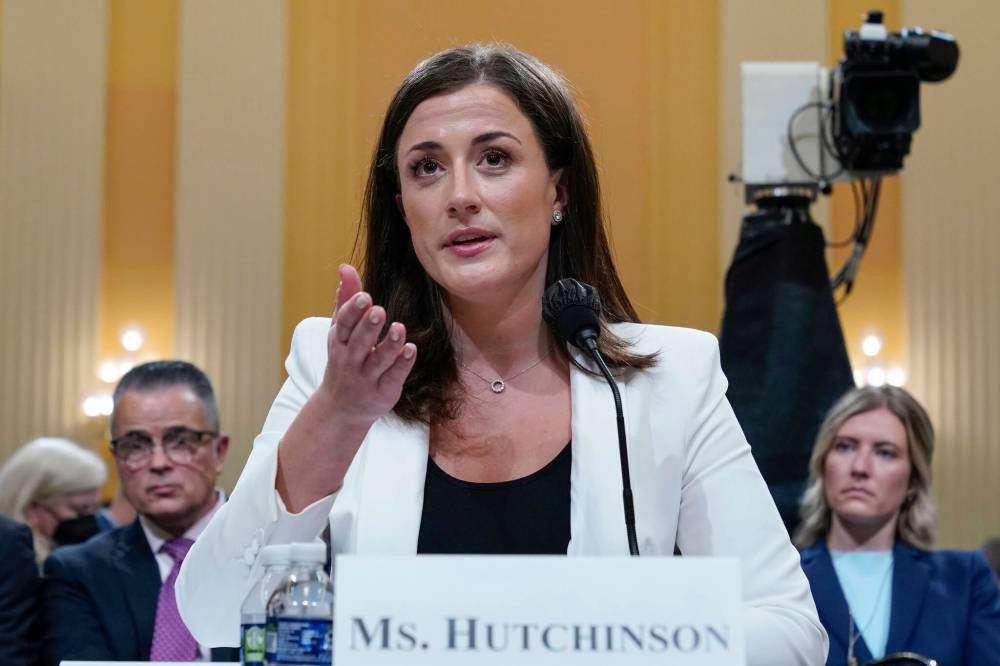
It’s true that the Jan. 6 committee brought in a TV producer, former ABC News president James Goldston, to help them put together a clear, coherent presentation. The hearings have run smoothly in technical terms, important for this kind of gavel-to-gavel coverage. Even more importantly, though, the select committee is using the lessons of good television to wrangle a vast amount of material into a clearly understandable, highly watchable narrative. Call that shallow, but it’s an absolutely necessary shallowness.
The Jan. 6 investigation has been described as “Watergate for the streaming era,” and there have been inevitable comparisons to those 1973 hearings, which were long and often dry and dull but nevertheless gripped American viewers for months. (And Canadians, too. I remember my parents watching.) The Jan. 6 hearings are better television than Watergate — but then they have to be. Compared with the 1970s, our media universe is fractured, our attention spans frazzled. To speak to this political moment and get this information out, the Jan. 6 hearings need to be catchy, watchable TV.
And they are. They have pacing, suspense, some great dialogue, a clear storyline and a cast of colourful characters.
There is Rusty Bowers, speaker of the Arizona House of Representatives, straight out of central casting if you need someone to embody old-school, upright moral rectitude. There is surprise witness Cassidy Hutchinson, an overlooked minor character suddenly thrust into the spotlight. (Soon to be played by Jennifer Lawrence in an Oscar-nominated performance, as one comedian joked.)
There is a strong central narrative. The hearings’ overarching theme has been the threat to the peaceful and lawful transition of power, the foundation of any democracy, but the committee has broken this into single episodes, each with a distinct subplot. They have covered the brutal violence of the insurrection (“I was slipping in people’s blood,”); the fact Trump was informed, repeatedly, that there was no election fraud; the harm the Big Lie has done to ordinary election workers like Shaye Moss and Ruby Freeman; the threat of violent domestic extremists.
There are cliffhangers. Congresswoman Liz Cheney likes to drop a tantalizing hint about what’s coming next, recently inviting audiences to stay tuned for some witness intimidation action. The season has even been broken up into two parts — kind of like Stranger Things! — with the in-between time helping to build anticipation and fuel fan excitement.

The hearings’ televisual vibe sometimes suggests other shows. The footage from the British documentarian who got intimate access to the Trump family calls up Succession, for example, inviting us to play the fun game of trying to figure out which Trump sibling is Kendall.
Most of the references seem to involve the gangster genre, though, what with the clandestine parking garage meetings, the betrayals and backstabbing, the heavily loaded talk about “loyalty” from the Trump camp. There are moments that feel like outtakes from a late-season Sopranos episode, as when tough-guy attorney Eric Herschmann testifies on Zoom — with a baseball bat emblazoned with the word “Justice” behind his head — that he told alleged coup planner John Eastman to “get a great effing criminal defence lawyer.”
Even with all these made-for-TV high points, though, the hearings never descend into trash television. There is no desk pounding, no grandstanding, no shouty spectacle. The hearings mostly come off as a talky Law & Order episode — sober, understated, restrained, rather quiet. One CNN commentator has suggested they are characterized by “stoic grandeur” and “grim meticulousness,” phrases not usually associated with boffo TV ratings. That’s the encouraging thing about the Jan. 6 hearings: They prove that in a world beset with polarizing disinformation and buzzy conspiracy, real live truth, conveyed clearly and comprehensively, can still be compelling.
I’m old-fashioned enough to think that watchability shouldn’t be a criterion for something as crucial as preserving democracy. But I’m also pragmatic. It’s because the hearings are so important that they need to connect with the largest audience possible. They need to be good TV.
alison.gillmor@freepress.mb.ca
Studying at the University of Winnipeg and later Toronto’s York University, Alison Gillmor planned to become an art historian. She ended up catching the journalism bug when she started as visual arts reviewer at the Winnipeg Free Press in 1992.
Our newsroom depends on a growing audience of readers to power our journalism. If you are not a paid reader, please consider becoming a subscriber.
Our newsroom depends on its audience of readers to power our journalism. Thank you for your support.
Studying at the University of Winnipeg and later Toronto’s York University, Alison Gillmor planned to become an art historian. She ended up catching the journalism bug when she started as visual arts reviewer at the Winnipeg Free Press in 1992.
Our newsroom depends on a growing audience of readers to power our journalism. If you are not a paid reader, please consider becoming a subscriber.
Our newsroom depends on its audience of readers to power our journalism. Thank you for your support.
Advertisement Advertise With Us
Advertisement Advertise With Us