

Towards Zero’s froideur freezes out the fun

Advertisement
Read this article for free:
or
Already have an account? Log in here »
To continue reading, please subscribe:
Monthly Digital Subscription
$1 per week for 24 weeks*
- Enjoy unlimited reading on winnipegfreepress.com
- Read the E-Edition, our digital replica newspaper
- Access News Break, our award-winning app
- Play interactive puzzles
*Billed as $4.00 plus GST every four weeks. After 24 weeks, price increases to the regular rate of $19.95 plus GST every four weeks. Offer available to new and qualified returning subscribers only. Cancel any time.
Monthly Digital Subscription
$4.99/week*
- Enjoy unlimited reading on winnipegfreepress.com
- Read the E-Edition, our digital replica newspaper
- Access News Break, our award-winning app
- Play interactive puzzles
*Billed as $19.95 plus GST every four weeks. Cancel any time.
To continue reading, please subscribe:
Add Free Press access to your Brandon Sun subscription for only an additional
$1 for the first 4 weeks*
*Your next subscription payment will increase by $1.00 and you will be charged $16.99 plus GST for four weeks. After four weeks, your payment will increase to $23.99 plus GST every four weeks.
Read unlimited articles for free today:
or
Already have an account? Log in here »
Hey there, time traveller!
This article was published 12/04/2025 (351 days ago), so information in it may no longer be current.
‘You have no idea of the agony of having your characters taken and made to say things they never would have said, and do things they never would have done,” complains Mrs. Oliver in Agatha Christie’s 1952 mystery novel Mrs. McGinty’s Dead.
Mrs. Oliver pens popular detective stories and, with her frequent grumbling about the writing life, is often seen as a Christie stand-in.
Going by Mrs. Oliver’s grievances about adaptations, what would Dame Agatha think about two of her characters engaging in oral sex halfway up a grand staircase?
That’s just one of the questions raised by the new BBC adaptation of Christie’s 1944 book Towards Zero, which airs on BritBox next week (with three episodes streaming April 16-18).
The other question, of course, involves which person in an ill-assorted country-house party might have committed two vicious murders.
Somehow that puzzle never becomes coherent or compelling, and that’s the real problem with this handsomely produced but ultimately ineffectual mystery.
In recent years, there have been several big-budget BBC adaptations that tiptoe around Christie’s texts, hoping to satisfy old-school purists — who tend to be strict about period details and possibly a bit prim about public stairway sex — while also pulling in newer, younger audiences by amping up the eroticism and the explicit social themes.
These projects include a feminist take on The Witness for the Prosecution, which featured a character screaming, “You f**king men!” in open court; a gratuitously grimy version of The ABC Murders, complete with BDSM; and a fabulously cruel and fatalistic version of And Then There Were None (probably the best of the bunch).
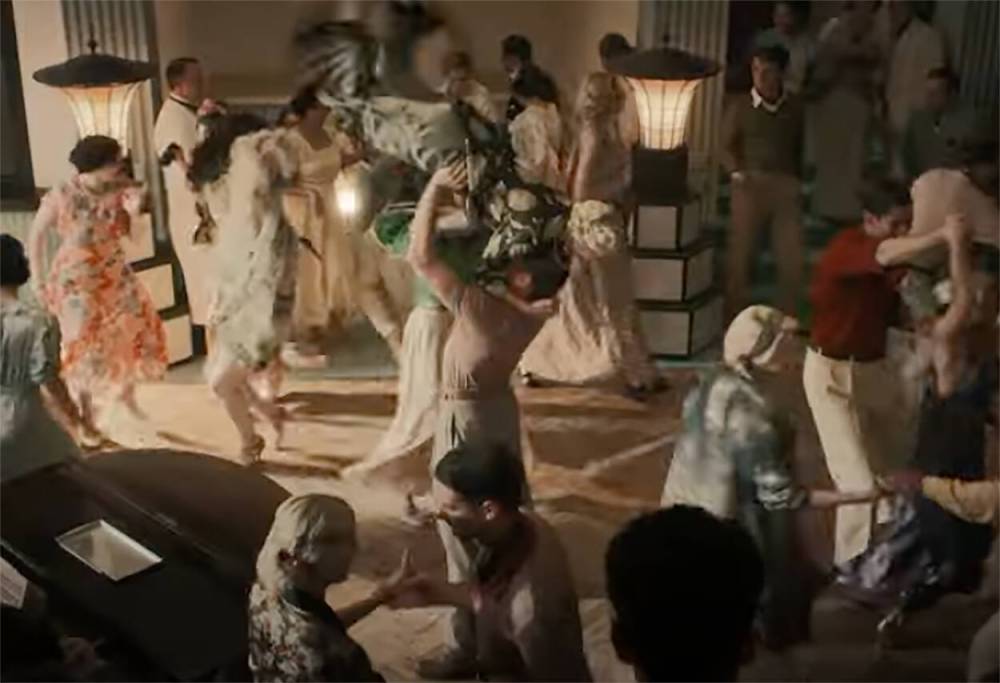
A scene from the new BBC adaptation of Christie’s 1944 book Towards Zero, available on Britbox with three episodes streaming April 16-18.
Speaking as a dedicated Christie fan, I don’t care whether a Christie adaptation is trying to be a faithful copy or a fresh new take. I just want it to be fun. And I want the mechanics of the mystery to work. Unfortunately, despite all its fabulous frocks, sumptuous settings and high-cheekboned performances, Towards Zero is a bit of a confused and pointless trudge.
Lady Tressilian (Anjelica Huston) is an imperious, aristocratic old woman, bedridden and given to Dowager Countess-like pronouncements. (“Why have a husband when you can have a lawyer?”)
Nevile Strange (Oliver Jackson-Cohen), the ward of Lady Tressilian’s late husband, is a handsome young tennis star. After a scandalous divorce, Nevile, his former wife, Audrey (Ella Lily Hyland), and his decorative new wife, Kay (Mimi Keene), somehow all end up staying at Gull’s Point, Lady Tressilian’s picturesque home on the Devonshire coastline. Nevile hopes his former and current spouses can get along, an idea Lady T. finds intolerably modern.
Add in a dissatisfied paid companion, a nervous cousin, a chatty barrister, a slinky gigolo and an unhappy adolescent kleptomaniac, and mealtimes at Gull’s Point can be uncomfortable.
Unfortunately, despite all its fabulous frocks, sumptuous settings and high-cheekboned performances, Towards Zero is a bit of a confused and pointless trudge.
“I like a good detective story,” as the barrister (Clarke Peters) remarks. “But you know, they begin in the wrong place. They begin with the murder.” Accordingly, the show’s first episode slowly sets up the love triangle and the long-buried secrets that are inexorably leading the characters, as the title suggests, towards zero, towards murder.
There are good reasons to change Christie’s novels. Modern adaptations can let go of elements of Christie’s works that are dated or outright offensive, like the racist and antisemitic tropes that pop up in her early books, or the odd ideas about hereditary “taints” in the blood.
In Christie’s Towards Zero, Audrey is “a lady,” as people keep saying, who remains icily polite and passive, while Kay is a grasping social climber who throws tantrums. There’s a certain amount of social snobbery in Christie’s depiction of the rivalry between the two women.
Rachel Bennette, who scripts the adaptation, clearly wants to make Kay’s motives more relatable and give Audrey a bit more gumption. From a modern feminist point of view, that’s admirable. Unfortunately, it also makes nonsense of the story’s tensions and the tight web of cause and effect surrounding the murders and their investigation. Towards Zero slogs along with a lot of atmosphere and some strong performances, but it never really clicks as a mystery.
There are good reasons to change Christie’s novels. Modern adaptations can let go of elements of Christie’s works that are dated or outright offensive.
And this is the issue with so many current Christie adaptations, from Kenneth Branagh to the BBC: They often go long on vibes while getting light on plot mechanics.
Critics often go after these contemporary versions of Christie for being too modern, too graphic and edgy, too mopey and moody, or — for conservative commentators — too “woke.” But what really makes or breaks a Christie adaptation is plotting.
Christie’s mysteries are sometimes classed as “cosy.” In fact, they can be unexpectedly dark, but in a supremely detached way. Christie tends to remain briskly, breathtakingly unsentimental about the victims, the suspects and the detectives, so her stories can function as puzzles, as games, as entertainments.
There’s no mystery to why Agatha Christie is a billion-selling writer. She’s entertaining. Her best books set up clever clues, play fair (more or less) with motive, means and opportunity, and deliver a snappy, satisfying conclusion.
Christie tends to remain briskly, breathtakingly unsentimental about the victims, the suspects and the detectives, so her stories can function as puzzles, as games, as entertainments.
As far as I’m concerned, creators should feel free to set their Christie locked-room mystery on the international space station in the year 2034, if that’s what they want. Just keep a sharp, Agatha-like eye on the plotting.
alison.gillmor@freepress.mb.ca
Studying at the University of Winnipeg and later Toronto’s York University, Alison Gillmor planned to become an art historian. She ended up catching the journalism bug when she started as visual arts reviewer at the Winnipeg Free Press in 1992.
Our newsroom depends on a growing audience of readers to power our journalism. If you are not a paid reader, please consider becoming a subscriber.
Our newsroom depends on its audience of readers to power our journalism. Thank you for your support.
Studying at the University of Winnipeg and later Toronto’s York University, Alison Gillmor planned to become an art historian. She ended up catching the journalism bug when she started as visual arts reviewer at the Winnipeg Free Press in 1992.
Our newsroom depends on a growing audience of readers to power our journalism. If you are not a paid reader, please consider becoming a subscriber.
Our newsroom depends on its audience of readers to power our journalism. Thank you for your support.
Advertisement Advertise With Us
Advertisement Advertise With Us