Candy-cane cookies

Advertisement
Read this article for free:
or
Already have an account? Log in here »
To continue reading, please subscribe:

Digital Subscription
One year of digital access for only $205*
- Enjoy unlimited reading on winnipegfreepress.com
- Read the E-Edition, our digital replica newspaper
- Access News Break, our award-winning app
- Play interactive puzzles
*First annual payment billed as $205.00 + GST for one year. This annual subscription will automatically renew at $233.00 + GST every 52 weeks (10% off the regular annual price of $259.35). Offer available to new and qualified returning subscribers only. Cancel any time.
To continue reading, please subscribe:
Add Free Press access to your Brandon Sun subscription for only an additional
$1 for the first 4 weeks*
- Enjoy unlimited reading on winnipegfreepress.com
- Read the E-Edition, our digital replica newspaper
- Access News Break, our award-winning app
- Play interactive puzzles
*Your next Brandon Sun subscription payment will increase by $1.00 and you will be charged $17.95 plus GST for four weeks. After four weeks, your payment will increase to $24.95 plus GST every four weeks.
Read unlimited articles for free today:
or
Already have an account? Log in here »
Hey there, time traveller!
This article was published 14/12/2011 (5381 days ago), so information in it may no longer be current.
Wendy Sawatzky sent in a recipe for the candy-cane cookies that her mother, Phyllis Sawatzky, has been making for more than 35 years. Not only do they taste like Christmas, as Wendy says, they also look like Christmas, with their candy-cane shape and sparkling sprinkling of crushed peppermint sticks.
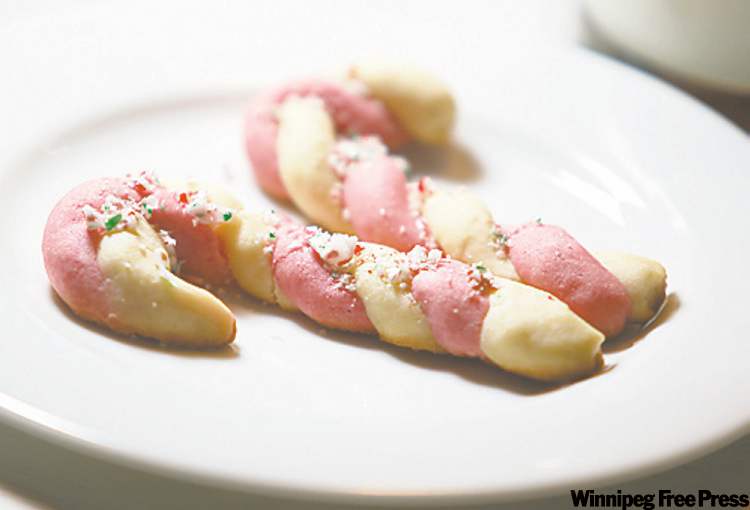
Candy-cane cookies
228 g (1 cup) margarine or butter, softened
250 ml (1 cup) sifted icing sugar
1 egg
7 ml (1 1/2 tsp) almond extract
5 ml (1 tsp) vanilla
625 ml (2 1/2 cups) all-purpose flour
5 ml (1 tsp) baking powder
5 ml (1 tsp) salt
2 ml (1/2 tsp) red food colouring
125 ml (1/2 cup) crushed peppermint candies or candy canes
125 ml (1/2 cup) white sugar or decorative sugar
Preheat oven to 190C (375F). In a medium bowl, cream butter and icing sugar until light and fluffy. Add egg and beat well. Stir in almond and vanilla extracts. In a small bowl, whisk together flour, baking powder and salt. Add to butter mixture and mix until blended. Divide dough in half. Add red food colouring to one half, mixing until colour is evenly distributed. Chill both sections of dough for about 2 hours. Pinch off a generous tablespoon of dough and roll into strips about .8 cm (1/3 in) wide and about 10 cm (4 in) long. Place a red strip next to a plain strip, twist into a rope and curve the top like a candy cane. Bake on lightly greased cookie sheets for 7-9 minutes or until light golden on the underside. Do not overbake. Cool slightly on rack, then carefully remove from pan and sprinkle warm cookies with mixture of crushed peppermint candies and sugar. Yields 3 dozen.
Tester’s notes: I like the interplay of the cookie, which has an understated almond taste, and its minty decorations. I experimented a bit to find what seemed like an optimum thickness for the dough strips: You want them to be quite thin — they do plump up a little when baking — but not so thin that they break easily. If the dough becomes too soft as you work with it, just put it in the freezer for a few minutes.
Studying at the University of Winnipeg and later Toronto’s York University, Alison Gillmor planned to become an art historian. She ended up catching the journalism bug when she started as visual arts reviewer at the Winnipeg Free Press in 1992.
Our newsroom depends on a growing audience of readers to power our journalism. If you are not a paid reader, please consider becoming a subscriber.
Our newsroom depends on its audience of readers to power our journalism. Thank you for your support.
Studying at the University of Winnipeg and later Toronto’s York University, Alison Gillmor planned to become an art historian. She ended up catching the journalism bug when she started as visual arts reviewer at the Winnipeg Free Press in 1992.
Our newsroom depends on a growing audience of readers to power our journalism. If you are not a paid reader, please consider becoming a subscriber.
Our newsroom depends on its audience of readers to power our journalism. Thank you for your support.
Related Articles
Rum Balls


Advertisement Advertise With Us