Michael Smith showcases versatility, simplicity of Canadian lentils in web series
Advertisement
Read this article for free:
or
Already have an account? Log in here »
To continue reading, please subscribe:

Digital Subscription
One year of digital access for only $205*
- Enjoy unlimited reading on winnipegfreepress.com
- Read the E-Edition, our digital replica newspaper
- Access News Break, our award-winning app
- Play interactive puzzles
*First annual payment billed as $205.00 + GST for one year. This annual subscription will automatically renew at $233.00 + GST every 52 weeks (10% off the regular annual price of $259.35). Offer available to new and qualified returning subscribers only. Cancel any time.
To continue reading, please subscribe:
Add Free Press access to your Brandon Sun subscription for only an additional
$1 for the first 4 weeks*
- Enjoy unlimited reading on winnipegfreepress.com
- Read the E-Edition, our digital replica newspaper
- Access News Break, our award-winning app
- Play interactive puzzles
*Your next Brandon Sun subscription payment will increase by $1.00 and you will be charged $17.95 plus GST for four weeks. After four weeks, your payment will increase to $24.95 plus GST every four weeks.
Read unlimited articles for free today:
or
Already have an account? Log in here »
Hey there, time traveller!
This article was published 02/03/2012 (5314 days ago), so information in it may no longer be current.
TORONTO – Lentils are not only good for you, but they’re homegrown, with much of the world’s supply produced right here in Canada.
For those who are mystified about how to prepare these dried legumes, there is a newly launched series of 12 how-to videos hosted by Canadian chef Michael Smith, who provides plenty of tips on their health benefits as well as how to buy, store and cook them.
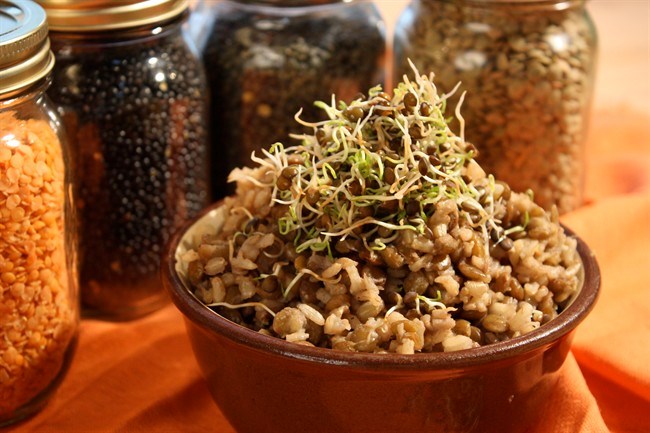
In the webisode “Lentils 101,” Smith explains that there are four basic types of lentils grown in Canada — green, red, black beluga and French green, or du Puy — that they’re easy to prepare, and packed with such nutrients as zinc, beta carotene, selenium and folate.
“Right here in Canada we grow some of the world’s best lentils,” he says on the video. Smith also shares that he spent time with lentil farmers from the Nagel Family Farm in Mossbank, Sask., last summer in an effort to learn how these nutritional powerhouses are cultivated and harvested.
The cookbook author and host of such Food Network shows as “Chef at Home” and “Chef Abroad” describes lentils’ flavour as warm, hearty and earthy.
The legumes can be served on their own — easily cooked in a saucepan on the stovetop using a simple recipe of one part lentils and three parts water. They can also be pureed and added to such recipes as Vegan Lentil Burgers, Sweet Potato Lentil Chili, and Green Lentils with Bacon and Tarragon — among those created by Smith for Canadian Lentils.
Parents trying to get their kids to eat healthily might want to view the webisode “Sneaky Lentils,” in which Smith shows how to make a simple lentil puree that can be added to pasta sauce, biscuits, cookies, soups and stews — with no one being any the wiser.
In Canada’s Food Guide, lentils fall under the meat and alternatives category. It is recommended that people eat meat and alternatives such as beans, lentils and tofu often. One serving of lentils is 175 millilitres (3/4 cup).
The Canadian Lentils’ website states that regularly consuming lentils can contribute to reduced cholesterol and triglycerides — two major factors in heart health. Eating lentils regularly may also reduce the risk of heart disease through favourable effects on blood pressure, blood glucose and insulin moderation.
Because lentils are loaded with fibre and protein (which helps us feel full longer), are low in fat (zero saturated) and contain no cholesterol, they can help those trying to maintain a healthy body and lifestyle.
Lentils do not contain gluten, so they are suitable for people who are gluten intolerant or have celiac disease.
As well, lentils are a nitrogen fixing crop, meaning they give back to the environment by replacing nitrogen in the soil they are grown in, according to the Canadian Lentils’ website.
Canadian Lentils is part of the not-for-profit Saskatchewan Pulse Growers, which represents lentil producers in Saskatchewan. Pulses are the family of crops that are edible seeds of a legume. These crops include lentils, dry peas, chickpeas and beans.
———
Brown Rice and Lentils
Here is a recipe using lentils created by chef Michael Smith. He says: “This is perhaps my single most popular lentil recipe. It is certainly the one I turn to most often. This is a quick and easy side dish that is not only tasty and healthy, but complements any meat or fish dish.”
250 ml (1 cup) brown rice
250 ml (1 cup) dried lentils
1 l (4 cups) water or chicken broth
2 ml (1/2 tsp) salt
In a medium saucepan with a tight-fitting lid, combine rice, lentils, water and salt. Bring everything to a full boil then adjust the heat lower, just enough to maintain a slow, steady simmer. Continue cooking until rice and lentils are tender and liquid is absorbed, about 45 minutes.
Turn off the heat, let stand for a few minutes, and you are ready to serve and share.
Variation: You can add any fresh or dried herbs you like to this dish. Rosemary, thyme and tarragon all work well.
Makes 4 to 6 servings.
Source: Chef Michael Smith for Canadian Lentils, www.lentils.ca