Kelekis doors closed… but the crispy memories live on

Advertisement
Read this article for free:
or
Already have an account? Log in here »
To continue reading, please subscribe:

Digital Subscription
One year of digital access for only $205*
- Enjoy unlimited reading on winnipegfreepress.com
- Read the E-Edition, our digital replica newspaper
- Access News Break, our award-winning app
- Play interactive puzzles
*First annual payment billed as $205.00 + GST for one year. This annual subscription will automatically renew at $233.00 + GST every 52 weeks (10% off the regular annual price of $259.35). Offer available to new and qualified returning subscribers only. Cancel any time.
To continue reading, please subscribe:
Add Free Press access to your Brandon Sun subscription for only an additional
$1 for the first 4 weeks*
- Enjoy unlimited reading on winnipegfreepress.com
- Read the E-Edition, our digital replica newspaper
- Access News Break, our award-winning app
- Play interactive puzzles
*Your next Brandon Sun subscription payment will increase by $1.00 and you will be charged $17.95 plus GST for four weeks. After four weeks, your payment will increase to $24.95 plus GST every four weeks.
Read unlimited articles for free today:
or
Already have an account? Log in here »
Hey there, time traveller!
This article was published 03/04/2013 (4915 days ago), so information in it may no longer be current.
In January, the legendary Winnipeg restaurant Kelekis closed after 81 years in business. Lorraine Turner wrote in asking if anyone knows the secret to their fabled french fries.
It’s impossible to truly replicate those famously crispy fries, since eating them was just one small part of the larger Kelekis experience, which included soaking in the unchanging ambience, staring at the signed celebrity photos on the walls and running into people you hadn’t seen for a while.
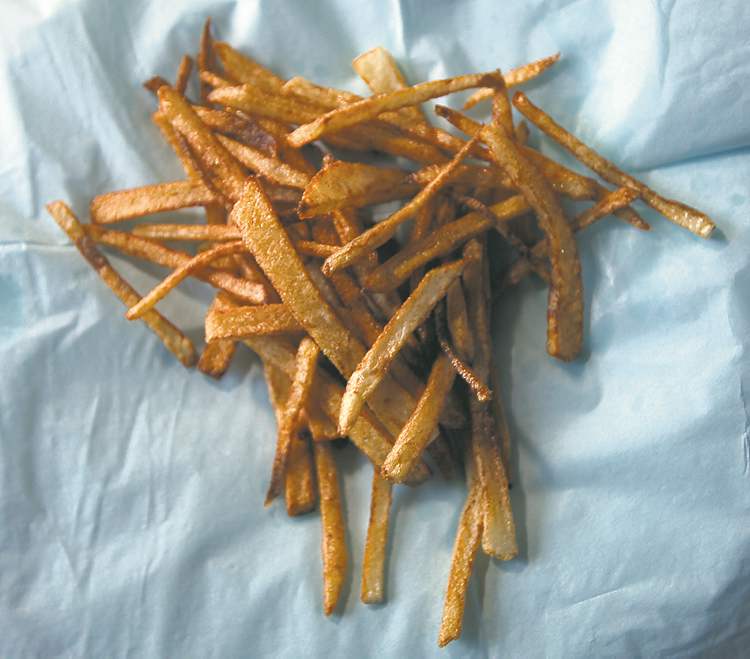
What follows is not so much a recipe as a series of techniques and tips to try to get that very skinny, very crispy fry. I received some great ideas from readers, and then experimented a little (though not in a completely scientific way, since there were a few variables in play).
This week Johanne O’Brien, who sent in some great french fry advice, asked for a recipe for fried green tomatoes, a popular dish in the American south. If you can help with a recipe request, have your own request, or a favourite recipe you’d like to share, send an email to recipeswap@freepress.mb.ca, fax it to 697-7412, or write to Recipe Swap, c/o Alison Gillmor, Winnipeg Free Press, 1355 Mountain Ave. Winnipeg, MB, R2X 3B6. Please include your first and last name, address and telephone number.
French fries, as much like Kelekis as possible
about 1 kg (2 lbs) potatoes
a quantity of vegetable oil with a high smoke-point (such as canola, safflower or peanut) or lard, for frying
A reader named Val says that the secret to Kelekis fries really came down to freshness — fresh-cut red potatoes and fresh oil. Kelekis used a “potato shoe-stringer,” which machine-cut the potatoes to a narrow, uniform size to ensure even cooking. Val also emphasized the need for “CLEAN hot oil.” Resist the temptation to reuse deep-frying oil.
For her Kelekis-like fries, Johanne O’Brien recommends Russet potatoes, peeled if desired and then cut very thin, rinsed several times in very cold water and then dried very well with clean tea towels or paper towels.
Many restaurants have built-in fryers. The next best thing for home cooks is a deep fat fryer, which maintains a steady cooking temp. If you’re doing stove-top deep-frying, a big, solid, heavy-bottomed pot is best for even heat and is also safer, which is important when working with hot oil. Add oil to cold pot. You need at least 7 cm (3 in) oil for cooking, but you also need to leave lots of headspace as a safety margin if the oil bubbles up.
A thermometer will help you maintain an optimum temperature between 175-190 C (350-375 F) — you might need to adjust the heat during the cooking process. At the right temp, the fries should float and the oil around them should bubble rapidly.
You can cook quite a lot of fries at once, but you should add them slowly, to keep the oil from boiling over and to keep the temperature as constant as possible. (Adding too many potatoes at once lowers the temp, which means the fries soak up more oil and can get soggy.) Johanne uses lard, and she also advocates the “double fry” method, which first cooks the potatoes briefly on the inside, and then, with the second cooking, crisps them beautifully on the outside. This double-fry method also allows you to prep the first steps and freeze the partially-cooked fries. Then, when you need them, the fries are easy and fast to finish off.

For this method, take the cut, rinsed and dried potatoes and deep-fry them at 160 C (325 F) for a few minutes, until pale but not browning. Remove from heat, place on cookie sheets. At this point, you can let the fries sit a little and then proceed with the second frying. Or you can freeze the fries on the sheet, place frozen fries in bags, and then store in freezer. For the second frying, raise temperature to 175 C (350 F) and cook the fries until desired golden-brown colour. Remove to paper towel-lined rack. Johanne then tosses the cooked fries in a stainless steel bowl with salt and serves immediately.
Tester’s notes: I experimented with both red and Russet potatoes, and with cooking oil and lard. I found the Russets crisped up better than the red potatoes. And while not everyone will want to cook with saturated fat, the pure lard did seem to achieve the crispiest fry. I also liked the double-frying technique. It allows you to prep ahead of time, and reportedly, the freezing process actually contributes to crispiness. Other tips for crisp fries include not just rinsing the potatoes in cold water but soaking them for at least one hour in cold water with some added salt. Make sure to dry them thoroughly.
And, finally, always, always be careful when deep-frying: I got impatient with my last batch, added too many potatoes at once, and the oil bubbled over the top of the pot. It didn’t turn into a fire, fortunately, but it made a huge, huge mess.
alison.gillmor@freepress.mb.ca
Studying at the University of Winnipeg and later Toronto’s York University, Alison Gillmor planned to become an art historian. She ended up catching the journalism bug when she started as visual arts reviewer at the Winnipeg Free Press in 1992.
Our newsroom depends on a growing audience of readers to power our journalism. If you are not a paid reader, please consider becoming a subscriber.
Our newsroom depends on its audience of readers to power our journalism. Thank you for your support.
Studying at the University of Winnipeg and later Toronto’s York University, Alison Gillmor planned to become an art historian. She ended up catching the journalism bug when she started as visual arts reviewer at the Winnipeg Free Press in 1992.
Our newsroom depends on a growing audience of readers to power our journalism. If you are not a paid reader, please consider becoming a subscriber.
Our newsroom depends on its audience of readers to power our journalism. Thank you for your support.
Advertisement Advertise With Us
Advertisement Advertise With Us