This bun is the one
Advertisement
Read this article for free:
or
Already have an account? Log in here »
To continue reading, please subscribe:

Digital Subscription
One year of digital access for only $205*
- Enjoy unlimited reading on winnipegfreepress.com
- Read the E-Edition, our digital replica newspaper
- Access News Break, our award-winning app
- Play interactive puzzles
*First annual payment billed as $205.00 + GST for one year. This annual subscription will automatically renew at $233.00 + GST every 52 weeks (10% off the regular annual price of $259.35). Offer available to new and qualified returning subscribers only. Cancel any time.
To continue reading, please subscribe:
Add Free Press access to your Brandon Sun subscription for only an additional
$1 for the first 4 weeks*
- Enjoy unlimited reading on winnipegfreepress.com
- Read the E-Edition, our digital replica newspaper
- Access News Break, our award-winning app
- Play interactive puzzles
*Your next Brandon Sun subscription payment will increase by $1.00 and you will be charged $17.95 plus GST for four weeks. After four weeks, your payment will increase to $24.95 plus GST every four weeks.
Read unlimited articles for free today:
or
Already have an account? Log in here »
Hey there, time traveller!
This article was published 12/04/2014 (4482 days ago), so information in it may no longer be current.
As Easter approaches, stores start stocking my favourite bun — the sweet, fruity one marked with a white cross. As kids, we would pick off the cross first, and then devour the buns, toasted with butter and a slice of aged cheddar.
These little buns have a great history. Even before the medieval expansion of religion and ceremony into almost every part of everyday life, marking baked goods with the sign of a cross was a common thing for a baker to do. The cross was said to ward off evil spirits, which, it was believed, could make the bread go mouldy or stale, so bakers used it, and customers looked for it. An early form of marketing!
In many historically Christian countries, sweet buns are traditionally eaten hot or toasted during the season of Lent, beginning with the evening of Shrove Tuesday (the evening before Ash Wednesday) to midday Good Friday, with the cross standing as a symbol of the Crucifixion.
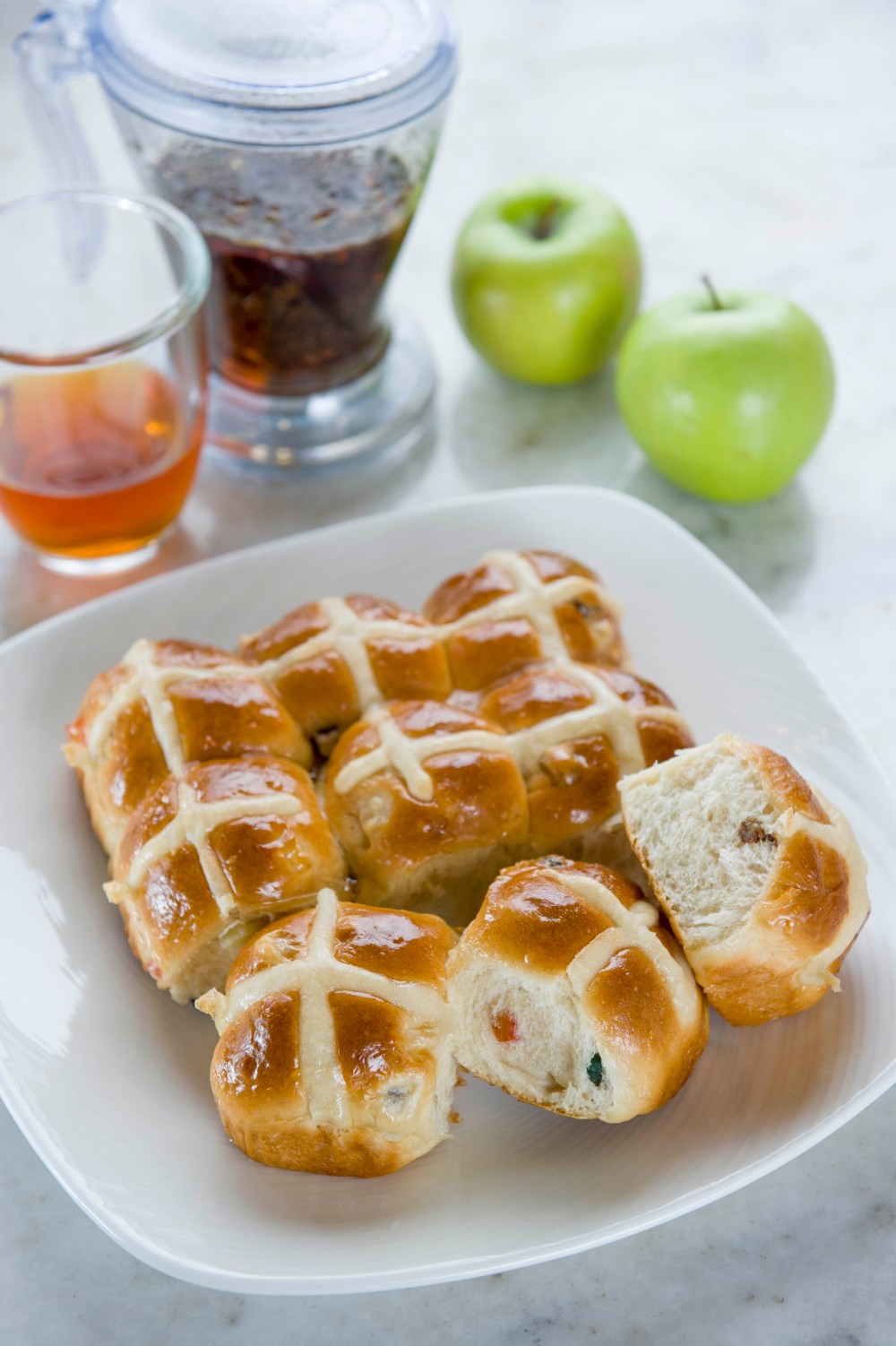
In the times of Elizabeth I of England (1592), there were even restrictions and laws as to when hot cross buns could be sold. They were allowed only at funerals, on Good Friday or at Christmas. The punishment for transgressing the decree was forfeiting all the forbidden product to the poor.
My recipe below is for a soft, nicely spiced, but not-too-sweet bun. Be sure to use mixed peel available at the bulk store.
Hot Cross Buns
350 ml (11/2 cups) full-fat milk
50 g (31/2 tbsp) butter
500 g (1 lb) strong bread flour
5 ml (1 tsp) salt
75 g (1/3 cup) sugar
7 g (11/2 tsp) instant yeast
1 egg, beaten
75 g (2 2/3 oz) sultanas
50 g (13/4 oz) mixed peel
zest 1 orange
1 apple, peeled, cored and finely chopped
7 ml (11/4 tsp) ground cinnamon
2.5 ml (1/2 tsp) ground nutmeg
11/4 ml (1/4 tsp) ground cardamom
11/4 ml (1/4 tsp) ground allspice
For the cross
75 g (2 2/3 oz) plain flour
For the glaze
45 ml (3 tbsp) apricot jam
1. Bring the milk to the boil, then remove from the heat and add the butter. Leave to cool until it reaches hand temperature. Put the flour, salt, sugar and yeast into a bowl. Make a well in the centre. Pour in the warm milk and butter mixture, then add the egg. Using a wooden spoon, mix well, then bring everything together with your hands until you have a sticky dough.
2. Knead for 5 minutes until smooth and elastic.
3. With the dough still in the bowl, add in the sultanas, mixed peel, orange zest, apple and spices. Knead into the dough
4. Leave to rise for 1 hour, or until doubled in size, covered by some well-oiled cling film.
5. Divide the dough into 20 even pieces (about 50 g per piece). Roll each piece into a smooth ball on a lightly floured work surface. Arrange the buns on one or two baking trays lined with parchment, leaving enough space for the dough to expand.

6. Cover (but don’t wrap) with more oiled cling film, or a clean tea towel, then set aside to prove for 1 hr more.
7. Heat oven to 180 C (350 F).
8. Mix the flour with about 75 ml (5 tbsp) water to make the paste for the cross — add the water 15 ml (1 tbsp) at a time, so you add just enough for a thick paste. Spoon into a piping bag with a small nozzle. Pipe crosses.
9. Bake for 20 minutes on the middle shelf of the oven, until golden brown.
10. Gently heat the apricot jam to melt, then sieve to get rid of any chunks. While the jam is still warm, brush over the top of the warm buns and leave to cool.