Tricks to making a simply perfect pavlova

Advertisement
Read this article for free:
or
Already have an account? Log in here »
To continue reading, please subscribe:

Digital Subscription
One year of digital access for only $205*
- Enjoy unlimited reading on winnipegfreepress.com
- Read the E-Edition, our digital replica newspaper
- Access News Break, our award-winning app
- Play interactive puzzles
*First annual payment billed as $205.00 + GST for one year. This annual subscription will automatically renew at $233.00 + GST every 52 weeks (10% off the regular annual price of $259.35). Offer available to new and qualified returning subscribers only. Cancel any time.
To continue reading, please subscribe:
Add Free Press access to your Brandon Sun subscription for only an additional
$1 for the first 4 weeks*
- Enjoy unlimited reading on winnipegfreepress.com
- Read the E-Edition, our digital replica newspaper
- Access News Break, our award-winning app
- Play interactive puzzles
*Your next Brandon Sun subscription payment will increase by $1.00 and you will be charged $17.95 plus GST for four weeks. After four weeks, your payment will increase to $24.95 plus GST every four weeks.
Read unlimited articles for free today:
or
Already have an account? Log in here »
Hey there, time traveller!
This article was published 28/05/2014 (4480 days ago), so information in it may no longer be current.
This week we have two versions of pavlova, a summery dessert involving meringue, cream and fruit. Thanks to everyone who sent in recipes: Marjorie Hughes, Donna Gylywoychuk, Edna Mroz of Beausejour, Muriel McPhail of Carberry, Celine Kear, who contributed a basic recipe for a large pavlova, and Betty Nesbitt, who offered a recipe for making small individual pavlovas.
There is a long-running dispute between Australia and New Zealand about the dessert’s origins, both countries claiming pavlova as their own. The ideal pavlova base is crisp on the outside and soft and marshmallowy inside, and the basic recipe of egg whites and sugar is simplicity itself. (Some versions add very small amounts of binders and stabilizers like salt, cornstarch or vinegar.)
Still, working with egg whites can be tricky, so a few hints can help ensure success. Start with eggs at room temperature. Use a glass, metal or ceramic bowl, because plastic bowls are more likely to retain grease residue that can inhibit volume. Make sure there is no yolk at all in the white mixture. (It’s best to separate each white into a small container first and then add to the bowl to avoid contaminating the whole mixture.) Humidity can also affect meringue, so if possible choose a clear day and avoid washing hot sinks full of dishes while making it.
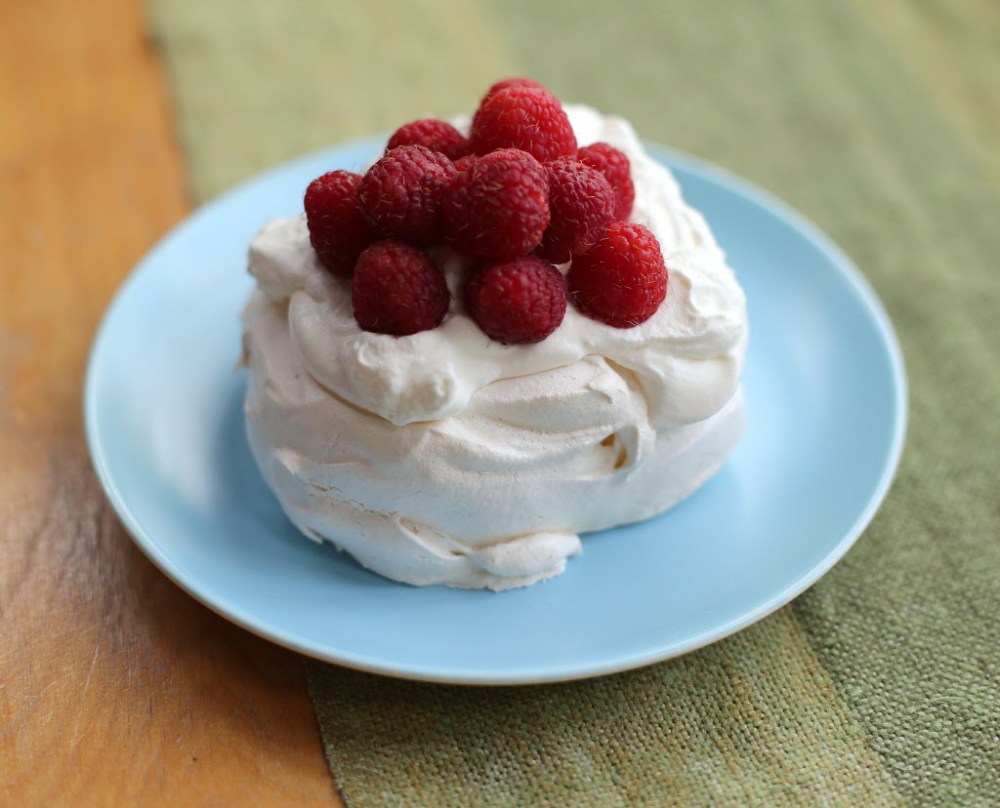
Use an electric stand mixer if possible, since you’ll need about 10 minutes of beating to make sure the sugar is completely dissolved. (Test by rubbing a small amount of meringue between your fingers to make sure there is no grainy feel.) The final mixture should be glossy and white — one recipe suggests it should look like “the Swiss alps on a sunny day.” If it becomes dull or starts to separate, the eggs have been overbeaten and you’ll need to start again.
Try not to open the oven, though you’ll need to peek briefly near the end to check on doneness. The pavlova should be dry to the touch on the outside but offer some sense of softness inside. After shutting off the heat, cool the pavlova in the oven since any abrupt drop in temperature can cause it to collapse.
One thing you shouldn’t worry about too much: even pavlova perfectionists admit that some cracking is inevitable. Fortunately, you cover the base with whipped cream. Marjorie Hughes cleverly uses the leftover egg yolks to make lemon curd, which she then folds into whipped cream to give another layer of flavour to her pavlova.
You can make the meringue base ahead and store in an airtight container, but wait until close to serving to add the whipped cream and fruit. Fruit toppings can include strawberries, raspberries, sliced peaches or nectarines, mangoes, kiwis or passion fruit pulp.
This week, Linda Vincent would love the secret to Rae & Jerry’s brilliantly crispy and light onion rings. If you can help with a recipe request, have your own request, or a favourite recipe you’d like to share, send an email to recipeswap@freepress.mb.ca, fax it to 697-7412, or write to Recipe Swap, c/o Alison Gillmor, Winnipeg Free Press, 1355 Mountain Ave. Winnipeg, MB, R2X 3B6. Please include your first and last name, address and telephone number.
Pavlova
6 egg whites
310 ml (1 1/4 cups) superfine sugar (also called berry or fruit sugar)
About 310 ml (1 1/4 cup) whipping cream
About 250 g (8 oz) assorted fruit
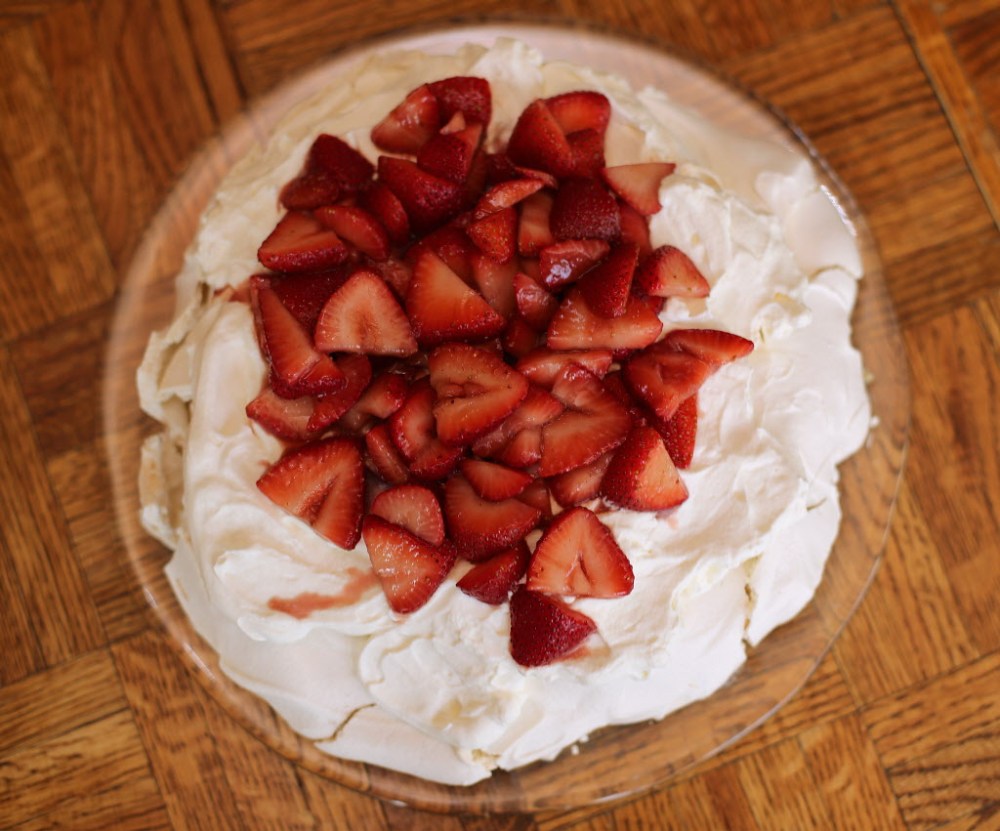
Using an electric mixer, beat egg whites until soft peaks form, then add sugar gradually, about 30 ml (2 tbsp) at a time, beating well after each addition. (It is important to beat for 10 minutes.) Preheat oven to 120 C (250 F). Cut a 25-cm (10-inch) circle of foil and place on a greased baking tray. Spread meringue evenly over foil. Bake until meringue feels dry to the touch, about 75-90 minutes. Turn off the heat and cool in oven for several hours. Before serving, whip cream and spread over base. Decorate with fruit.
Tester’s notes: Absolutely delicious and easier than I thought. I did have a lot of cracking when transferring my pavlova base to a serving plate, but whipped cream covers a multitude of problems. I didn’t add any sugar to the cream as the meringue base has plenty of sweetness, and for the fruit topping I used strawberries that had macerated for a few minutes with a touch of sugar and a splash of balsamic vinegar.
Small Pavlovas
4 egg whites
250 ml (1 cup) granulated sugar
2 ml (1/2 tsp) vanilla
5 ml (1 tsp) white vinegar
500 ml (2 cups) whipping cream

Fresh fruit such as kiwis, blueberries, strawberries
125 ml (1/2 cup) toasted slivered almonds
In a large bowl, beat egg whites until soft peaks form. Continue beating while adding sugar slowly, 15 ml (1 tbsp) at a time. Add vanilla and vinegar and continue beating until stiff and glossy. (Overall beating time will probably be about 10 minutes.) Preheat oven to 135 C (275 F). Using an 11-cm (4.5-inch) bowl as a pattern, use a dark pencil to draw nine circles on two pieces of parchment paper cut to fit cookie sheets, leaving space around each circle. Turn the parchments over — the circles will show through paper — and spread meringue mixture over each circle to form the bases. Bake for about 45 minutes, then turn off the oven and leave to dry several hours (or even overnight). Remove carefully from parchment paper with a lifter. Pavlova bases can be made ahead and stored in an airtight container. When ready to serve, whip the cream, spread over the meringues and top with fruit and almonds.
Tester’s notes: These turned out really well for me. The small pavlovas are less likely to crack when lifted and are easily stored, making them handy for make-ahead.
Studying at the University of Winnipeg and later Toronto’s York University, Alison Gillmor planned to become an art historian. She ended up catching the journalism bug when she started as visual arts reviewer at the Winnipeg Free Press in 1992.
Our newsroom depends on a growing audience of readers to power our journalism. If you are not a paid reader, please consider becoming a subscriber.
Our newsroom depends on its audience of readers to power our journalism. Thank you for your support.
Studying at the University of Winnipeg and later Toronto’s York University, Alison Gillmor planned to become an art historian. She ended up catching the journalism bug when she started as visual arts reviewer at the Winnipeg Free Press in 1992.
Our newsroom depends on a growing audience of readers to power our journalism. If you are not a paid reader, please consider becoming a subscriber.
Our newsroom depends on its audience of readers to power our journalism. Thank you for your support.
Advertisement Advertise With Us
Advertisement Advertise With Us