

Cookie in a cup: Edible invention replaces coffee waste with a sweet taste
Advertisement
Read this article for free:
or
Already have an account? Log in here »
To continue reading, please subscribe:
Digital Subscription
One year of digital access for only $75*
- Enjoy unlimited reading on winnipegfreepress.com
- Read the E-Edition, our digital replica newspaper
- Access News Break, our award-winning app
- Play interactive puzzles
*Billed as $5.77 plus GST every four weeks. After 52 weeks, price increases to the regular rate of $19.95 plus GST every four weeks. Offer available to new and qualified returning subscribers only. Cancel any time.
Monthly Digital Subscription
$4.99/week*
- Enjoy unlimited reading on winnipegfreepress.com
- Read the E-Edition, our digital replica newspaper
- Access News Break, our award-winning app
- Play interactive puzzles
*Billed as $19.95 plus GST every four weeks. Cancel any time.
To continue reading, please subscribe:
Add Free Press access to your Brandon Sun subscription for only an additional
$1 for the first 4 weeks*
- Enjoy unlimited reading on winnipegfreepress.com
- Read the E-Edition, our digital replica newspaper
- Access News Break, our award-winning app
- Play interactive puzzles
*Your next Brandon Sun subscription payment will increase by $1.00 and you will be charged $17.95 plus GST for four weeks. After four weeks, your payment will increase to $24.95 plus GST every four weeks.
Read unlimited articles for free today:
or
Already have an account? Log in here »
Hey there, time traveller!
This article was published 19/07/2014 (4324 days ago), so information in it may no longer be current.
Talk about a pile of garbage.
On average, North Americans consume about 125 billion cups of coffee every year. Problem is, close to 60 per cent of those servings arrive in paper or Styrofoam cups, which eventually find their way to a landfill where some can sit for a bazillion years — give or take a week — before they decompose.
In 2000, Giuseppe (Joe) Palumbo was having coffee with some “amicos” when he began noticing customer after customer tossing their non-recyclable cups into the trash bin. Palumbo, a dead ringer for actor Danny DeVito, thought to himself: What a waste. Then he thought: What a waste if I don’t do something about it.
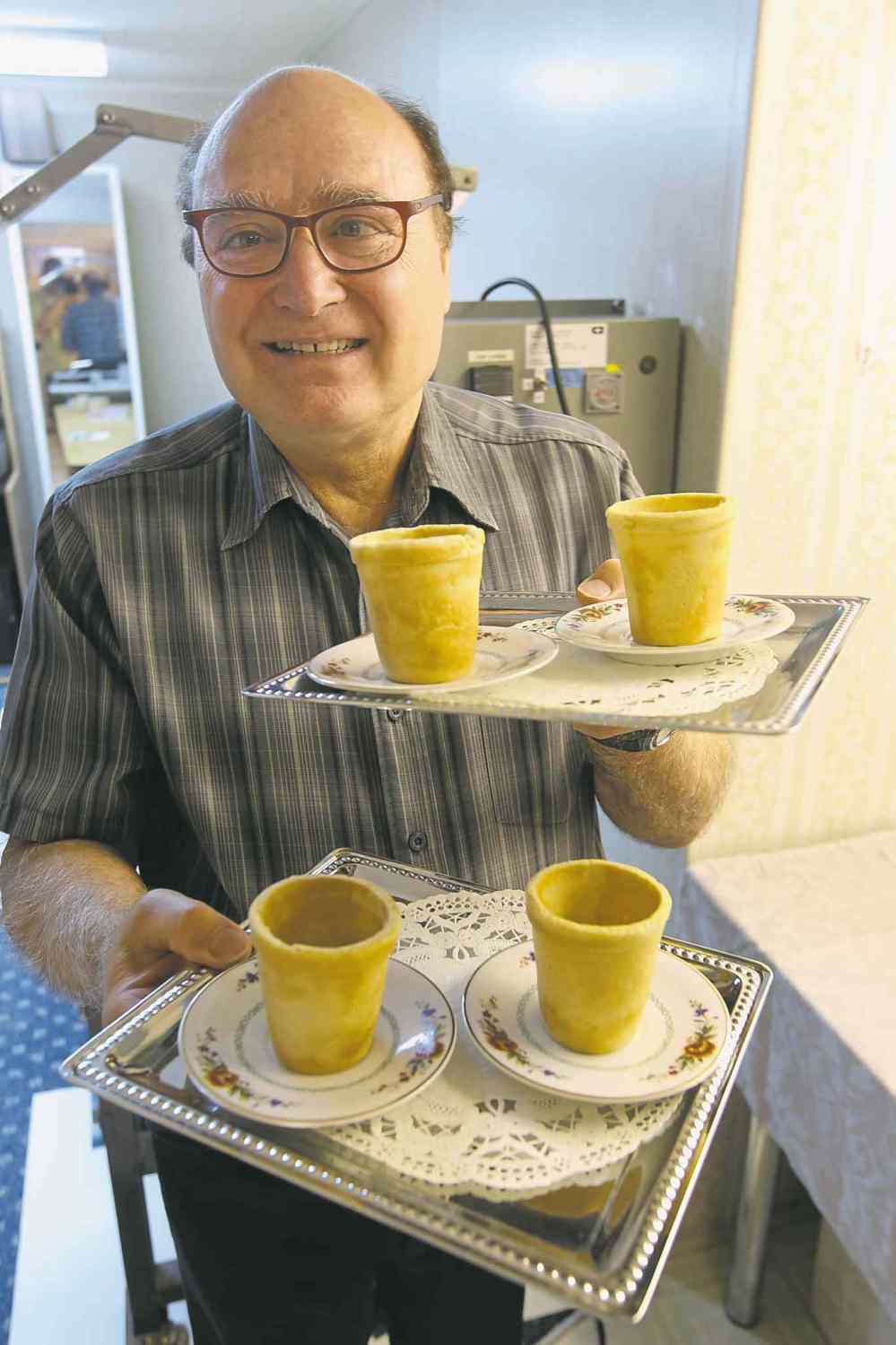
The father of two and grandfather of four returned to his home in Garden City, got out his mixing bowls and measuring spoons and began working on a solution. More precisely: an edible coffee cup. But we’re getting a bit ahead of ourselves…
Joe Palumbo, 67, was born in Sicily. When he was 12 years old, his father enrolled him at a trade school where half a student’s day was spent learning the three Rs, and the other half taking a vocation — in Palumbo’s case, baking.
In 1971, Palumbo, his wife Maria and their eight-month-old daughter moved to Winnipeg to join his in-laws. Never mind the fact he’d never seen a snowflake in his life: Palumbo also couldn’t speak a lick of English. So he enrolled in ESL classes, which he attended immediately after clocking out from his day job as a pastry chef at the International Inn on Wellington Avenue.
Palumbo opened his own bakery — La Preferita — on Leila Avenue in the mid-1970s. La Preferita had a loyal following but after a decade of pulling 16-hour days, seven days a week, he accepted a bakery manager’s position at the Real Canadian Superstore. Palumbo moved over to Sobeys a few years later — and was still at Sobeys in 2000 (he retired in 2012) when he began toying around with the idea of an edible cup.
“I came up with a recipe fairly quickly but I needed help fine-tuning it so I drove out to the Food Development Centre in Portage la Prairie,” Palumbo said, adding his original, smallish design was tailored more for espressos than double-doubles. “The first ones were a little bit leaky so we came up with a glaze to line the inside (of the cup). But that added an extra step so I went back to the drawing board and eventually came up with a cup that was just cookie, but where the liquid wouldn’t go through.”
In 2008, Palumbo entered La Tazzina, Italian for coffee cup, in the Manitoba Food Fight, a MasterChef-style competition in Brandon. He placed first in the Ideation category, which was reserved for “food products made for family and friends and not currently available for sale in any market.”
For his efforts, Palumbo was awarded an attractive, glass trophy and $10,000 in research funds. Palumbo invested the prize money, along with a chunk of his own savings, in a one-of-a-kind contraption he built with the help of an engineer.
Here’s the way Palumbo’s prototype works: batter — a blend of sugar, flour, eggs and a few mystery ingredients — is poured into the base of the device. Palumbo flicks a switch and as soon as two, cup-shaped, aluminum moulds reach the required temperature, they are lowered into the mix for 90 seconds or so. When Palumbo raises the moulds back up, what he’s left with are two, perfectly shaped cups. (Palumbo has four flavours to choose from: vanilla, chocolate, mocha and Nutella.)
Sal Infantino is Palumbo’s cousin “by force, I mean marriage,” he jokes. He is also the owner of X-Cues’ Billiards & Cafe, a Sargent Avenue institution that, according to reviewers at Urbanspoon.com, dishes out the best coffee in Winnipeg.
“Joe has been talking to me about this cup forever; it’s changed shapes, it’s changed sizes… and we’ve been testing it here for what I want to say is three or four years now,” Infantino said during an interview while a crowd had gathered at his locale for a World Cup match. (Infantino admitted the tourney was a lot easier on his heart rate — and pocketbook — after Italy was officially eliminated from competition. “Everybody would pack the place to watch, for sure, but they were too involved in the Italian matches to stop and order anything to eat or drink,” he said with a laugh.)
Infantino doesn’t listen to what regulars say about his cousin’s cup; he watches what they do, instead.
“The guys who come here are the definition of old-school,” he said, noting his father started the business in 1969. “They look at (the cup). They turn it over. And when they’re finished their coffee and take a bite, they’re like, ‘Hey, this is pretty good.’ “
Infantino said one of La Tazzina’s most attractive features is that it works for whatever customers are in the mood for: the cookie/cup maintains its texture and taste as much for ice cream as hot beverages, he explained.

“It’s especially popular with the younger crowd… and with women,” he said. “And if you’re asking me, it goes best with a cappuccino. You don’t really want to eat a cookie after you’ve had an espresso but after a cappuccino, you definitely do. The two really go hand-in-hand.”
Palumbo admitted he’s not the first person who has ever thought about an edible cup. But the big difference between his and those he’s read about on the Internet is that his isn’t coated with sugar, a feature that would be a deterrent for people who take their coffee black, he said.
Palumbo is hoping to take La Tazzina to “the next level.” He has tried out for Dragon’s Den twice but was rebuffed on both occasions, only because his sales weren’t up to snuff, he was told. (Last year, Palumbo met Jim Treliving, star dragon and CEO of Boston Pizza, at a book signing. Treliving told the Winnipegger to mention his name the next time he auditions for the show.)
“I don’t know — $1, $1.50,” Palumbo said when he was asked what he thinks the market will bear, price-wise. “For now it’s still an expensive hobby but I have no doubt as soon as people see it and try it, they’ll like it.”
david.sanderson@freepress.mb.ca
Dave Sanderson was born in Regina but please, don’t hold that against him.
Our newsroom depends on a growing audience of readers to power our journalism. If you are not a paid reader, please consider becoming a subscriber.
Our newsroom depends on its audience of readers to power our journalism. Thank you for your support.