Two tiny bars are giving McMillan neighbourhood a big-city feel

Advertisement

Advertise with us

When you’re trying to create a sense of intimacy in a restaurant space, bigger is never better. Two new McMillan-neighbourhood establishments demonstrate this maxim vividly by daring to operate in spaces that are not just small, but minuscule.

Read this article for free:


or

Already have an account? Log in here »

To continue reading, please subscribe:

Subscribe and receive a limited-edition Free Press branded hat or tote.

Digital Subscription

One year of digital access for only $205*

  • Enjoy unlimited reading on winnipegfreepress.com
  • Read the E-Edition, our digital replica newspaper
  • Access News Break, our award-winning app
  • Play interactive puzzles

*First annual payment billed as $205.00 + GST for one year. This annual subscription will automatically renew at $233.00 + GST every 52 weeks (10% off the regular annual price of $259.35). Offer available to new and qualified returning subscribers only. Cancel any time.

To continue reading, please subscribe:

Add Free Press access to your Brandon Sun subscription for only an additional

$1 for the first 4 weeks*

  • Enjoy unlimited reading on winnipegfreepress.com
  • Read the E-Edition, our digital replica newspaper
  • Access News Break, our award-winning app
  • Play interactive puzzles
Start now

*Your next Brandon Sun subscription payment will increase by $1.00 and you will be charged $17.95 plus GST for four weeks. After four weeks, your payment will increase to $24.95 plus GST every four weeks.

Opinion

Hey there, time traveller!
This article was published 06/04/2016 (3835 days ago), so information in it may no longer be current.

When you’re trying to create a sense of intimacy in a restaurant space, bigger is never better. Two new McMillan-neighbourhood establishments demonstrate this maxim vividly by daring to operate in spaces that are not just small, but minuscule.

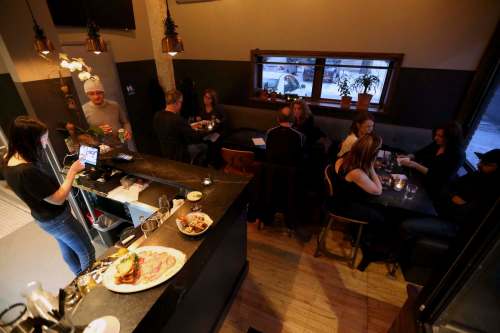
The Roost, a converted loft on the Corydon strip, seats precisely 18 people. Close Co., on Stafford Street in Grosvenor Village, has sit-down space for a grand total of 10.

Both tiny spots offer a short menu of small plates and a similarly sized selection of cocktails. Both pretty much require their customers to interact with each other, given the small amount of seating. Both, as a result of their menus and physical environments, offer the potential for a tremendous amount of fun.

TREVOR HAGAN / WINNIPEG FREE PRESS
At the aptly named Close Co., you'll get to know your neighbour.
TREVOR HAGAN / WINNIPEG FREE PRESS At the aptly named Close Co., you'll get to know your neighbour.

But there’s something else going on here. On a philosophical level, the Roost and Close Co. are making a bold and staunchly urbanist statement. They’re essentially pocket bars, the neighbourhood establishments that serve as a foundational aspect of everyday life in cities that are much more dense than Winnipeg.

And given the modest profit margins involved in the food-and-beverage industry — margins that usually demand restaurants go big and rely on volume to survive — the people behind these pocket bars are putting their dreams of recreating a tiny piece of Brooklyn or Barcelona ahead of their potential for profits.

It’s not quite altruistic, but it is a radical move in a city where the suburban surface-parking lots can be seen from the International Space Station.

“People are super-excited about it,” says Tammie Rocke, one of the three entrepreneurs behind Close Co., which opened in February in a space occupied by Steve’s Hairstyling For Men for the previous 61 years. “They don’t want to tell anyone about it. They want us to be their secret.”

That was never going to happen, given Close’s pedestrian-friendly location between the Grove pub and Máquè restaurant. But Close is a destination unto its own.

TREVOR HAGAN / WINNIPEG FREE PRESS
Beef carpaccio at Close Co.
TREVOR HAGAN / WINNIPEG FREE PRESS Beef carpaccio at Close Co.

There are precisely six items on the regular menu right now, including a great warm salad of squid rings and tentacles, shaved fennel and orange slices, dressed with an acidic and spicy roasted-pepper mayo. There’s also a pair of meatballs swimming in a salty but addictive tomato sauce, and dish of roasted carrots and beets placed over the strained yoghurt known as labneh in the Middle East.

The cocktail menu is only six items, too. Try the Close take on a Diablo, an old cocktail traditionally made with tequila, ginger beer and cassis. This version goes with espresso and ancho syrup.

In order to gain an occupancy permit, Close Co. is technically a food service and not a restaurant. This space was created by Rocke, who pays her own bills as an interior designer.

The Roost is a similar labour of love, but licensed as an actual restaurant. It opened in September in a former office space above a structure best known as the former home of Soup Pierre.

The upstairs location presented as many regulatory challenges, as did the small size of the space itself, said Caiden Bircham, one of six partners in the Roost — four of whom are in their early 20s.

TREVOR HAGAN / WINNIPEG FREE PRESS
Beef carpaccio (rear) and tomato salad at the Roost.
TREVOR HAGAN / WINNIPEG FREE PRESS Beef carpaccio (rear) and tomato salad at the Roost.

“You may have noticed we’re upstairs, and we have a wheelchair-accessible washroom,” he says. In more sensible cities, officials would have granted an inaccessible, second-floor loft an exemption from an accessible-washroom requirement. But I digress.

Compared with Close Co., The Roost is more focused on cocktails. Over the winter, they offered an eye-popping array of 26 (including an amazingly dry, basil-infused number called the Cleo, which is no longer on the menu but still available). That list has been whittled down to 10 cocktails, as the Roost prepares to open a patio that will effectively triple its capacity.

The kitchen has ambitions of its own, however. Over the winter, they served a decent mushroom risotto topped with slices of seared duck breast, a classic dish of gnocchi tossed with brown butter, butternut squash and sage and a playful plate of minced-rabbit fritters that would have worked better as “Kentucky fried rabbit” had they been bunny nuggets instead of meatballs.

They’ve just switched over to a spring menu, which includes a satisfying dish of pork-neck meat tossed with spaetzle and topped with a poached egg, plus (unsampled) offerings such as mackerel ceviche and quinoa salad.

In both the Roost and Close Co., you can not help but speak to your neighbours. You may, in fact, be required to share a table with strangers, should you desire to sit.

TREVOR HAGAN / WINNIPEG FREE PRESS
The Roost at 651 Corydon Ave.
TREVOR HAGAN / WINNIPEG FREE PRESS The Roost at 651 Corydon Ave.

A living nightmare for introverts? Perhaps, but welcome additions for a city plagued by too much personal space.

bartley.kives@freepress.mb.ca

History

Updated on Wednesday, April 6, 2016 2:12 PM CDT: Headline changed.

Report Error Submit a Tip

More Stories

Real journalists matter in an AI world

Paul Deegan 4 minute read Preview

Real journalists matter in an AI world

Paul Deegan 4 minute read 2:00 AM CDT

An algorithm can decide what you see, but it doesn’t report the news. Nunatsiaq News, an award-winning newspaper in Nunavut, recently reported that a so-called “news” website was posting AI-generated articles about the north by stealing real news stories produced by real journalists.

The articles were supposedly written by Nunavut correspondent Leah Qammaniq — a fake journalist, with a fake photo and a fake bio.

Governor General Louise Arbour warned us of fake news in her installation speech in June. She said, “We must continue to protect the public space in which our national debates take place: from schools and universities to the media, political parties, unions and civil society organizations …With instant access to vast amounts of information, it is very tempting to pay little attention to the reliability of sources. The lines between knowledge and belief, between truth and falsehood, between facts and assumptions, are increasingly blurred. AI could be threatening not only the way we live and work, but also the control we exercise over our own destiny.”

The Government of Canada has recognized the problem as well. Its recent discussion paper, Enhancing trust in artificial intelligence through increased transparency, stated, “Canadians encounter news reporting, product reviews, and audio-visual content across the internet, often without any indication of whether it was written by a person, generated by an AI system, or produced through some combination of both … A particular concern within this broader landscape is that generative AI greatly enables the creation and dissemination of deceptive or misleading content.”

Read
2:00 AM CDT

Two tiny bars are giving McMillan neighbourhood a big-city feel

By Bartley Kives  5 minute read Preview

Two tiny bars are giving McMillan neighbourhood a big-city feel

By Bartley Kives  5 minute read Wednesday, Apr. 6, 2016

When you’re trying to create a sense of intimacy in a restaurant space, bigger is never better. Two new McMillan-neighbourhood establishments demonstrate this maxim vividly by daring to operate in spaces that are not just small, but minuscule.

The Roost, a converted loft on the Corydon strip, seats precisely 18 people. Close Co., on Stafford Street in Grosvenor Village, has sit-down space for a grand total of 10.

Both tiny spots offer a short menu of small plates and a similarly sized selection of cocktails. Both pretty much require their customers to interact with each other, given the small amount of seating. Both, as a result of their menus and physical environments, offer the potential for a tremendous amount of fun.

But there’s something else going on here. On a philosophical level, the Roost and Close Co. are making a bold and staunchly urbanist statement. They’re essentially pocket bars, the neighbourhood establishments that serve as a foundational aspect of everyday life in cities that are much more dense than Winnipeg.

Read
Wednesday, Apr. 6, 2016

Puzzles Palace

1 minute read Monday, Jul. 27, 2026

To solve our puzzles, please subscribe with this special offer: |

MPI lowers speed limit on tech upgrade with ‘IT roadmap’ following Project Nova debacle

Carol Sanders 5 minute read Preview

MPI lowers speed limit on tech upgrade with ‘IT roadmap’ following Project Nova debacle

Carol Sanders 5 minute read Updated: Yesterday at 9:44 PM CDT

Manitoba Public Insurance is now using an “IT road map” and phasing in new technology and systems after pulling the plug last year on its failed $164-million overhaul known as Project Nova, its annual report says.

Read
Updated: Yesterday at 9:44 PM CDT

Clocks stay in daylight saving, but analysis backs permanent standard time

Ashley Joannou, The Canadian Press 5 minute read Preview

Clocks stay in daylight saving, but analysis backs permanent standard time

Ashley Joannou, The Canadian Press 5 minute read Updated: Yesterday at 6:15 AM CDT

VANCOUVER - Ralph Mistlberger's light is adjustable, allowing him to have the full spectrum of options depending on what his internal clock needs.

"You want cool in the morning. You want warm in the evening or warm in the afternoon," he said.

"And so, it goes from being more bluish in the morning to more reddish in the evenings. Both of those are important because artificial light affects your clock."

Mistlberger knows real sunlight is better than a lamp, but after more than 40 years as a neuroscientist studying sleep and the body's circadian rhythms, he's preparing for what's to come Nov. 1.

Read
Updated: Yesterday at 6:15 AM CDT

‘Amazing honour’: Winnipeg distribution centre continues award-winning ways for McKesson Canada

Aaron Epp 6 minute read Preview

‘Amazing honour’: Winnipeg distribution centre continues award-winning ways for McKesson Canada

Aaron Epp 6 minute read Yesterday at 6:00 AM CDT

After a three-year absence, the trophy is back in Winnipeg.

Last week, McKesson Canada named its 120,000-square-foot pharmaceutical distribution centre in the northwest part of the Manitoba capital its Distribution Centre of the Year. The award recognizes the facility’s role in helping essential medications reach communities across the province and some of Canada’s remote regions.

This is the fourth time the Winnipeg facility has earned the company-wide award since it opened five years ago. McKesson previously honoured the centre in 2021, 2022 and 2023. The recognition comes with a trophy, as well as a banner that was hung from the rafters on Thursday.

More than 100 employees work across the centre’s day-and-night operations, processing between 80,000 and 100,000 medication units daily. Last year, the centre distributed more than 21 million medication units while maintaining more than 99 per cent accuracy.

Read
Yesterday at 6:00 AM CDT