Take your best shot
World of whisky serves up odd cask of characters
Advertisement
Read this article for free:
or
Already have an account? Log in here »
To continue reading, please subscribe:

Digital Subscription
One year of digital access for only $205*
- Enjoy unlimited reading on winnipegfreepress.com
- Read the E-Edition, our digital replica newspaper
- Access News Break, our award-winning app
- Play interactive puzzles
*First annual payment billed as $205.00 + GST for one year. This annual subscription will automatically renew at $233.00 + GST every 52 weeks (10% off the regular annual price of $259.35). Offer available to new and qualified returning subscribers only. Cancel any time.
To continue reading, please subscribe:
Add Free Press access to your Brandon Sun subscription for only an additional
$1 for the first 4 weeks*
- Enjoy unlimited reading on winnipegfreepress.com
- Read the E-Edition, our digital replica newspaper
- Access News Break, our award-winning app
- Play interactive puzzles
*Your next Brandon Sun subscription payment will increase by $1.00 and you will be charged $17.95 plus GST for four weeks. After four weeks, your payment will increase to $24.95 plus GST every four weeks.
Read unlimited articles for free today:
or
Already have an account? Log in here »
Hey there, time traveller!
This article was published 07/03/2020 (2383 days ago), so information in it may no longer be current.
There will be some high-end tippling going on at the eighth annual Winnipeg Whisky Festival, which kicked off Friday and winds up tonight at the Fairmont Winnipeg.
Hundreds of devoted whisky fans — yes, including this columnist — will descend to sample some of the finest and priciest products the world of whisky has to offer.
Free Press drinks writer Ben MacPhee-Sigurdson noted earlier this week that this year’s festival will likely be the biggest ever, what with Canadian whisky alone making up about 25 per cent of all spirits sold in the province.
Along with seminars, mixology sessions and souvenir glasses, the increasingly popular festival is featuring more than 170 spirits, including 150 whiskies from around the world, along with a handful of upscale vodkas, gins, tequilas and cognacs.
“This is a whisky festival in a whisky market,” Aaron Alblas, Manitoba Liquor Mart product ambassador and whisky enthusiast, told the Free Press, noting there is a growing thirst in this province for high-end, limited-release whiskies, including single-barrel offerings.
“There are always lineups, and a lottery for your right to purchase these whiskies. Everyone’s always looking for something new.”
When you blend upscale spirits with fun-loving Manitobans, the stories are going to flow freely, but we suspect few will rival those on today’s highly potable list of Five of the Most Famously Weird Whisky Tales of All Time:
5) The tale of the tipple: Whisky on ice
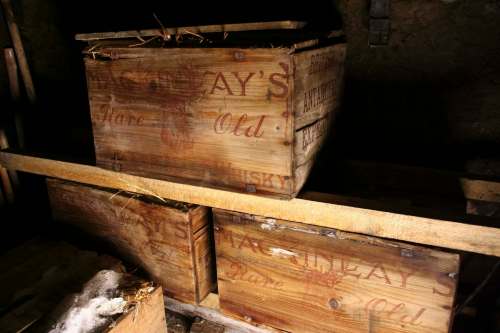
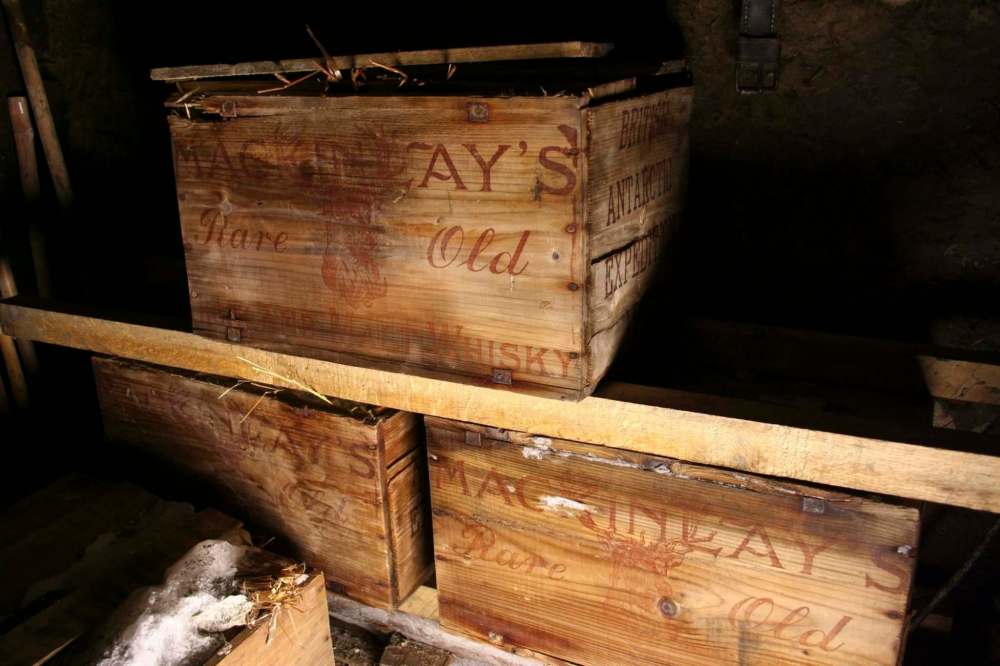
The angels’ share: When you think about legendary Antarctic explorer Sir Ernest Shackleton, whisky is not the first thing that comes to mind. But that changed in 2010 when three cases of rare 19th-century Scotch, kept on ice for more than 100 years, were found and retrieved from beneath the explorer’s abandoned hut.
The cases of MacKinlay scotch — bottled in 1898 after the blend was aged 15 years — and two cases of brandy were left behind when Shackleton ran out of other supplies and gave up his attempt to reach the South Pole in 1909.
The Nimrod expedition failed to reach the pole but set a record at the time for reaching the farthest southern latitude. Shackleton was knighted after his return to Great Britain.
When found in 2010, the crates were frozen solid after more than a century beneath the Antarctic surface, but the bottles were intact — and researchers could hear the whisky sloshing around inside because the wicked weather was not enough to freeze the whisky.
Whyte & Mackay, the current owner of MacKinlay distillery which provided Shackleton with his alcohol supplies, launched the expedition by the New Zealand Antarctic Heritage Trust to recover the scotch.
After analyzing the contents in 2011, they were able to replicate the original blend.
“The recipe for the whisky had been lost. But Whyte & Mackay recreated a limited edition of 50,000 bottles, costing about $157 each, from a sample drawn with a syringe through a cork of one of the bottles. The conservation work of the Antarctic Heritage Trust has received five per cent of the proceeds from every bottle sold,” CBC reported in 2013, when three bottles of the whisky were returned to the polar continent to be reburied beneath the restored hut as part of a program to protect the legacy of the so-called heroic era of Antarctic exploration from 1898 to 1915.
The bottles were unopened as they were returned, because if Shackleton couldn’t have a dram, no one could.
4) The tale of the tipple: The $1.9-million whisky
The angels’ share: Dropping a bottle of expensive Scotch is always a crime, but dropping a bottle of this particular whisky should likely be a capital offence.
Last October, a single bottle of whisky — The Macallan Fine and Rare 60-Year-Old 1926 — sold for (dramatic pause to build tension) $1.9 million, becoming the most expensive bottle of wine or spirit ever auctioned.
“The electricity in the auction room was palpable,” Sotheby’s spirits specialist Jonny Fowle said in a statement at the time. “There were cheers when the hammer fell on the Macallan Fine and Rare 1926, in what has to be one of the most exciting moments in the history of whisky sales.”
According to CNN, it was the second time a vintage bottle of this kind has made history at auction. In 2018, a bottle from the same Macallan batch broke the same record, selling for $1.2 million at Christie’s in London.
Distilled in 1926, the highly coveted bottle comes from cask number 263. Of the 40 bottles drawn from the cask, only 14 were given the Fine and Rare Label that the 2019 auction item bore. The 700-ml bottle contains about 45 pours of 15 ml each, breaking down to about $42,000 a drink for its lucky new owners, who were not identified.
The record-breaking scotch had been described by Sotheby’s as the “holy grail” of whisky.
What does a $1.9-million whisky taste like? The BBC tracked down one of the few people who knew, whisky expert David Robertson, who tasted it between 1994 and 2000 when he worked at The Macallan.
“From memory it was an incredibly rich, intense spirit — full of dried fruits, of prunes and dates and tons of incredible spicy notes of cloves, ginger and cinnamon,” Robertson told the BBC. “I also recall zesty orange marmalade, hints of peat and smoke, finished with a delicious drying oak tannin from the sherry cask, and waxy, linseed oil and leather notes. It’s a great whisky — but I’ve had better… There are other bottles from other distillers that are at least as good.”
3) The tale of the tipple: Fish-flavoured whisky
The angels’ share: What we are talking about here is a single-malt scotch that has been branded the worst whisky ever created. It was called “Fishky” and, according to winerist.com, was the brainchild of an independent bottler, Stupid Cask, which took a perfectly fine single-cask Bruichladdich whisky from the Scottish Isle of Islay and finished it in a barrel which previously contained (you might want to sit down before reading this next bit) herring.
“Stupid Cask were inspired in this unusual endeavour by Scottish history, which shows that distillers may have used fish casks for the same purpose in the dim and distant past,” the website noted.
According to whiskycast.com, the guy behind Stupid Cask was Klaus Pinkernell, the owner of two whisky shops bearing his name in Austria and Germany. With the fifth anniversary of his stores coming up, he wanted to do something memorable — while sending a message about the annoying trend of finishing whisky in barrels that previously held other products.
“At that time, it was the beginning of the movement that everyone wanted to do some sort of finishing, and everyone wanted to be the first to do something more strange,” Pinkernell told whiskycast.com. “I said, OK folks, you call all these things serious even though they are stupid, and I decided to do something even more stupid.”
So he had barrels made and then “seasoned” with herring for six months before being filled with whisky. In 2007, he hand-bottled the result, which he branded Fishky and sold in his shops. It is virtually impossible to find today, which is probably a good thing. A taster at whiskycast called it “the worst whisky I’ve ever tasted… The nose hides the secrets of this whisky well, with notes of malt, brine, and heather. The taste reveals all, though, with sour butyric baby vomit, brine, and stomach acid. The finish is salty, greasy, and nasty with no redeeming qualities.”
2) The tale of the tipple: Outer Space Scotch
The angels’ share: If you attend the Winnipeg Whisky Festival, you’ll be able to sample some of the finest whiskies from the Ardbeg distillery, nestled on the remote Scottish island of Islay. But, sadly, you will not be able to wrap your mitts around a glass of their one product that was literally out of this world.
In 2011, Ardbeg did something no one had tried before, conducting an experiment to see what effect a sojourn in space would have on an unmatured single malt.
In October 2011, Ardbeg sent a vial of their whisky to the International Space Station in a cargo spacecraft, while another vial of the same whisky was kept at the distillery for comparison. The space vial spent almost three years out of our atmosphere to determine how micro-gravity would affect the behaviour of terpenes, the building blocks of flavour for many foods and wines as well as whisky.
The vial reportedly orbited Earth 15 times a day travelling at 17,227 miles per hour before touching down in Kazakhstan in 2014.
In 2015, the distillery described its findings as “groundbreaking.” Dr. Bill Lumsden, Ardbeg’s director of distilling and whisky creation, said the space samples were “noticeably different” than those kept on Earth.
“When I nosed and tasted the space samples, it became clear that much more of Ardbeg’s smoky, phenolic character shone through — to reveal a different set of smoky flavours which I have not encountered here on earth before,” Lumsden told the BBC. “Ardbeg already has a complex character, but the results of our experiment show that there is potentially even more complexity that we can uncover, to reveal a different side to the whisky.”
Its tasting notes on the space sample said: “Its intense aroma had hints of antiseptic smoke, rubber and smoked fish, along with a curious, perfumed note, like violet or cassis, and powerful woody tones, leading to a meaty aroma.”
1) The tale of the tipple: Whiskey Galore!
The angels’ share: It is has been called one of Scotland’s most famous shipwrecks, likely because it spawned Compton Mackenzie’s famed 1947 novel, Whiskey Galore!, and two movies of the same name.
The SS Politician cargo ship was en route to Jamaica and New Orleans when it ran aground off the island of Eriskay in the Outer Hebrides during a storm in February 1941.
What made the wreck especially notable was the fact that, tucked into Hold No. 5 were an estimated 264,000 bottles of the finest Scotch whisky, which prompted thirsty islanders from across the Hebrides to take matters into their own hands in contravention of marine salvage laws.
“Following the wreck, unofficial salvage parties started to form, with reports of men donning their wives’ dresses to prevent their own clothes becoming stained by the ship’s oil, according to accounts,” The Scotsman newspaper recalled in 2019. “Hundreds of cases were successfully removed from the ship at a time of wartime rationing with some crofters reportedly burying the bottles and sowing oats over the top to conceal the cargo.”
The stricken vessel also carried 290,000 10-shilling banknotes destined for the then colony of Jamaica. On Aug. 11, 1941, The Scotsman ran a story under the headline “Whisky from Wreck — Secret That Could Not Be Kept.” It said: “When news of the shipwreck spread, boats went prospecting from the islands round about, even from as far south as Tobermory, and large consignments of the whisky were cached down in barns and byres along the coast.”

For the islanders, the rules of salvage meant that once the bounty was in the sea, it was theirs to recover. But local customs officer Charles McColl saw it as thievery, because no duty had been paid.
Ultimately, McColl was granted permission to blow up the hull of the boat to destroy its contents. The islanders watched this extraordinary action with Angus John Campbell summing up the view of most: “Dynamiting whisky. You wouldn’t think there’d be men in the world so crazy as that.”
In 1987, eight bottles from the wreck fetched more than US$5,000 at auction. Two later sold in 2013 for more than $15,000. Six bottles legally salvaged in 1990 were expected to fetch about $10,000 each at auction last year.
Slàinte mhath!
doug.speirs@freepress.mb.ca
Related Articles
Antarctic explorer Shackleton’s ship found after a century
Advertisement Advertise With Us
Advertisement Advertise With Us