Canadians drinking more due to stress, boredom during COVID-19, study says

Advertisement

Advertise with us

A study commissioned by the Canadian Centre on Substance Use and Addiction suggests some Canadians are drinking more alcohol due to boredom and stress during the COVID-19 pandemic.

Read this article for free:


or

Already have an account? Log in here »

To continue reading, please subscribe:

Subscribe and receive a limited-edition Free Press branded hat or tote.

Digital Subscription

One year of digital access for only $205*

  • Enjoy unlimited reading on winnipegfreepress.com
  • Read the E-Edition, our digital replica newspaper
  • Access News Break, our award-winning app
  • Play interactive puzzles

*First annual payment billed as $205.00 + GST for one year. This annual subscription will automatically renew at $233.00 + GST every 52 weeks (10% off the regular annual price of $259.35). Offer available to new and qualified returning subscribers only. Cancel any time.

To continue reading, please subscribe:

Add Free Press access to your Brandon Sun subscription for only an additional

$1 for the first 4 weeks*

  • Enjoy unlimited reading on winnipegfreepress.com
  • Read the E-Edition, our digital replica newspaper
  • Access News Break, our award-winning app
  • Play interactive puzzles
Start now

*Your next Brandon Sun subscription payment will increase by $1.00 and you will be charged $17.95 plus GST for four weeks. After four weeks, your payment will increase to $24.95 plus GST every four weeks.

Hey there, time traveller!
This article was published 15/04/2020 (2358 days ago), so information in it may no longer be current.

A study commissioned by the Canadian Centre on Substance Use and Addiction suggests some Canadians are drinking more alcohol due to boredom and stress during the COVID-19 pandemic.

The poll, conducted by Nanos Research, found 25 per cent of Canadians aged 35 to 54 and 21 per cent of Canadians aged 18 to 34 say they have increased the amount of alcohol they drink while spending more time at home.

Only 10 per cent of adults older than 54 say they have been drinking more alcohol since they began practising social distancing and self-isolation.
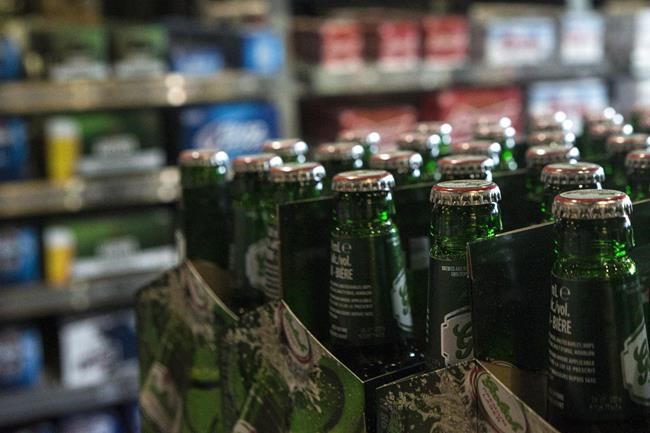
A Toronto beer store is pictured on April 16, 2015. A study commissioned by the Canadian Centre on Substance Use and Addiction suggests some Canadians are drinking more alcohol due to boredom and stress during the COVID-19 pandemic. THE CANADIAN PRESS/Chris Young

Lack of regular schedule, boredom and stress were the main reasons cited for the increase among those who reported drinking more, according to the poll.

“The Canadian drinking culture is one where alcohol use serves as a boundary between weekday and weekend, work and leisure — it marks a ‘time out,'” Catherine Paradis, a senior research and policy analyst at CCSA, said in a release. “With the ongoing threat of COVID-19, these boundaries have become blurred.

“Disrupted routine may be accompanied by loneliness and anxiety about the current situation. With the possibility that people are stocking up and there is more alcohol in the home than usual, some might drink more than they typically do.”

Jeff Sturgeon, a social worker and therapist in Calgary, says social distancing and self-isolation can particularly affect those battling alcohol addictions.

“In my experience, it further exacerbates perhaps the underlying root cause of the addiction,” he said in a recent phone interview with The Canadian Press. “It increases loneliness, boredom and can magnify those negative thought patterns.

“It kind of amplifies that narrative that perhaps is the underlying piece of the addiction.”

The poll was conducted between March 30 and April 2 through telephone and online random surveys of 1,036 Canadians aged 18 or older.

The CCSA said results were statistically checked and weighted by age and gender using the latest census information and that the sample was geographically stratified to be representative of Canada.

The polling industry’s professional body, the Marketing Research and Intelligence Association, says online surveys cannot be assigned a margin of error because they do not randomly sample the population.
Report Error Submit a Tip

More Stories

Puzzles Palace

1 minute read Monday, Jul. 27, 2026

To solve our puzzles, please subscribe with this special offer: |

Teacher barred for ‘repeated boundary-crossing conduct’

Maggie Macintosh 3 minute read Yesterday at 11:01 PM CDT

A disciplinary panel has ordered the cancellation of a Chinese-Canadian teacher’s certificate because of her “repeated boundary-crossing with a student” during her tenure at an international school with local ties.

Janice Wen Ying Ma is permanently barred from teaching on Manitoba soil or at a Manitoba-accredited institution as of Sept. 14.

The new ruling concludes that Ma engaged in inappropriate physical interaction and “emotionally intimate online messages” with a girl who attended Clifford International School in Guangzhou, China in 2024-25.

“This conduct represents a fundamental departure from the standards expected of a teacher,” the panel, chaired by public representative Gordon Schumacher, wrote in its 22-page decision.

Completely separating inmates unrealistic, inquest judge says in report on three Stony Mountain slayings

Erik Pindera 5 minute read Preview

Completely separating inmates unrealistic, inquest judge says in report on three Stony Mountain slayings

Erik Pindera 5 minute read 1:43 PM CDT

Nothing short of keeping inmates separated at all times could have prevented three unrelated prisoner-on-prisoner killings several years ago in Stony Mountain Institution’s maximum-security unit, an inquest judge has found.

Provincial court Judge Lindy Choy made the finding after overseeing an inquest earlier this year into the slayings of Adrian Fillion, 42, Michael Monney, 27, and Nolan Thomas, 26, all of which occurred at the hands of fellow maximum-security inmates in the federal prison just north of Winnipeg. The killings occurred when cells were unlocked, allowing inmates to briefly move around to other areas in the cell block.

“The overall impression I was left with from the (Stony Mountain Institution) witnesses was that management of inmates in a custodial facility is a very complex undertaking. There are clearly multiple levels of oversight involved in any decisions that are made and it is all done in a very structured manner,” Choy wrote in her report on the inquest, which was made public Tuesday.

“While maintaining complete physical distance between inmates at all times would have prevented the homicides from occurring, we know that from a social and psychological perspective, this is not generally realistic nor acceptable.”

Read
1:43 PM CDT

Chalk surprise gift up to lust, not love

Maureen Scurfield 4 minute read 2:00 AM CDT

DEAR MISS LONELYHEARTS: I just got a funny birthday card and a single pink rose delivered to me at work from a boyfriend who broke up with me last spring because I’d gotten too serious (in his opinion). I cried for days back then. He ignored his phone.

I don’t know how to respond to him now. Do you think he’s really had a change of heart, or has he just not gotten lucky for a long time and thought I might be open to hooking up on my birthday?

— Suspicious Ex, Downtown

Dear Suspicious Ex: You just received a birthday card, a single pink rose and no voice contact? He wasn’t taking any chances on being shot down face-to-face, but he definitely is taking a stab at possibly getting some action.

Canadians drinking more due to stress, boredom: study

The Canadian Press 2 minute read Preview

Canadians drinking more due to stress, boredom: study

The Canadian Press 2 minute read Wednesday, Apr. 15, 2020

A study commissioned by the Canadian Centre on Substance Use and Addiction suggests some Canadians are drinking more alcohol due to boredom and stress during the COVID-19 pandemic.

The poll, conducted by Nanos Research, found 25 per cent of Canadians aged 35 to 54 and 21 per cent of Canadians aged 18 to 34 say they have increased the amount of alcohol they drink while spending more time at home.

Only 10 per cent of adults older than 54 say they have been drinking more alcohol since they began practising social distancing and self-isolation.

Lack of regular schedule, boredom and stress were the main reasons cited for the increase among those who reported drinking more, according to the poll.

Read
Wednesday, Apr. 15, 2020

Province to acquire campground near former residential school

Morgan Modjeski 3 minute read Preview

Province to acquire campground near former residential school

Morgan Modjeski 3 minute read 6:00 AM CDT

A burial site for dozens of children who died while attending the Brandon Indian Residential School will be acquired by the province, the Free Press has learned.

Premier Wab Kinew will announce the province’s plan to protect Turtle Crossing Campground at a news conference in Brandon Wednesday to mark National Day for Truth and Reconciliation. The move is in partnership with the City of Brandon.

The graves of at least 56 children are located at the campground, the Sioux Valley Dakota Nation has said, pointing to a geophysical study conducted by an archaeology firm in 2018.

There have been longstanding concerns from Indigenous leaders and community members that people were camping on the resting place of children victimized by colonialism.

Read
6:00 AM CDT