Restaurant chains jump on ghost kitchen trend to boost sales during COVID-19
Advertisement
Read this article for free:
or
Already have an account? Log in here »
To continue reading, please subscribe:

Digital Subscription
One year of digital access for only $205*
- Enjoy unlimited reading on winnipegfreepress.com
- Read the E-Edition, our digital replica newspaper
- Access News Break, our award-winning app
- Play interactive puzzles
*First annual payment billed as $205.00 + GST for one year. This annual subscription will automatically renew at $233.00 + GST every 52 weeks (10% off the regular annual price of $259.35). Offer available to new and qualified returning subscribers only. Cancel any time.
To continue reading, please subscribe:
Add Free Press access to your Brandon Sun subscription for only an additional
$1 for the first 4 weeks*
- Enjoy unlimited reading on winnipegfreepress.com
- Read the E-Edition, our digital replica newspaper
- Access News Break, our award-winning app
- Play interactive puzzles
*Your next Brandon Sun subscription payment will increase by $1.00 and you will be charged $17.95 plus GST for four weeks. After four weeks, your payment will increase to $24.95 plus GST every four weeks.
Read unlimited articles for free today:
or
Already have an account? Log in here »
Hey there, time traveller!
This article was published 24/06/2020 (2268 days ago), so information in it may no longer be current.
VANCOUVER – When the COVID-19 outbreak forced many restaurants to shutter dining rooms across Canada, Vancouver-based Joey Restaurants responded by opening two “ghost kitchens” — a new model being adopted for delivery- and pick-up-only spaces.
Large restaurant chains are accelerating their adoption of the design, in which centralized kitchens pump out orders without the need for a dining room, amid a surge in demand during the pandemic, and the trend may be here to stay.
“All the big players are actually having this conversation,” said Robert Carter, industry analyst with The StratonHunter Group.
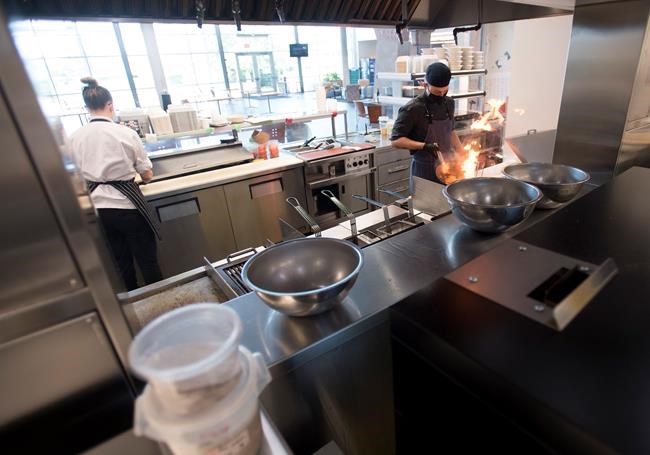
Ghost kitchens started cropping up several years ago, typically with individual restaurants operating a delivery-only business that differed from what they sold in their dining rooms.
By the start of the year, Carter said, the idea started gaining popularity among bigger players in the full-service restaurant chain space, he said, especially in the United States where third-party companies sprang up to create virtual kitchen concepts for existing restaurants.
One such company, Kitchen Hub, announced in February it was opening a virtual food hall in Etobicoke, Ont. The delivery-only restaurant would feature food from six different brands, allowing customers to mix-and-match on single orders, it said, and would be the first of several planned halls for Canada.
Now, corporations are starting to open their own ghost kitchens instead of outsourcing them to these third parties, said Carter.
Part of that comes down to increasing demand for delivery amid the coronavirus outbreak, with many restaurants still closed or operating at reduced capacity, and consumers wary of lingering near other people.
“Consumers are embracing the off-premises much more than they were pre-COVID,” said Carter. “It’s accelerated by, I would say, a couple years.”
That’s made the ghost kitchen model “much more attractive” to big players in the full-service restaurant space, he said.
Restaurant conglomerate Recipe Unlimited Corp. started planning its virtual concept — named Ultimate Kitchen — last summer, said CEO Frank Hennessey.
The first one opened in Toronto at the end of March. The company first targeted the middle of April, but when the pandemic hit, it sped the process up by a couple of weeks.
The single kitchen cooks food from six of its brands: Swiss Chalet, East Side Mario’s, Montana’s, Fresh, New York Fries and Harveys. The company uses third-party app services, for delivery, but is “absolutely considering” moving the service in-house in the future.
Recipe turned to a ghost kitchen for several reasons, including the desire to offer a better guest experience for delivery, said Hennessey. Running different brands out of a single restaurant, and overseeing delivery, is a complicated affair, he added.
It’s also a cheaper way to enter certain markets than by building a brick-and-mortar, dine-in location.
And, “the cherry on the top” is that customers can purchase items from the different brands in a single order, he said, which is a benefit for groups with competing tastes.
“It’s more than exceeded our expectations,” said Hennessey, noting the concept benefits from the pandemic lockdown, but he expects it will continue to perform well once the health crisis is over as well.
Recipe plans to open more kitchens in Toronto, Calgary and Montreal by the end of the year.
“Many of these markets could, you know, handle a lot of these kitchens,” he said, adding the company doesn’t want to open in places that will compete with its existing physical restaurant locations.
Joey Restaurants opened a ghost kitchen at Kwantlen Polytechnic University in Surrey, B.C., May 14 and another in a stationary food truck in Brampton, Ont., May 21.
It did so partly to provide jobs to staff who could no longer work as servers in its dining rooms, as well as create new jobs, said Rupert Martin, vice-president of culinary.
The need to make sales played a role as well.
“There was obviously a steep decline in sales,” he said.
Ghost kitchens offer a quick, cost-effective method, Martin said, noting brick-and-mortar restaurants are very expensive to open and can take months, whereas ghost kitchens can be opened in weeks.
Before the coronavirus, the off-premises channel accounted for less than 10 per cent of the commercial restaurant industry’s revenue, said Carter. He predicts it to make up close to 20 per cent of a full-service restaurant operator’s business once the pandemic ends.
“I would expect we’ll see a lot more operators looking to understand this model and start to roll out a very similar model,” he said.
For Joey, it’s too soon to know if they’ll keep the ghost kitchens beyond the pandemic, said Martin.

But for Recipe Unlimited, the concept will be a permanent fixture.
“We could see it being relatively decent sized,” said Hennessey.
“The model itself is something that can go beyond our borders. It could be something that you see us do south of the border or even potentially overseas.”
This report by The Canadian Press was first published June 21, 2020.
Companies in this story: (TSX:RECP)
Related Articles
Heading to these 3 states? Quarantine might be in the cards
Advertisement Advertise With Us
Advertisement Advertise With Us